What tourmaline is worth
By variety
Show 12 of the listings behind these numbers
These are dealer asking prices: what shops list tourmaline for, not what it sells for and not an appraisal. Selling to a dealer usually brings well below retail, because the dealer has to resell it at a margin.
How to identify tourmaline
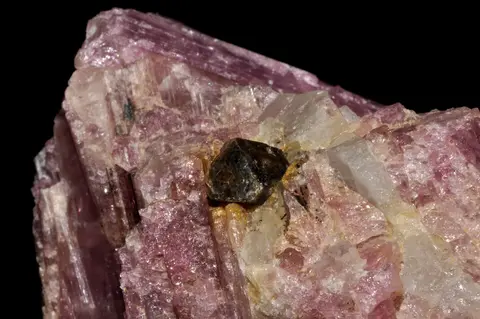
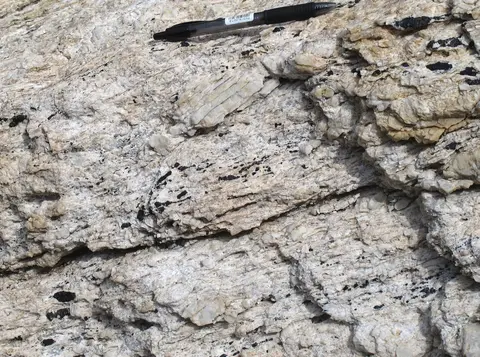
Tourmaline is a group of complex boron silicate minerals that share one crystal structure but vary widely in iron, magnesium, lithium, sodium and calcium content, which is why it comes in more colors than almost any other gem. Black schorl, brown dravite and the lithium-rich elbaite that supplies most gem colors are the species collectors meet most often.
- Long prismatic crystals with deep lengthwise striations and a rounded triangular cross section (a crystal end looks like a puffy triangle).
- Strong pleochroism: looking down the length of a crystal or a cut stone often shows a much darker color than looking from the side.
- Hardness 7 to 7.5: scratches glass and a steel knife easily.
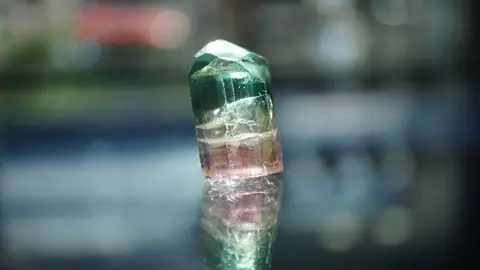
- Color zoning across or along the crystal is common (pink core with green rim, or different colors at each end).
- Glassy luster on crystal faces and on broken surfaces, with uneven to small conchoidal fracture and no good cleavage.
- Feels noticeably heavier than quartz of the same size (specific gravity about 3.0 to 3.2 versus 2.65).
- Facet edges in cut stones look doubled under a 10x loupe in larger stones because of moderate double refraction.
- Pyroelectric: a crystal warmed in the hand or in sunlight can pick up dust and fine lint.
Tourmaline varieties
Elbaite tourmaline
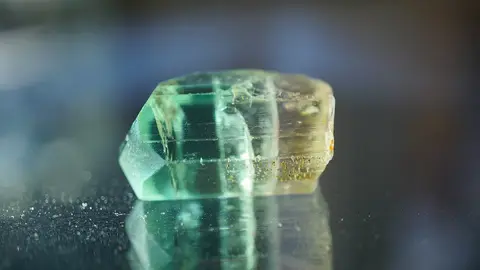
Elbaite is the sodium lithium aluminum tourmaline species that supplies nearly all colored gem tourmaline, named for the island of Elba, Italy. It is the main gem species within the tourmaline group; pink, green, blue, watermelon and Paraiba stones are mostly elbaite.
Cat's eye tourmaline
Cat's eye tourmaline is tourmaline cut as a cabochon to show a single bright line of light caused by many parallel growth tubes. The chatoyant band comes from dense parallel inclusions that would be flaws in a faceted stone.
Bicolor tourmaline
Bicolor tourmaline shows two colors along the length of the crystal or stone, most often pink and green. Unlike watermelon slices cut across the crystal, bicolor stones are cut lengthwise so the color change shows end to end.
Himalaya mine tourmaline
Himalaya mine tourmaline is pink, green and bicolor elbaite from the Himalaya mine at Mesa Grande, San Diego County, California. It is ordinary elbaite valued for its historic locality: around 1900 the mine shipped large amounts of pink tourmaline to China for carvings.
Liddicoatite tourmaline
Liddicoatite is the calcium-rich tourmaline named for gemologist Richard Liddicoat, known from Madagascar slices with triangular and star-like color zoning. It has calcium where elbaite has sodium; the valid species today is fluor-liddicoatite, and many slices sold as liddicoatite are elbaite or mixed zones that only lab analysis can sort out.
Where tourmaline comes from
- Minas Gerais, Brazil
- The largest long-term source of gem elbaite in green, blue, pink and bicolor, plus schorl needles in quartz.
- Sao Jose da Batalha, Paraiba, Brazil
- Discovery site of copper-bearing neon blue to green Paraiba tourmaline in the late 1980s; old Brazilian material is the most sought after.
- Mozambique and Nigeria
- Major sources of copper-bearing Paraiba-type tourmaline since the early 2000s, plus large volumes of pink, red and green gem rough.
- Afghanistan and Pakistan
- Nuristan and Kunar pegmatites give fine gem crystals, often blue-capped or pink; Pakistan supplies schorl with aquamarine from the Skardu region.
- Madagascar
- Known for color-zoned calcium-rich tourmaline cut into triangular slices showing concentric patterns.
- San Diego County, California, USA
- Pala and Mesa Grande pegmatites, including the Himalaya mine, produced pink and bicolor elbaite for the Chinese market around 1900.
- Oxford County, Maine, USA
- Mount Mica and Plumbago Mountain produced green, pink and watermelon elbaite; tourmaline is the Maine state mineral.
- Erongo, Namibia
- Lustrous black schorl crystals, often with smoky quartz or feldspar, a staple of mineral specimen shows.
- Tanzania and Kenya
- Source of chrome tourmaline (vivid green dravite and uvite) and brown dravite.
Tourmaline lookalikes
Obsidian has smooth curved shell-like breaks and no crystal faces or striations; black tourmaline grows as striated prisms.
- Obsidian hardness 5 to 5.5 vs tourmaline 7 to 7.5
- Obsidian SG 2.35 to 2.6 vs schorl about 3.2
- Obsidian is volcanic glass with no crystal shape
black obsidian vs tourmaline
Black onyx is evenly dyed chalcedony with a waxy polish and no striations or crystal shape.
- Onyx SG about 2.6 vs schorl 3.2
- Onyx is almost always dyed and sold as beads and cabochons
- Hardness 6.5 to 7 vs 7 to 7.5
black onyx vs tourmaline
Black kyanite forms flat fanned blades that split along a perfect cleavage; tourmaline prisms are rounded triangles with no cleavage.
- Kyanite hardness varies 4.5 to 7 with direction
- Kyanite SG 3.6 vs 3.2
- Kyanite blades are thin and flexible looking
Green tourmaline shows strong two-tone pleochroism and doubled facet edges; emerald shows little doubling and has a flatter, more bluish green.
- Emerald RI 1.57 to 1.59 vs 1.62 to 1.65
- Emerald SG 2.7 vs about 3.05
- Emerald usually has more visible inclusions and is often oil-filled
tourmaline vs emerald
Sapphire is much harder (9) and heavier (SG 4.0) and shows silk or fingerprint inclusions; pink tourmaline is lighter in hand for its size.
- Sapphire RI 1.76 to 1.77 vs 1.62 to 1.65
- Sapphire SG 4.0 vs 3.05
- Tourmaline shows more doubling of back facets
tourmaline vs pink sapphire
Spinel is singly refractive, so it shows no doubling and no pleochroism; tourmaline shows both.
- Spinel RI 1.718 vs 1.62 to 1.65
- Spinel SG 3.6 vs 3.05
- Spinel hardness 8
tourmaline vs spinel
Peridot shows very strong doubling of back facets and a uniform yellowish green; green tourmaline usually shows darker color along one direction.
- Peridot birefringence about 0.036, roughly double that of tourmaline
- Peridot hardness 6.5 to 7
- Peridot SG about 3.3
tourmaline vs peridot
Topaz has a perfect cleavage and feels slick; blue topaz is usually a lighter, even sky to steel blue without pleochroism you can see.
- Topaz hardness 8
- Topaz SG 3.5 vs 3.05
- Topaz RI 1.61 to 1.64, close to tourmaline
Tanzanite shifts from blue to violet as you turn it; blue tourmaline shifts from blue to darker blue or greenish blue.
- Tanzanite hardness 6.5
- Tanzanite SG 3.35
- Tanzanite RI 1.69 to 1.70
Rose quartz is a hazy, pale pink; pink tourmaline is usually clear and more saturated, and crystals are striated prisms.
- Rose quartz SG 2.65 vs 3.05
- Rose quartz rarely forms crystals
- Rose quartz RI 1.54 to 1.55
Also mistaken for tourmaline: opal, ametrine, watermelon tourmaline, corundum, parti sapphire, grandidierite, chrysoberyl, cat's eye chrysoberyl.
Fake, dyed and treated tourmaline
Glass sold as tourmaline
Common
- Gas bubbles and swirl marks under a loupe
- No doubling of facet edges and no pleochroism
- Rounded, worn facet edges because glass is softer
- Warms quickly in the hand
Blue apatite or glass sold as Paraiba tourmaline
Common
- Apatite scratches with a steel knife (hardness 5)
- Apatite shows less pleochroism
- Origin and copper content can only be confirmed by a lab report
Tourmaline-colored glass sold as watermelon tourmaline slices
Occasional
- Perfectly sharp color boundaries with no striated rim
- Bubbles under magnification
- No triangular outline or prism faces on the edge
Synthetic tourmaline
Rare
- Lab-grown tourmaline exists in research but is not a meaningful market product; a stone sold as synthetic tourmaline is usually glass or another material
Fracture-filled tourmaline
Common
- Flash of color or a flat, glassy look inside cracks under a loupe
- Most common in rubellite and Paraiba-type stones
- Disclosed on lab reports as clarity enhancement
Is my tourmaline real? Tests you can do at home
-
Scratch test against glass
Press a sharp edge or crystal tip of the stone across a clean glass bottle or tile and try to cut a line.
- Real
- Leaves a clear scratch in glass and is not marked itself.
- Fake or lookalike
- Glass imitations scratch only weakly or slide; apatite and obsidian do not scratch glass reliably.
Can leave a small mark.
-
Look for pleochroism
Look at a crystal or cut stone from the side, then down its length or through a different direction, under daylight.
- Real
- Color changes in depth or tone with direction, often strongly darker down the long axis.
- Fake or lookalike
- Glass and spinel show the same color from every direction.
-
Loupe check for doubling
With a 10x loupe, look through the table of a cut stone at the back facet edges.
- Real
- Back facet edges look doubled in stones of a few millimeters and larger.
- Fake or lookalike
- Glass, spinel and garnet show single, crisp edges; glass may also show bubbles.
-
Specific gravity with a kitchen scale
Weigh the stone dry, then weigh a cup of water on the scale, suspend the stone on a thread fully submerged without touching, and divide dry weight by the added weight.
- Real
- About 3.0 to 3.2.
- Fake or lookalike
- Glass usually 2.4 to 2.6 (lead glass can be higher), obsidian 2.35 to 2.6, quartz 2.65.
-
Striation and cross section check
Look along the sides of an uncut crystal and at its broken end.
- Real
- Fine parallel grooves run the length of the prism and the end outline is a rounded triangle.
- Fake or lookalike
- Obsidian and glass show smooth curved fractures with no crystal faces.
A stone that passes these tests is consistent with natural tourmaline, not proven. For valuable pieces, a gem lab report settles treatment and origin.
Treatments
- Heating (common)
- Lightens overly dark green and blue stones and removes purple or brown tones from copper-bearing Paraiba-type material; accepted in the trade and stable. Usually not detectable, even by labs; assume blue, green and Paraiba-type stones may be heated.
- Irradiation (common)
- Deepens pink and red color in pale elbaite; stable under normal wear. Generally not detectable with standard lab tests.
- Fracture filling with resin (occasional)
- Hides surface-reaching cracks in included rubellite and Paraiba-type stones; lowers value and the filler can degrade with heat or solvents. Flash effects or trapped bubbles in fractures under magnification; confirmed by a lab.
What moves the price of tourmaline
- Color and variety. Copper-bearing Paraiba-type neon blue and green leads, followed by fine rubellite, chrome green and saturated pink; black schorl is the most common and least valued per gram.
- Saturation and tone. Bright, saturated color without brown or gray tones, and without becoming too dark to show life face up.
- Clarity. Green and blue stones are expected to be eye clean; red and pink are commonly included, so clean rubellite is valued more.
- Size. Fine color in larger stones is scarce, especially in Paraiba-type and chrome material.
- Origin. Brazilian Paraiba-state copper tourmaline and documented classic localities such as the Himalaya mine or Maine bring more when origin is supported by a report or provenance.
- Treatment. Undisclosed fracture filling lowers value; heating and irradiation are routine and have less impact.
- Crystal quality for specimens. Sharp terminations, undamaged prisms, good luster, color zoning and attractive matrix associations drive specimen value.
- Cut quality. Orientation that avoids the dark closed c-axis color, good symmetry and polish.
Questions collectors ask about tourmaline
- Is tourmaline a natural stone?
- Yes. Tourmaline is a natural mineral group mined from pegmatites and metamorphic rocks; synthetic tourmaline is not sold commercially, though glass imitations and treated stones are.
- Is tourmaline a gem or crystal?
- Both. It is a mineral that grows as striated prismatic crystals, and transparent pieces are cut as gemstones.
- How do I tell if my tourmaline is real?
- Check that it scratches glass, shows a color change in depth when viewed from different directions, and has a specific gravity near 3.0 to 3.2. Glass shows bubbles, no pleochroism and no doubled facet edges.
- How much is real tourmaline worth?
- Value depends mainly on color, clarity, size and whether it is a copper-bearing Paraiba type; see the price table above for current observed prices by variety.
- What color tourmaline is most expensive?
- Copper-bearing neon blue to green Paraiba tourmaline is the most valued, followed by fine red rubellite and vivid chrome green.
- What birth month is tourmaline?
- Tourmaline is a birthstone for October, alongside opal.
Sources
Prices: 39 current listings from Dakota Matrix Minerals, FossilEra, iRocks (The Arkenstone), Throwin Stones, seen 2026-11-20 to 2026-11-20. How we collect prices.