Black tourmaline is almost always schorl, the iron-rich tourmaline species, and is the most common tourmaline worldwide, found in granites, pegmatites and schists.
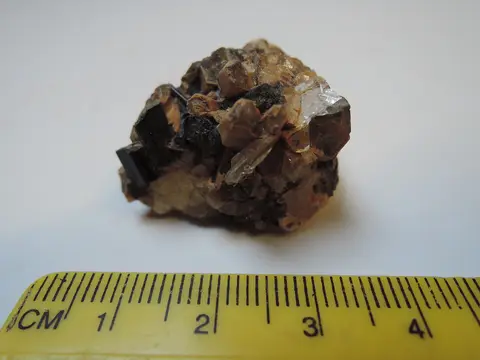
Schorl black tourmaline - NaFe2+3Al6(BO3)3Si6O18(OH)4, quartz SiO2 (42306593550). Photo: Jan Helebrant, CC BY-SA 2.0, via Wikimedia Commons.
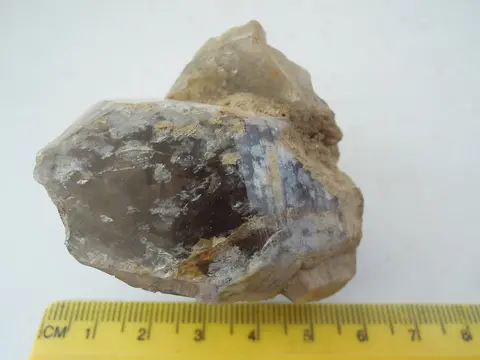
Smoky quartz, schorl (black tourmaline) (29601125504). Photo: Jan Helebrant, CC BY-SA 2.0, via Wikimedia Commons.
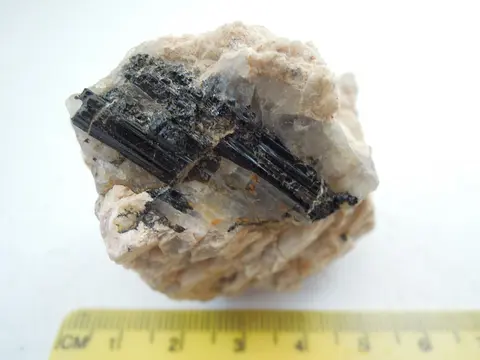
Quartz, orthoclase, schorl (black tourmaline) (25507408573). Photo: Jan Helebrant, CC BY-SA 2.0, via Wikimedia Commons.
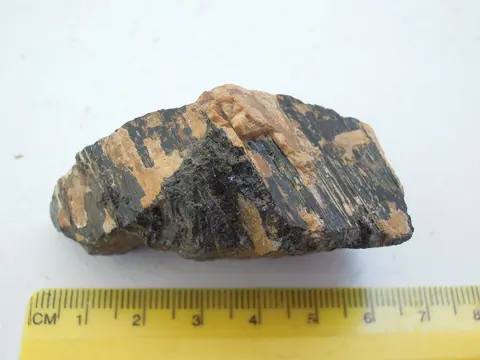
Schorl (black tourmaline), muscovite, quartz (25837852850). Photo: Jan Helebrant, CC BY-SA 2.0, via Wikimedia Commons.
What black tourmaline is worth
Not enough data. We have not yet seen 5 or more current dealer listings for black tourmaline in any one form, so we show no range rather than guess.
These are dealer asking prices: what shops list black tourmaline for, not what it sells for and not an appraisal. Selling to a dealer usually brings well below retail, because the dealer has to resell it at a margin.
How to identify black tourmaline
It is opaque and black because of high iron content, while gem tourmaline is mostly lithium-rich elbaite in transparent colors. See tourmaline value for the species as a whole.
Jet black, opaque prisms with deep lengthwise striations and a rounded triangular cross section.
Bright glassy luster on crystal faces; broken ends look glassy and uneven.
Scratches glass easily (hardness 7 to 7.5).
Heavy for its size, around SG 3.2.
Often embedded in white quartz, feldspar or mica, or grows with smoky quartz and aquamarine.
Black glass tumbles or points sold as black tourmaline
Occasional
No striations
Conchoidal fractures and bubbles
SG under 2.7
Black obsidian or dyed black stone sold as black tourmaline
Occasional
Obsidian is translucent on thin edges
Dyed stones can leave color on an acetone swab
Is my black tourmaline real? Tests you can do at home
Striation check
Look along the length of a raw piece under a strong light.
Real
Parallel grooves run the length of the crystal.
Fake or lookalike
Obsidian and glass show smooth curved breaks.
Magnet drag test
Hang the piece on a thread and bring a strong neodymium magnet close without touching.
Real
Schorl often swings slightly toward the magnet because of its iron content.
Fake or lookalike
Obsidian and glass usually show no response.
A stone that passes these tests is consistent with natural black tourmaline, not proven. For valuable pieces, a gem lab report settles treatment and origin.
What moves the price of black tourmaline
Crystal quality. Sharp, lustrous, terminated prisms command much more than broken rough.
Matrix and associations. Schorl on feldspar or with smoky quartz or aquamarine brings more.
Locality. Erongo and Skardu specimens carry a premium.
Size and damage. Large undamaged crystals are scarce; chipped terminations lower value.
Questions collectors ask about black tourmaline
What is black tourmaline used for?
It is collected as mineral specimens and cut into beads, cabochons and carvings; much of the retail demand comes from the metaphysical market. Tourmaline's pressure-sensitive electrical property was also used historically in pressure gauges.
Sources
Prices: 11 current listings from FossilEra, Throwin Stones, seen 2026-11-20 to 2026-11-20. How we collect prices.