RockValues

Tourmaline in quartz value and identification

Tourmaline in quartz is clear quartz containing needles or prisms of tourmaline, usually black schorl, sold as tourmalinated quartz.

A variety of tourmaline. Prices checked .
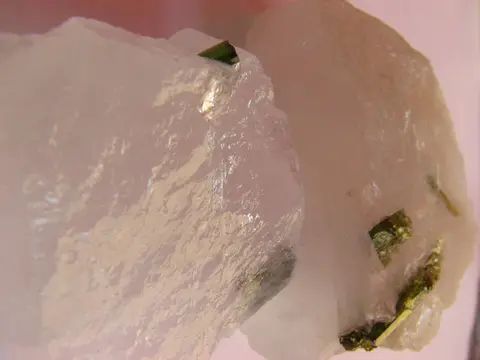
Tourmaline in quartz: Tourmaline in quartz (167360070)
Tourmaline in quartz (167360070). Photo: Jarno from Rotterdam, Netherlands, CC BY 2.0, via Wikimedia Commons.

What tourmaline in quartz is worth

Not enough data. We have not yet seen 5 or more current dealer listings for tourmaline in quartz in any one form, so we show no range rather than guess.

These are dealer asking prices: what shops list tourmaline in quartz for, not what it sells for and not an appraisal. Selling to a dealer usually brings well below retail, because the dealer has to resell it at a margin.

How to identify tourmaline in quartz

The value comes from the pattern of tourmaline inclusions inside quartz, not from the tourmaline itself, so properties follow quartz. See tourmaline value for the species as a whole.

  • Straight black needles or thin prisms crossing clear or white quartz.
  • Needles are thicker and blacker than the golden needles in rutilated quartz.
  • Hardness 7, SG near 2.65 to 2.7 because the host is quartz.
  • Needles that reach the polished surface may leave small pits.

Other tourmaline varieties

Where tourmaline in quartz comes from

Minas Gerais, Brazil
Main source of tourmalinated quartz for cabochons and spheres.
Madagascar
Quartz with black tourmaline needles for carvings.

Tourmaline in quartz lookalikes

Rutilated quartz

Rutile needles are golden, red or silvery and very thin; tourmaline needles are black and thicker.

  • Rutile needles have metallic luster

Fake, dyed and treated tourmaline in quartz

  • Glass with black fiber inclusions

    Rare

    • Bubbles
    • Inclusions too evenly spaced
    • Feels warmer and is softer

Is my tourmaline in quartz real? Tests you can do at home

These are the tests for tourmaline in general; they apply to tourmaline in quartz too.

  1. Scratch test against glass

    Press a sharp edge or crystal tip of the stone across a clean glass bottle or tile and try to cut a line.

    Real
    Leaves a clear scratch in glass and is not marked itself.
    Fake or lookalike
    Glass imitations scratch only weakly or slide; apatite and obsidian do not scratch glass reliably.

    Can leave a small mark.

  2. Look for pleochroism

    Look at a crystal or cut stone from the side, then down its length or through a different direction, under daylight.

    Real
    Color changes in depth or tone with direction, often strongly darker down the long axis.
    Fake or lookalike
    Glass and spinel show the same color from every direction.
  3. Loupe check for doubling

    With a 10x loupe, look through the table of a cut stone at the back facet edges.

    Real
    Back facet edges look doubled in stones of a few millimeters and larger.
    Fake or lookalike
    Glass, spinel and garnet show single, crisp edges; glass may also show bubbles.
  4. Specific gravity with a kitchen scale

    Weigh the stone dry, then weigh a cup of water on the scale, suspend the stone on a thread fully submerged without touching, and divide dry weight by the added weight.

    Real
    About 3.0 to 3.2.
    Fake or lookalike
    Glass usually 2.4 to 2.6 (lead glass can be higher), obsidian 2.35 to 2.6, quartz 2.65.
  5. Striation and cross section check

    Look along the sides of an uncut crystal and at its broken end.

    Real
    Fine parallel grooves run the length of the prism and the end outline is a rounded triangle.
    Fake or lookalike
    Obsidian and glass show smooth curved fractures with no crystal faces.

A stone that passes these tests is consistent with natural tourmaline in quartz, not proven. For valuable pieces, a gem lab report settles treatment and origin.

What moves the price of tourmaline in quartz

  1. Clarity of the host. Clear quartz showing distinct needles is valued over milky material.
  2. Needle pattern. Even, dense, attractive needle arrangement.
  3. Size and finish. Larger polished pieces without surface pits.

Sources

Prices: no current dealer listings yet. How we collect prices.