RockValues

Pink tourmaline value and identification

Pink tourmaline is elbaite colored by manganese, ranging from pale pastel to hot pink, and is one of the most common gem tourmaline colors.

A variety of tourmaline. Prices checked .
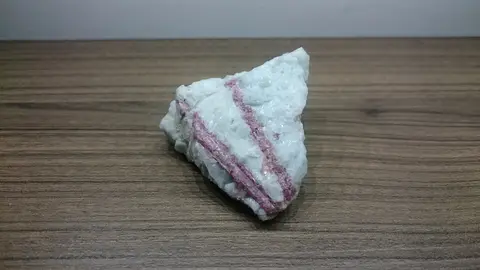
Pink tourmaline: Pink Tourmaline with Quartz (48341630737)
Pink Tourmaline with Quartz (48341630737). Photo: Timon Jähnert, CC BY 2.0, via Wikimedia Commons.

What pink tourmaline is worth

Not enough data. We have not yet seen 5 or more current dealer listings for pink tourmaline in any one form, so we show no range rather than guess.

These are dealer asking prices: what shops list pink tourmaline for, not what it sells for and not an appraisal. Selling to a dealer usually brings well below retail, because the dealer has to resell it at a margin.

How to identify pink tourmaline

It is the lithium-rich elbaite species in pink shades; deeper red stones that keep their color under incandescent light are sold as rubellite. See tourmaline value for the species as a whole.

  • Pink to purplish pink, transparent, often with visible color zoning.
  • Pleochroism shows darker pink along the length of a crystal.
  • Scratches glass; SG about 3.05.
  • Commonly shows small fluid inclusions and growth tubes.

Other tourmaline varieties

Where pink tourmaline comes from

Minas Gerais, Brazil
Steady supply of gem rough and crystals.
Nigeria and Mozambique
Large volumes of pink gem rough.
Afghanistan
Fine pink crystals from Nuristan pegmatites.
San Diego County, California, USA
Historic pink from the Himalaya mine and Pala district.
Madagascar
Pink and color-zoned crystals.

Pink tourmaline lookalikes

Also mistaken for pink tourmaline: rhodonite, spodumene, poudretteite.

Fake, dyed and treated pink tourmaline

  • Pink glass

    Common

    • Bubbles and swirls
    • No pleochroism
    • Light in hand
  • Dyed quartz or quartzite beads sold as pink tourmaline

    Occasional

    • Dye concentrated in cracks
    • Color on an acetone swab
    • SG 2.65

Is my pink tourmaline real? Tests you can do at home

These are the tests for tourmaline in general; they apply to pink tourmaline too.

  1. Scratch test against glass

    Press a sharp edge or crystal tip of the stone across a clean glass bottle or tile and try to cut a line.

    Real
    Leaves a clear scratch in glass and is not marked itself.
    Fake or lookalike
    Glass imitations scratch only weakly or slide; apatite and obsidian do not scratch glass reliably.

    Can leave a small mark.

  2. Look for pleochroism

    Look at a crystal or cut stone from the side, then down its length or through a different direction, under daylight.

    Real
    Color changes in depth or tone with direction, often strongly darker down the long axis.
    Fake or lookalike
    Glass and spinel show the same color from every direction.
  3. Loupe check for doubling

    With a 10x loupe, look through the table of a cut stone at the back facet edges.

    Real
    Back facet edges look doubled in stones of a few millimeters and larger.
    Fake or lookalike
    Glass, spinel and garnet show single, crisp edges; glass may also show bubbles.
  4. Specific gravity with a kitchen scale

    Weigh the stone dry, then weigh a cup of water on the scale, suspend the stone on a thread fully submerged without touching, and divide dry weight by the added weight.

    Real
    About 3.0 to 3.2.
    Fake or lookalike
    Glass usually 2.4 to 2.6 (lead glass can be higher), obsidian 2.35 to 2.6, quartz 2.65.
  5. Striation and cross section check

    Look along the sides of an uncut crystal and at its broken end.

    Real
    Fine parallel grooves run the length of the prism and the end outline is a rounded triangle.
    Fake or lookalike
    Obsidian and glass show smooth curved fractures with no crystal faces.

A stone that passes these tests is consistent with natural pink tourmaline, not proven. For valuable pieces, a gem lab report settles treatment and origin.

Treatments

Irradiation (common)
Deepens pale pink to stronger pink or red; stable. Generally not detectable.
Heating (occasional)
Removes brownish or orange tones. Usually not detectable.

What moves the price of pink tourmaline

  1. Saturation. Hot, saturated pink without brown is valued most; pastel stones are common.
  2. Clarity. Eye-clean stones bring more since pink is often included.
  3. Size. Larger clean stones with good color are less common.
  4. Cut. Good proportions that avoid a dark or windowed center.

Questions collectors ask about pink tourmaline

How rare is a pink tourmaline?
Pink is one of the more plentiful gem tourmaline colors. Large, clean stones with saturated color and no brown are much less common.
Is pink tourmaline expensive?
Pastel pink is widely available, while saturated, clean stones in larger sizes cost more; see the price table above for observed prices.

Sources

Prices: no current dealer listings yet. How we collect prices.