Poudretteite is a very rare potassium sodium borosilicate, KNa2B3Si12O30, of the milarite group. It was first described in 1987 from tiny crystals at Mont Saint-Hilaire, Quebec, and gem-quality pink stones were later found in the gem gravels of Mogok, Myanmar.
Prices checked . Page updated .
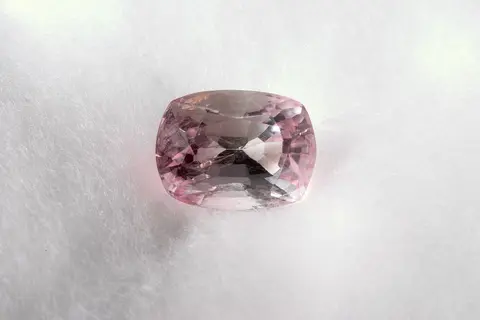
Cutted Poudretteite from the National Museum of Natural History. Photo: Ken Larsen, CC0, via Wikimedia Commons.
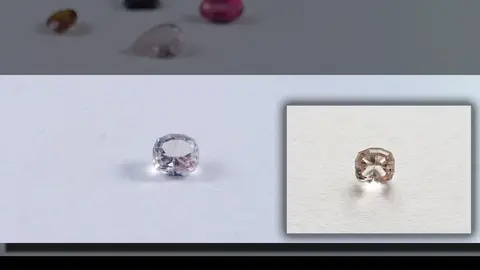
Fotostrecke Weltraritaeten- Poudretteit-G-EmpireTheWorldOfGems. Photo: DonGuennie (G-Empire The World Of Gems), CC BY-SA 4.0, via Wikimedia Commons.
What poudretteite is worth
Not enough data. We have not yet seen 5 or more current dealer listings for poudretteite in any one form, so we show no range rather than guess.
These are dealer asking prices: what shops list poudretteite for, not what it sells for and not an appraisal. Selling to a dealer usually brings well below retail, because the dealer has to resell it at a margin.
How to identify poudretteite
Pale to medium purplish pink color in faceted stones; type locality crystals are tiny and colorless to pale pink.
Glassy luster and good transparency.
Low refractive index (about 1.51 to 1.53) with fairly high birefringence (about 0.021) for such a low RI, a combination that is diagnostic in a lab.
Light for a gem: specific gravity about 2.5, lighter than quartz.
Hardness about 5, so faceted stones scratch and wear more easily than quartz.
Almost all genuine stones are small and come with a lab report; most other 'poudretteite' offered is something else.
Where poudretteite comes from
Poudrette quarry, Mont Saint-Hilaire, Quebec, Canada
Type locality, named after the Poudrette family who ran the quarry; crystals are tiny and of mineralogical interest only.
Mogok, Myanmar
Source of the gem-quality pink rough found in gem gravels from about 2000; facetable material remains extremely scarce.
Quartz has a slightly higher RI (1.544 to 1.553) and much lower birefringence (0.009), and is heavier (2.65).
Hardness 7
Fake, dyed and treated poudretteite
Pink tourmaline, spinel, kunzite, quartz or glass sold as poudretteite
Very common
No lab report
Larger size or lower price than the extreme rarity would allow
Properties measured by a gemologist do not match
Pink glass sold as poudretteite
Common
Round bubbles and swirl marks
Single refraction, no doubling
Rounded facet edges
Is my poudretteite real? Tests you can do at home
Ask for a lab report
Request a report from a recognized gemological lab that names the stone as poudretteite.
Real
Genuine stones are almost always sold with a report confirming RI, birefringence and often Raman or chemical data.
Fake or lookalike
Misnamed stones are sold with no report or a vague certificate.
Loupe for doubling
Look through the table at the back facet edges with a 10x loupe.
Real
Back facet edges appear slightly doubled because of the birefringence.
Fake or lookalike
Glass and spinel show sharp single edges.
Inclusion check
Examine the interior with a loupe under strong light.
Real
Natural crystal or fluid inclusions, if any.
Fake or lookalike
Round gas bubbles indicate glass.
A stone that passes these tests is consistent with natural poudretteite, not proven. For valuable pieces, a gem lab report settles treatment and origin.
What moves the price of poudretteite
Authentication. A lab report confirming poudretteite is essential; without it a stone is valued as an unidentified pink gem.
Size. Most faceted stones are very small; anything over a few carats is exceptional.
Color. Saturated purplish pink is preferred over pale tones.
Clarity and cut. Clean, well-cut stones are scarcer and bring more.
Rarity. Demand comes mainly from rare-gem collectors, so sales are infrequent and individual.
Care and safety
At hardness 5, poudretteite scratches more easily than common gems. Keep it as a collector stone or in protective settings, and clean with mild soapy water only.