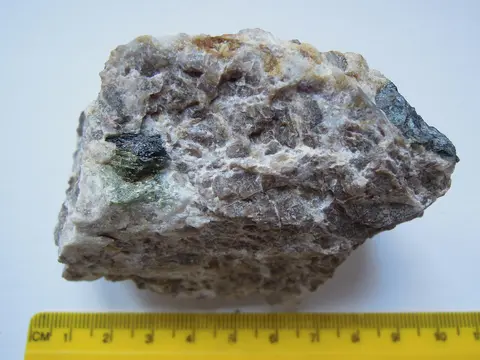
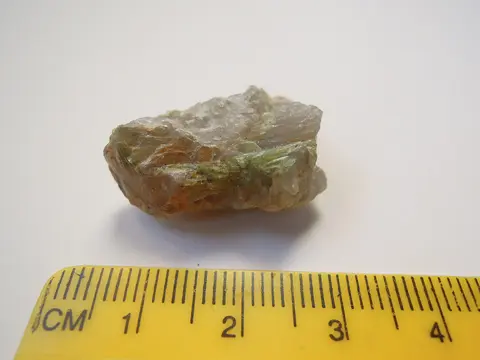
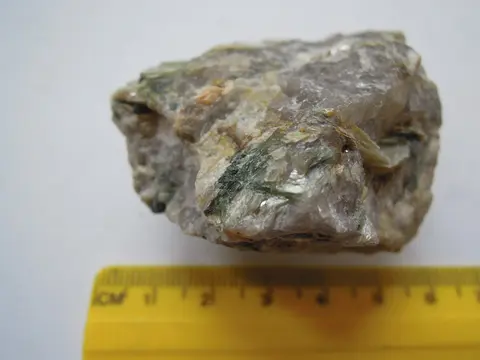
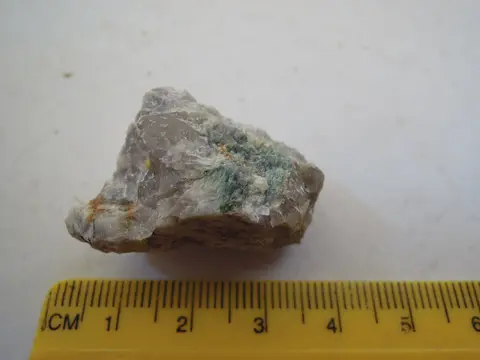
Green tourmaline, also called verdelite, is mostly elbaite colored by iron, from yellowish green to deep bluish green, and is the most common transparent gem tourmaline color.
Black and green tourmaline, topaz (11185986366). Photo: Jan Helebrant, CC BY 2.0, via Wikimedia Commons.
Probably green tourmaline, mica, quartz (33201057220). Photo: Jan Helebrant, CC BY-SA 2.0, via Wikimedia Commons.
Schorl (black), verdelite (green) tourmaline, muscovite, quartz (24860222061). Photo: Jan Helebrant, CC BY-SA 2.0, via Wikimedia Commons.
Verdelite (green) tourmaline, muscovite, quartz (26043659821). Photo: Jan Helebrant, CC BY-SA 2.0, via Wikimedia Commons.
What green tourmaline is worth
Not enough data. We have not yet seen 5 or more current dealer listings for green tourmaline in any one form, so we show no range rather than guess.
These are dealer asking prices: what shops list green tourmaline for, not what it sells for and not an appraisal. Selling to a dealer usually brings well below retail, because the dealer has to resell it at a margin.
How to identify green tourmaline
It is the iron-colored green form of elbaite; vivid emerald green stones colored by chromium or vanadium are sold separately as chrome tourmaline. See tourmaline value for the species as a whole.
Green with strong pleochroism: often nearly black when viewed down the crystal length.
Cut stones are usually laid with the table parallel to the length to avoid the dark direction.
Is my green tourmaline real? Tests you can do at home
These are the tests for tourmaline in general; they apply to green tourmaline too.
Scratch test against glass
Press a sharp edge or crystal tip of the stone across a clean glass bottle or tile and try to cut a line.
Real
Leaves a clear scratch in glass and is not marked itself.
Fake or lookalike
Glass imitations scratch only weakly or slide; apatite and obsidian do not scratch glass reliably.
Can leave a small mark.
Look for pleochroism
Look at a crystal or cut stone from the side, then down its length or through a different direction, under daylight.
Real
Color changes in depth or tone with direction, often strongly darker down the long axis.
Fake or lookalike
Glass and spinel show the same color from every direction.
Loupe check for doubling
With a 10x loupe, look through the table of a cut stone at the back facet edges.
Real
Back facet edges look doubled in stones of a few millimeters and larger.
Fake or lookalike
Glass, spinel and garnet show single, crisp edges; glass may also show bubbles.
Specific gravity with a kitchen scale
Weigh the stone dry, then weigh a cup of water on the scale, suspend the stone on a thread fully submerged without touching, and divide dry weight by the added weight.
Real
About 3.0 to 3.2.
Fake or lookalike
Glass usually 2.4 to 2.6 (lead glass can be higher), obsidian 2.35 to 2.6, quartz 2.65.
Striation and cross section check
Look along the sides of an uncut crystal and at its broken end.
Real
Fine parallel grooves run the length of the prism and the end outline is a rounded triangle.
Fake or lookalike
Obsidian and glass show smooth curved fractures with no crystal faces.
A stone that passes these tests is consistent with natural green tourmaline, not proven. For valuable pieces, a gem lab report settles treatment and origin.
Treatments
Heating (common)
Lightens very dark green or blue-green stones; accepted and stable. Usually not detectable.
What moves the price of green tourmaline
Hue. Pure green to slightly bluish green is preferred over olive or yellowish green.
Tone. Medium tone; very dark stones look black.
Clarity. Expected to be eye clean.
Size. Larger stones are available, so color quality matters more than size alone.