Dealers list beryl specimens 5 to 10 cm (2 to 4 in) at $335 to $775; tumbled stones run about $305 to $475 per pound.
Prices checked . Page updated .
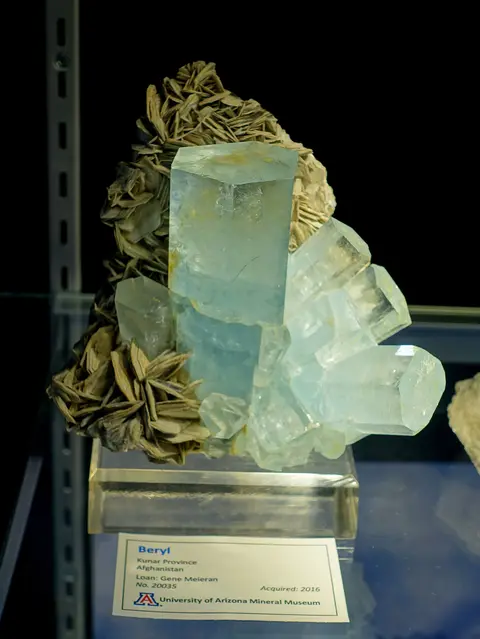
Beryl, Kunar Province, Afghanistan - University of Arizona Mineral Museum - University of Arizona - Tucson, AZ - DSC08518. Photo: Daderot, CC0, via Wikimedia Commons.
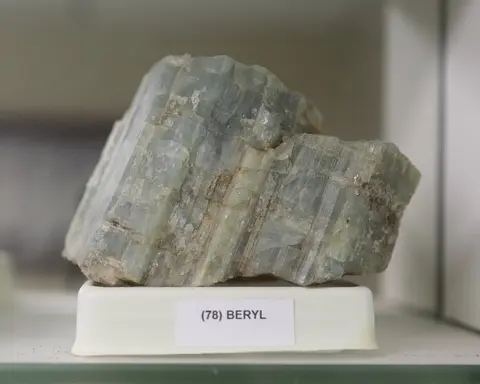
Beryl, Harman Mineral Collection, Capen Hill 2026-06-01. Photo: Peter Cooper Jr., CC0, via Wikimedia Commons.
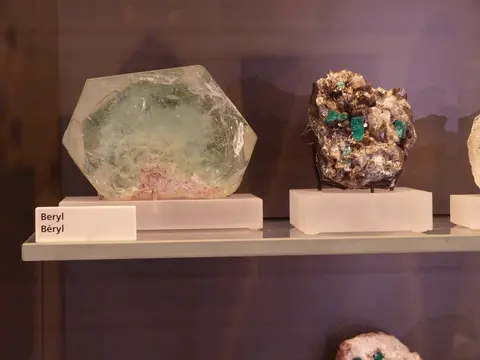
Mineral exhibit - Beryl (32052989631). Photo: S. Rae from Scotland, UK, CC BY 2.0, via Wikimedia Commons.
What beryl is worth
Dealer asking prices for beryl, middle half of current listings, checked 2026-11-20. Bar shows the 25th to 75th percentile; the dark tick is the median.
These are dealer asking prices: what shops list beryl for, not what it sells for and not an appraisal. Selling to a dealer usually brings well below retail, because the dealer has to resell it at a margin.
How to identify beryl
Beryl is a beryllium aluminum silicate mineral that grows as six-sided prisms and gives us emerald (green, colored by chromium or vanadium), aquamarine (blue, iron), morganite (pink, manganese), heliodor (yellow) and goshenite (colorless). Pure beryl is colorless; every color comes from trace elements.
Six-sided (hexagonal) prisms with flat, square-cut terminations; long crystals often show fine lengthwise striations.
Hardness 7.5 to 8: scratches glass and quartz with ease and is not scratched by a steel file.
Glassy luster and a light feel in the hand for a gem (SG about 2.7, close to quartz).
Weak dichroism: turning a crystal shows slightly different shades of its color down and across the prism.
Cleavage is poor, so broken surfaces are conchoidal to uneven rather than flat.
Usually found in granite pegmatites (aquamarine, morganite, heliodor, goshenite) or in schist and black shale veins (emerald).
Maxixe beryl is a deep, inky blue beryl first found at the Maxixe mine in Minas Gerais, Brazil, whose color comes from an unstable color center that fades in light. Unlike aquamarine, whose blue comes from iron and is stable, Maxixe blue fades to colorless or yellowish on exposure to light; most stones sold as Maxixe-type are irradiated.
Where beryl comes from
Muzo, Coscuez and Chivor, Colombia
The benchmark source for fine emerald, with a warm, pure green and three-phase fluid inclusions.
Kafubu area (Kagem), Zambia
Major modern emerald producer; slightly bluish green stones that are often cleaner than Colombian.
Minas Gerais and Bahia, Brazil
Large output of aquamarine, morganite, heliodor and goshenite from pegmatites, plus emerald from schist deposits.
Shigar Valley and Nagar, Pakistan
Sharp, transparent aquamarine crystals on feldspar and muscovite matrix that are staples of the mineral specimen market.
Erongo Mountains, Namibia
Aquamarine and heliodor crystals, often with black schorl tourmaline.
Wah Wah Mountains, Utah, USA
The only commercial source of gem red beryl.
Madagascar
Morganite and aquamarine, including some of the best pink beryl crystals.
Panjshir Valley, Afghanistan
Emerald crystals and fine cut stones from veins in metamorphic rock.
Usually cleaner and more even in color than natural emerald of the same size
Flux stones show wispy veil-like flux inclusions; hydrothermal stones show chevron or wavy growth patterns
Often glow stronger red under longwave UV than natural
Needs a gem lab for certainty
Blue topaz sold as aquamarine
Common
Noticeably heavy for its size
Color often too saturated and electric for aquamarine of that size
Emerald doublets and triplets
Occasional
A flat glue line around the girdle when viewed from the side
Color sits in a thin layer while the crown and pavilion are pale or colorless
Flattened bubbles in the join
Trade names like 'Brazilian emerald' for green tourmaline or 'Siberian aquamarine' for other blue stones
Occasional
Check SG and dichroism; tourmaline is heavier and strongly dichroic
Ask what species is on the lab report, not the trade name
Is my beryl real? Tests you can do at home
Specific gravity by water displacement
Weigh the loose stone on a 0.01 g kitchen scale, then weigh a cup of water, hang the stone in it on a thread without touching the sides, and divide dry weight by the gain in weight.
Real
Beryl gives about 2.7 (2.68 to 2.78 for most gems).
Fake or lookalike
Topaz gives about 3.5, sapphire about 4.0, tourmaline about 3.1, most glass 2.4 to 2.6 or higher if lead glass.
Scratch test on glass
Press an unpolished point or a crystal edge firmly across a piece of window glass or a glass bottle bottom.
Real
Beryl leaves a clear, deep scratch in the glass easily.
Fake or lookalike
Glass fakes scratch weakly or skid; softer stones like apatite or fluorite do not scratch glass.
Can leave a small mark.
Loupe inspection for inclusions
Look through the stone with a 10x loupe under a bright light, turning it slowly.
Real
Natural beryl shows angular fluid inclusions, fine growth tubes parallel to the length, mica flakes or fractures (emerald 'jardin').
Fake or lookalike
Glass shows round bubbles and swirls; composites show a flat join; synthetics are often too clean or show flux veils.
Crystal shape check
For rough specimens, look at the end of the crystal and count the sides of the prism.
Real
Six-sided prism with a flat end, sometimes with small corner faces.
Fake or lookalike
Quartz ends in a point; tourmaline is triangular in section; glass and resin show no crystal faces or mold seams.
Polarizing sunglasses dichroism check
Look through one lens of polarized sunglasses at a transparent stone or crystal and rotate the lens slowly.
Real
A weak shift in shade (emerald yellowish green to bluish green, aquamarine near colorless to blue).
Fake or lookalike
Glass shows no change at all; tourmaline shows a much stronger change.
A stone that passes these tests is consistent with natural beryl, not proven. For valuable pieces, a gem lab report settles treatment and origin.
Treatments
Oiling and resin filling (emerald) (almost always)
Fills surface-reaching fractures so they disappear; accepted in the trade but heavy filling lowers value and the filler can dry or discolor. Lab reports grade clarity enhancement from none to significant; a loupe may show flash colors or bubbles in filled fractures.
Heating (aquamarine and morganite) (common)
Removes the green or yellow tint from aquamarine and the orange from morganite; stable and widely accepted, with little effect on price. Generally not detectable, even by labs.
Irradiation (yellow and Maxixe-type blue beryl) (occasional)
Can create yellow beryl or a deep blue that fades in light; faded stones lose most of their value. Maxixe-type blue is detected by its unusual dichroism and by fading under strong light; yellow is hard to detect.
What moves the price of beryl
Variety. Emerald and red beryl sit far above aquamarine and morganite; heliodor and goshenite are the least valuable.
Color. Saturated, even color with a medium to medium-dark tone brings the most. Pale stones are common and sell at a fraction.
Clarity. Aquamarine and morganite are expected to be eye clean. Emerald is judged more leniently because inclusions are normal.
Treatment. Untreated or minor-oil emeralds with a lab report command a large premium over heavily filled stones.
Size. Value rises steeply with size for emerald and red beryl; aquamarine is plentiful in large sizes so the curve is flatter.
Origin. Colombian emerald and Santa Maria aquamarine carry an origin premium when backed by a lab report.
Crystal quality for specimens. Sharp, undamaged, gemmy crystals on contrasting matrix are valued by collectors independently of cutting value.
Questions collectors ask about beryl
Are beryl gems valuable?
Some are. Fine emerald and red beryl are among the most valuable colored gems, while aquamarine and morganite are moderately priced and goshenite and heliodor are inexpensive. Color saturation, clarity and size decide where a stone falls in the price table above.
Which emerald is considered the best in the world?
Fine emeralds from the Muzo and Chivor mines in Colombia are the traditional benchmark, prized for a pure, warm green. Top Zambian and Afghan stones can match them in quality, but a Colombian origin on a lab report still adds a premium.
Can a jeweler tell if an emerald is real?
A jeweler with a refractometer and loupe can separate emerald from glass and most simulants quickly. Telling natural from lab-grown emerald, and grading the level of oil or resin filling, is a job for a gem laboratory.
Sources
Prices: 50 current listings from Dakota Matrix Minerals, FossilEra, iRocks (The Arkenstone), Throwin Stones, Trade Roots, seen 2026-11-20 to 2026-11-20. How we collect prices.