RockValues

Aquamarine value and identification

Dealers list aquamarine specimens at $75 to $2,550; tumbled stones run about $305 to $475 per pound.

A variety of beryl. Prices checked .

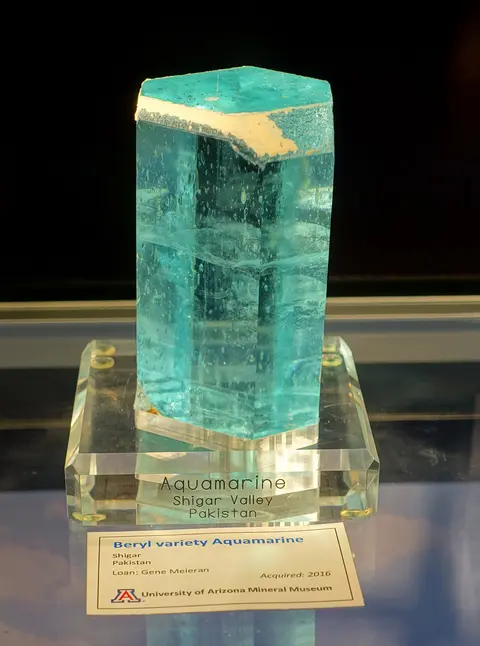
Aquamarine: Aquamarine, Shigar Valley, Pakistan - University of Arizona Mineral Museum - University of Arizona - Tucson, AZ - DSC08519
Aquamarine, Shigar Valley, Pakistan - University of Arizona Mineral Museum - University of Arizona - Tucson, AZ - DSC08519. Photo: Daderot, CC0, via Wikimedia Commons.
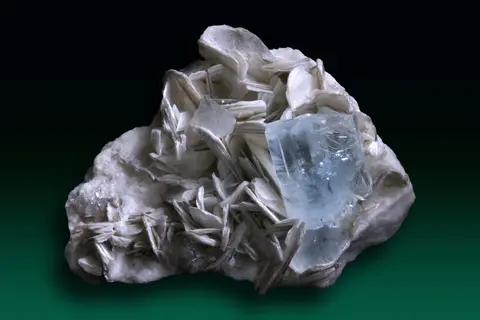
Aquamarine: Akwamaryn (aquamarine) na muskowicie - Skardu, Góry Haramosh, div. Gilgit, Northern Areas, Pakistan
Akwamaryn (aquamarine) na muskowicie - Skardu, Góry Haramosh, div. Gilgit, Northern Areas, Pakistan. Photo: Lech Darski, CC BY-SA 4.0, via Wikimedia Commons.
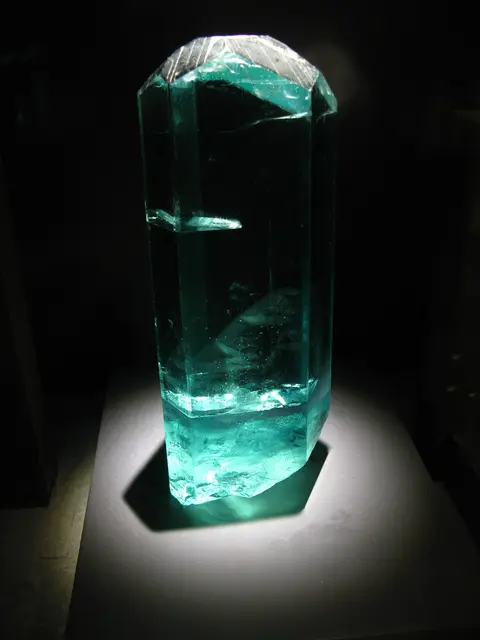
Aquamarine: 2009 04 19 - 4717 - Washington DC - Natural History Museum - Aquamarine (3527531918)
2009 04 19 - 4717 - Washington DC - Natural History Museum - Aquamarine (3527531918). Photo: thisisbossi from Washington, DC, USA, CC BY-SA 2.0, via Wikimedia Commons.
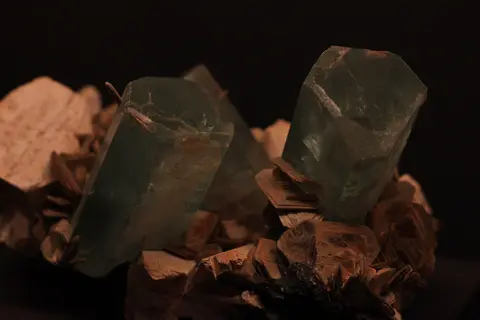
Aquamarine: Aquamarine, orthoclase, muscovite (9146117105)
Aquamarine, orthoclase, muscovite (9146117105). Photo: Thomas Liske from Dresden, Deutschland, CC BY 2.0, via Wikimedia Commons.

What aquamarine is worth

Dealer asking prices for aquamarine, middle half of current listings, checked 2026-11-20. Bar shows the 25th to 75th percentile; the dark tick is the median.
Form and sizeTypical asking priceRange chartMedianListings
Tumbled stones (per pound)$306 to $476$3549 from 1 dealer
Specimens (per piece)$75 to $2,538$1,2507 from 3 dealers
Show 12 of the listings behind these numbers
Sample dealer listings for Aquamarine
ListingSizeLocalityAskingSeen
Himalayan AQUAMARINE Tumbled Stones - Tumbled Crystals, Birthstone, Self Care, Healing Crystals and Stones, E0959 (Small)
Throwin Stones
2.5 cmIndia$8.10
Himalayan AQUAMARINE Tumbled Stones - Tumbled Crystals, Birthstone, Self Care, Healing Crystals and Stones, E0959 (Medium)
Throwin Stones
2.5 cmIndia$8.10
Himalayan AQUAMARINE Tumbled Stones - Tumbled Crystals, Birthstone, Self Care, Healing Crystals and Stones, E0959 (Large)
Throwin Stones
2.5 cmIndia$9.45
Himalayan AQUAMARINE Tumbled Stones - Tumbled Crystals, Birthstone, Self Care, Healing Crystals and Stones, E0959 (Extra Large)
Throwin Stones
2.5 cmIndia$11
AQUAMARINE Tumbled Stones - Tumbled Crystals, Birthstone, Self Care, Healing Crystals and Stones, E0045 (Small)
Throwin Stones
2.3 cm$12
AQUAMARINE Tumbled Stones - Tumbled Crystals, Birthstone, Self Care, Healing Crystals and Stones, E0045 (Medium)
Throwin Stones
2.3 cm$13
AQUAMARINE Tumbled Stones - Tumbled Crystals, Birthstone, Self Care, Healing Crystals and Stones, E0045 (Large)
Throwin Stones
2.3 cm$16
Himalayan AQUAMARINE Tumbled Stones - Tumbled Crystals, Birthstone, Self Care, Healing Crystals and Stones, E0959 (Bag)
Throwin Stones
2.5 cmIndia$27
Beryl var. aquamarine #66435
Dakota Matrix Minerals
2.5 cmShigar Valley, Baltistan, Northern Areas, Pakistan$30
AQUAMARINE Tumbled Stone - AAA Grade - Polished Blue Crystal Birthstone, Self Care, Jewelry Making, 51469
Throwin Stones
2.5 cmErongo, Namibia$62
2.6" Aquamarine and Schorl Crystals on Feldspar - Namibia
FossilEra
6.6 cmNamibia$75
2.5" Gemmy Aquamarine and Schorl Crystals on Feldspar - Namibia
FossilEra
6.4 cmNamibia$75

These are dealer asking prices: what shops list aquamarine for, not what it sells for and not an appraisal. Selling to a dealer usually brings well below retail, because the dealer has to resell it at a margin.

How to identify aquamarine

Aquamarine is light to medium blue or greenish blue beryl colored by iron, found mostly in granite pegmatites.

Aquamarine is the blue to blue-green color of beryl, caused by iron; it is often cleaner and larger than other beryl colors. See beryl value for the species as a whole.

  • Pale to medium sky blue or greenish blue; deep saturated blue is rare.
  • Usually eye clean in cut stones; rough often has long parallel growth tubes ('rain').
  • Long six-sided prisms with flat ends, frequently on feldspar or with muscovite.
  • Weak dichroism: near colorless to blue when turned.
  • Light for its size (SG about 2.7).

Other beryl varieties

Where aquamarine comes from

Minas Gerais, Brazil
Largest historic producer, including the Santa Maria de Itabira deposits.
Shigar Valley and Nagar, Pakistan
Sharp, gemmy crystals on matrix for collectors.
Erongo, Namibia
Bright blue crystals often with schorl.
Madagascar, Mozambique and Nigeria
Important sources of saturated cutting rough.
Mount Antero, Colorado, USA
High-altitude pegmatite source of collector crystals.

Aquamarine lookalikes

Synthetic blue spinel

Spinel is singly refractive and heavier (SG 3.6); no dichroism.

  • Synthetic aquamarine-colored spinel is common in costume jewelry
  • Often glows red or green under UV

Blue apatite

Apatite is soft (5) and scratched by steel.

  • SG 3.2
  • Neon greenish blue in many stones

Also mistaken for aquamarine: topaz, swiss blue topaz, sky blue topaz, zircon, larimar, blue fluorite, celestite, amazonite, montana sapphire, apatite, grandidierite, jeremejevite, euclase.

Fake, dyed and treated aquamarine

  • Blue topaz sold as aquamarine

    Common

    • Heavy in the hand
    • Color too strong for the price
  • Synthetic blue spinel

    Common

    • No dichroism
    • Too clean and even
  • Blue glass

    Very common

    • Bubbles and swirls
    • Worn facet edges

Is my aquamarine real? Tests you can do at home

  1. Specific gravity

    Weigh in air and in water on a 0.01 g scale and divide.

    Real
    About 2.7.
    Fake or lookalike
    Blue topaz 3.5, spinel 3.6, zircon 4.7.
  2. Dichroism with polarized sunglasses

    Rotate a polarizing lens over the stone.

    Real
    Shifts between almost colorless and blue.
    Fake or lookalike
    Glass and spinel show no change.

A stone that passes these tests is consistent with natural aquamarine, not proven. For valuable pieces, a gem lab report settles treatment and origin.

Treatments

Heating (almost always)
Removes yellow to turn greenish blue rough into a purer blue; stable and accepted. Not detectable in most cases.

What moves the price of aquamarine

  1. Depth of blue. Saturated medium-dark blue brings many times more than pale blue.
  2. Clarity. Eye clean is expected; visible inclusions lower value considerably.
  3. Size. Large clean stones are available, so size adds less premium than in emerald.
  4. Origin. Santa Maria labeling adds a premium when verified.
  5. Specimen quality. Sharp crystals on matrix from Pakistan or Namibia are priced as specimens.

Questions collectors ask about aquamarine

How do I tell if my aquamarine is real?
Check its weight: aquamarine has an SG of about 2.7, while blue topaz (3.5) and synthetic spinel (3.6) feel heavier. Real aquamarine also shows a weak blue to near colorless shift when turned under a polarizer, which glass and spinel do not.
Is aquamarine stone expensive than diamond?
Usually not. Comparable diamonds sell for much more per carat than aquamarine, though a deep blue aquamarine can cost more than a poor diamond. See the price table above for aquamarine grades.
What is a real aquamarine worth?
Depth of blue matters most, followed by clarity, size and cut. Pale stones are common and inexpensive, while saturated blue stones are priced much higher; the price table above shows observed ranges.

Sources

Prices: 17 current listings from Dakota Matrix Minerals, FossilEra, iRocks (The Arkenstone), Throwin Stones, seen 2026-11-20 to 2026-11-20. How we collect prices.