What grandidierite is worth
Not enough data. We have not yet seen 5 or more current dealer listings for grandidierite in any one form, so we show no range rather than guess.
These are dealer asking prices: what shops list grandidierite for, not what it sells for and not an appraisal. Selling to a dealer usually brings well below retail, because the dealer has to resell it at a margin.
How to identify grandidierite
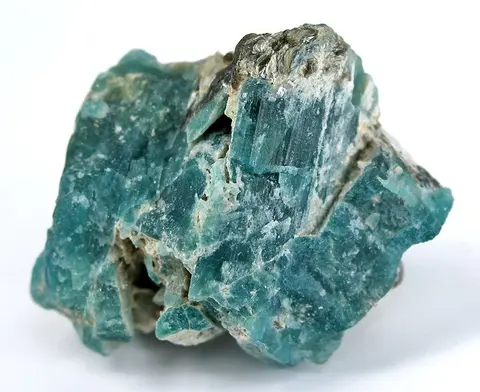
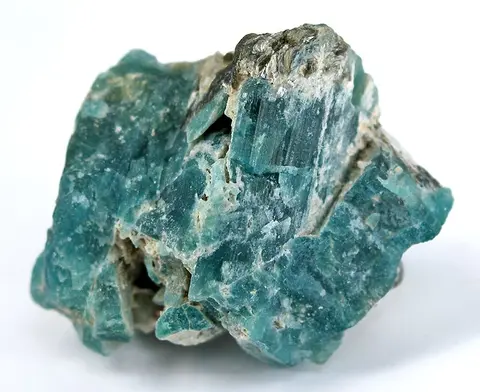
- Bluish green to greenish blue, from pale to deep teal; opaque material looks dark blue-green.
- Very strong pleochroism: turning a crystal or stone shows dark blue-green, near colorless to pale yellow, and green in different directions.
- Hardness 7.5: it scratches glass and quartz.
- Elongated crystals with a perfect cleavage, often broken into prismatic fragments in host rock.
- Strong birefringence (about 0.036 to 0.039) shows as doubled back facet edges under a loupe in larger faceted stones.
- Vitreous luster; translucent stones are often cut as cabochons.
Where grandidierite comes from
- Andrahomana, southern Madagascar
- Type locality, described in 1902 and named for the French explorer and naturalist Alfred Grandidier.
- Tranomaro area, southern Madagascar
- Source of the transparent gem material that reached the market in the 2010s.
- Sri Lanka
- Rare transparent stones have been found in gem gravels.
Grandidierite lookalikes
Tourmaline shows two pleochroic colors with one much darker along the length, and on a refractometer its birefringence is about half that of grandidierite.
- Tourmaline RI about 1.62 to 1.64, birefringence about 0.018 to 0.020
- Tourmaline SG about 3.06
- Long striated prisms with a rounded triangular cross section
Aquamarine shows weak pleochroism and very little doubling.
- Aquamarine RI 1.57 to 1.58, birefringence about 0.006
- SG about 2.7
Iolite is violet-blue to colorless or yellowish gray as it turns, not teal green.
- Iolite SG about 2.6
- Lower birefringence
Apatite is much softer (5) and scratched by steel.
- Apatite SG about 3.2
- Neon blue-green apatite is common and inexpensive
Kornerupine has higher RI (about 1.66 to 1.68) and is more often green to brownish green.
- Also a boron-bearing, strongly pleochroic gem
- Separated reliably by a refractometer
Fake, dyed and treated grandidierite
Other blue-green gems sold as grandidierite
Occasional
- Tourmaline, apatite or dyed material offered under the name
- Price far below what rare material commands
- No gem lab report
Teal glass
Occasional
- No pleochroism
- Bubbles or swirl marks
- Singly refractive in a polariscope
Is my grandidierite real? Tests you can do at home
-
Pleochroism check
Turn the stone slowly under a white light and look at the color from different directions.
- Real
- Distinct shifts between deep blue-green, pale yellowish and green.
- Fake or lookalike
- Glass and dyed stones keep the same color from every angle.
-
Loupe doubling check
Look through the table of a faceted stone at the back facet edges with a 10x loupe.
- Real
- Back facet edges appear doubled in larger stones.
- Fake or lookalike
- Glass and aquamarine show no obvious doubling.
-
Scratch test on glass
Drag the edge of a rough piece across a glass plate and wipe off any powder.
- Real
- Scratches glass cleanly.
- Fake or lookalike
- Apatite and glass do not scratch glass reliably.
Can leave a small mark.
A stone that passes these tests is consistent with natural grandidierite, not proven. For valuable pieces, a gem lab report settles treatment and origin.
Treatments
- None known (rare)
- Grandidierite is not known to be routinely treated; untreated status is expected. A gem lab report should confirm species and any treatment.
What moves the price of grandidierite
- Transparency. Transparent, eye-clean faceted stones are extremely rare and sit far above translucent cabochons and opaque specimens.
- Color. Saturated, even bluish green is preferred over pale or grayish tones.
- Size. Most faceted stones are small; larger clean stones are collector rarities.
- Documentation. A lab report identifying grandidierite adds confidence for a rare species.
- Cut. Orientation that shows the best color through the table and good proportions add value.