RockValues

Kornerupine value and identification

Kornerupine is a magnesium aluminum borosilicate that forms in high grade metamorphic rocks. It is a rare collector gem, usually green to brownish green, with strong pleochroism and occasional cat's eye stones.

Prices checked . Page updated .
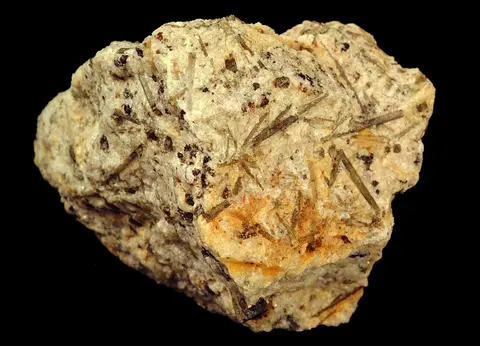
Kornerupine: Kornerupine (GeoDIL number - 274)
Kornerupine (GeoDIL number - 274). Photo: Nessa Eull, CC0, via Wikimedia Commons.

What kornerupine is worth

Not enough data. We have not yet seen 5 or more current dealer listings for kornerupine in any one form, so we show no range rather than guess.

These are dealer asking prices: what shops list kornerupine for, not what it sells for and not an appraisal. Selling to a dealer usually brings well below retail, because the dealer has to resell it at a margin.

How to identify kornerupine

  • Green, yellowish green, brownish green or brown; rarely blue green from Kenya
  • Strong pleochroism: green in one direction, yellowish or reddish brown in another
  • Prismatic crystals and water-worn pebbles from gem gravels
  • Hardness 6 to 7, scratches glass
  • Vitreous luster
  • Two good prismatic cleavages

Where kornerupine comes from

Sri Lanka
Gem gravels yield green to brown kornerupine, including cat's eye stones.
Madagascar
Source of gem quality green kornerupine.
Kwale district, Kenya
Bright green to blue green kornerupine.
Tanzania
East African gem gravels and metamorphic rocks.
Fiskenaesset, Greenland
Type locality, named after Danish geologist Andreas Kornerup.

Kornerupine lookalikes

Green tourmaline

Tourmaline is lighter and has lower refractive index; it is usually darkest looking down the crystal length.

  • SG about 3.06
  • RI 1.62 to 1.64
  • No cleavage

Enstatite

Enstatite overlaps closely in color and properties; RI and SG measurement or a lab is needed.

  • SG 3.2 to 3.3
  • RI 1.65 to 1.68

Peridot

Peridot is olive green with strong doubling of back facets and weak pleochroism.

  • Birefringence about 0.036, much higher
  • SG 3.27 to 3.37

Andalusite

Andalusite shows green and orange red flashes from pleochroism and is a little lighter.

  • SG 3.13 to 3.17
  • RI 1.63 to 1.65

Sinhalite

Sinhalite is brownish yellow to brown and heavier, with higher birefringence.

  • SG about 3.48
  • RI 1.665 to 1.712

Also mistaken for kornerupine: grandidierite.

Fake, dyed and treated kornerupine

  • Other green gems sold as kornerupine

    Occasional

    • Kornerupine is rarely sold in mass markets, so cheap lots are often tourmaline or enstatite
    • Confirm with RI, SG or a lab
  • Green glass

    Rare

    • No pleochroism
    • Bubbles
    • Lower SG

Is my kornerupine real? Tests you can do at home

  1. Pleochroism by eye

    Rotate the stone under a white light or view through a polarizing filter.

    Real
    Clear shift between green and yellowish or reddish brown.
    Fake or lookalike
    Glass shows no change; peridot changes little.
  2. Specific gravity by water displacement

    Weigh the loose stone dry and in water on a 0.01 g scale; divide dry weight by the loss.

    Real
    About 3.27 to 3.45.
    Fake or lookalike
    Tourmaline about 3.06, andalusite about 3.15, glass usually lower.
  3. Doubling check with a loupe

    Look through the table at back facet edges with a 10x loupe.

    Real
    Little or no visible doubling.
    Fake or lookalike
    Peridot shows obvious doubled edges.

A stone that passes these tests is consistent with natural kornerupine, not proven. For valuable pieces, a gem lab report settles treatment and origin.

Treatments

None known (rare)
Kornerupine is sold untreated. Not applicable.

What moves the price of kornerupine

  1. Color. Bright emerald to blue green ranks highest; brown and olive tones rank lower.
  2. Clarity. Eye clean stones are scarce.
  3. Size. Most gems are small; clean stones above a few carats are rare.
  4. Optical effect. Sharp cat's eye and rare star stones add value.
  5. Cut. Orientation that shows the greenest color through the table.

Sources

Prices: no current dealer listings yet. How we collect prices.