Peridot is the gem variety of olivine, a magnesium iron silicate close to forsterite in composition, (Mg,Fe)2SiO4. It is one of the few gems found in only one color family, yellowish green to olive, with the color coming from iron.
Prices checked . Page updated .
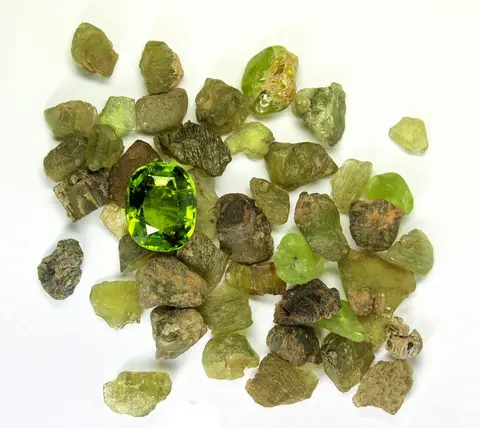
Peridot (Mg, Fe)2SiO4 in the rough form and a cut and polished gem - Sara Abey. Photo: Sara Abey, CC BY-SA 4.0, via Wikimedia Commons.
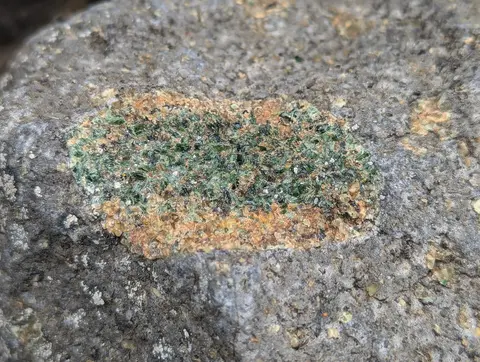
Olivine (peridot) in basalt, Lightning Peak, near Cherryville, British Columbia, Canada. Photo: Adam Kelliher / Rubble Rock and Gem, CC BY-SA 4.0, via Wikimedia Commons.
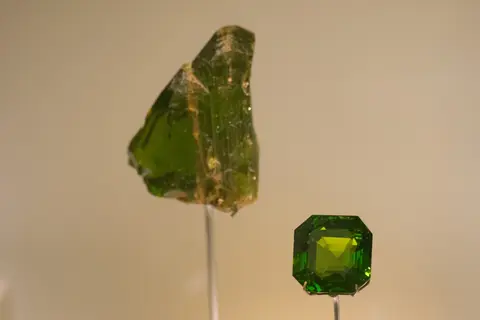
Olivine (24759079697). Photo: Thomas Quine, CC BY 2.0, via Wikimedia Commons.
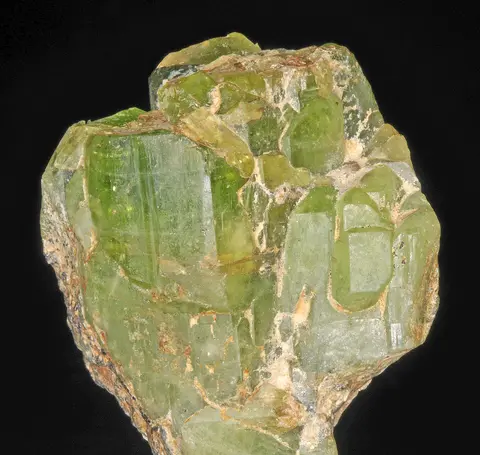
Péridot (Mansehra - Pakistan). Photo: Parent Géry, CC BY-SA 3.0, via Wikimedia Commons.
What peridot is worth
Not enough data. We have not yet seen 5 or more current dealer listings for peridot in any one form, so we show no range rather than guess.
These are dealer asking prices: what shops list peridot for, not what it sells for and not an appraisal. Selling to a dealer usually brings well below retail, because the dealer has to resell it at a margin.
How to identify peridot
Yellowish green to olive green color, never blue, pink or purple; more brown as iron content rises.
Strong double refraction: with a 10x loupe, back facet edges look doubled when viewed through the table.
Typical inclusions are flat disc-shaped 'lily pad' stress fractures around tiny crystals, and in Pakistani stones fine needles of ludwigite.
Oily to glassy luster on polished surfaces.
Rough is usually small rounded or broken grains rather than sharp crystals; well-formed crystals are uncommon.
Found as green grains in basalt xenoliths (San Carlos type) and as crystals in pegmatite-like veins (Pakistan, Zabargad).
Peridot varieties
Pakistan peridot
Peridot from the Kohistan region of northern Pakistan, known since the mid 1990s for large, clean, bright green crystals and cut stones. Pakistani peridot tends to be larger and cleaner with a purer green than most basalt-hosted peridot, and often contains fine ludwigite needles.
San Carlos peridot
Peridot from the San Carlos Apache Reservation in Arizona, mined from olivine nodules in basalt and a major source of small commercial stones. San Carlos peridot is usually small and slightly more yellowish or olive than the best Pakistani stones; it is mined only by tribal members.
Where peridot comes from
San Carlos Apache Reservation, Arizona, USA
A major source of small peridot from olivine nodules in basalt; mining is done by tribal members.
Kohistan, Pakistan
Since the 1990s the source of large, clean, bright green crystals and cut stones, often with ludwigite needles.
Zabargad (St. John's Island), Red Sea, Egypt
The historic source used in antiquity, known for fine crystals; now largely worked out.
Mogok, Myanmar
Fine, large, saturated peridot.
China and Vietnam
Commercial supplies of small to medium stones from basalt-hosted deposits.
Synthetic spinel, cubic zirconia or synthetic corundum in peridot color
Occasional
No doubling (spinel, CZ)
Too much fire (CZ)
Very clean with an unusual color tone
Peridot sold as 'evening emerald' or emerald
Occasional
Strong doubling under a loupe
Yellowish green color
Glass or quartz doublets
Rare
Join line along the girdle
Different luster above and below the girdle
Is my peridot real? Tests you can do at home
Loupe for doubling
Look through the table of a cut stone at the back facet edges with a 10x loupe, rotating slightly.
Real
Back facet edges and inclusions appear doubled.
Fake or lookalike
Glass, spinel and CZ show single, sharp facet edges.
Inclusion check
Examine the interior with a loupe under a bright light.
Real
Lily pad discs, small dark crystals or fine needles.
Fake or lookalike
Round bubbles and flow swirls indicate glass.
Specific gravity with a kitchen scale
For loose stones over a few grams, weigh dry and then the water displaced when suspended; divide. Small stones need a jeweler's scale.
Real
About 3.3.
Fake or lookalike
Ordinary glass about 2.5; CZ about 5.7.
Facet edge condition
Inspect facet junctions with a loupe.
Real
Sharp facet edges, with minor wear only on old stones.
Fake or lookalike
Molded glass shows rounded edges and dished facets.
A stone that passes these tests is consistent with natural peridot, not proven. For valuable pieces, a gem lab report settles treatment and origin.
Treatments
Fracture filling with oil or resin (rare)
Peridot is normally sold untreated. Occasionally stones with surface-reaching fractures are filled with oil or resin to improve appearance, which lowers value and durability. Flash effects or bubbles in fractures under magnification; lab confirmation.
What moves the price of peridot
Color. Saturated pure green with little yellow or brown is the most valued; olive and brownish tones are worth less.
Size. Most peridot is small; clean stones over a few carats, mostly from Pakistan and Myanmar, carry much more value.
Clarity. Eye-clean stones are preferred; visible lily pads and fractures lower value.
Cut quality. Good proportions and polish show color and brilliance; poorly cut native stones sell lower.
Origin. Pakistani and Burmese stones are associated with larger sizes and better color; Zabargad material has historic interest.
Care and safety
Peridot is moderately hard but can crack from sudden temperature change and is attacked by acids. Avoid ultrasonic and steam cleaners; use warm soapy water.
Questions collectors ask about peridot
How to tell if your peridot is real?
Look through the top of the stone with a 10x loupe: real peridot shows doubled back facet edges because of strong double refraction, and often lily pad inclusions. Glass shows single facet edges and round bubbles.
Why is peridot so rare?
Peridot is not rare as a gem overall, since basalt-hosted deposits produce plenty of small stones. Large, clean, saturated green stones are rare, which is why big peridot is valued much more.
What is the rarest color of peridot?
An intense pure green with little yellow or brown is the rarest and most valued, usually seen in larger stones from Pakistan and Myanmar.
Emerald vs peridot: how do you tell them apart?
Emerald is a bluish to pure green beryl with weak double refraction and fluid-filled inclusions. Peridot is yellowish green, heavier and shows strongly doubled back facets under a loupe.
Is peridot a real gem?
Yes. Peridot is a natural gem variety of olivine and has been used in jewelry since ancient Egypt.
How much is peridot worth per carat?
Value per carat climbs steeply with size, pure green color and clarity; small commercial stones are inexpensive while large fine stones are much more valuable. See the price table above.
Sources
Prices: 12 current listings from iRocks (The Arkenstone), Throwin Stones, seen 2026-11-20 to 2026-11-20. How we collect prices.