What prehnite is worth
Show 12 of the listings behind these numbers
These are dealer asking prices: what shops list prehnite for, not what it sells for and not an appraisal. Selling to a dealer usually brings well below retail, because the dealer has to resell it at a margin.
How to identify prehnite
Prehnite is a calcium aluminum silicate hydroxide that forms in cavities of basalt and in low grade metamorphic rocks. It is best known as pale green to yellow green rounded aggregates and translucent cabochon material.
- Pale apple green to yellow green, sometimes white, grey or yellow
- Grows as rounded botryoidal crusts, globes and bow-tie shaped clusters of tabular crystals rather than single crystals
- Translucent with a soft, slightly milky glow; vitreous to pearly luster
- Often occurs with zeolites, calcite or native copper in basalt cavities, or with black epidote needles
- Hardness 6 to 6.5: scratches glass weakly, a steel file scratches it
- SG about 2.9, slightly heavier than quartz or chalcedony
Prehnite varieties
Prehnite with epidote
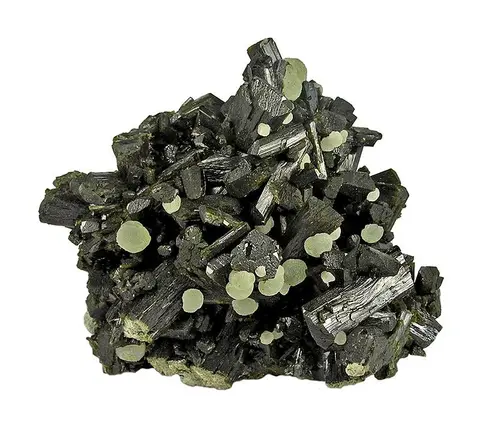
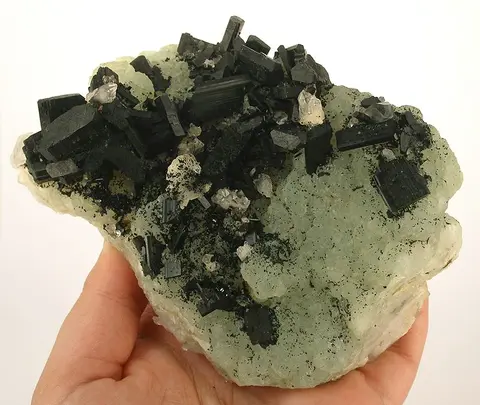
Prehnite with epidote is green prehnite containing black needle-like epidote crystals, mainly from the Kayes Region of Mali. The dark epidote needles make a sharp contrast against the green prehnite; they are often wrongly sold as tourmaline.
Where prehnite comes from
- Kayes Region, Mali
- Source of the familiar green prehnite with black epidote needles, as crystal clusters and cabochons.
- Northern Territory, Australia
- Yellow green translucent prehnite, cut into cabochons and beads.
- South Africa
- Prehnite was first described from the Cape region and is named after Hendrik von Prehn.
- Paterson area, New Jersey, USA
- Classic basalt quarry specimens of botryoidal prehnite with zeolites.
- Keweenaw Peninsula, Michigan, USA
- Prehnite with native copper inclusions from the copper district.
Prehnite lookalikes
Peridot is transparent olive to bottle green with obvious facet doubling under a loupe; prehnite is usually translucent and milky.
- Peridot SG about 3.3
- Peridot hardness 6.5 to 7
- Peridot RI 1.65 to 1.69 with high birefringence
prehnite vs peridot
Chrysoprase is a more saturated apple green, lighter in hand (SG 2.6) and harder (7).
- Chrysoprase has a waxy luster and no crystal aggregates
Moss agate is clear to milky chalcedony with green filaments, not an evenly colored green.
prehnite vs moss agate
Aventurine shows sparkling mica flakes and is granular quartz.
Smithsonite is much heavier (SG 4.3 to 4.5) and softer (4 to 4.5).
- Both form botryoidal crusts
Also mistaken for prehnite: serpentine, jade, green jade, thomsonite, wavellite, isle royale greenstone.
Fake, dyed and treated prehnite
Green glass beads and cabochons sold as prehnite
Occasional
- Gas bubbles under a loupe
- Perfectly even color with no fibrous or granular texture
- Lighter in hand
Dyed chalcedony or quartz sold as prehnite
Occasional
- Color concentrated in cracks
- Too saturated a green
- Lower SG
Prehnite with epidote sold as prehnite with tourmaline
Common
- The black needles in Mali prehnite are epidote
- Correct name matters for collectors, not for natural status
Is my prehnite real? Tests you can do at home
-
Loupe inspection
Look at the surface and interior at 10x.
- Real
- Fibrous, radiating or granular internal structure and natural inclusions such as epidote needles.
- Fake or lookalike
- Glass shows bubbles and swirls; dyed stones show color in cracks.
-
Specific gravity
Weigh the stone in air, then suspended in water on a kitchen scale, and divide weight in air by the weight lost in water.
- Real
- About 2.8 to 2.95.
- Fake or lookalike
- Glass and chalcedony are usually 2.4 to 2.65; peridot is about 3.3.
-
Facet doubling (for faceted stones)
Look through the table at the back facets with a 10x loupe.
- Real
- Prehnite shows only slight doubling, if any, through its cloudy body.
- Fake or lookalike
- Peridot shows strong, obvious doubling.
-
Glass scratch
Try to scratch a glass bottle with a sharp edge.
- Real
- Prehnite scratches glass, though not as easily as quartz.
- Fake or lookalike
- Soft dyed stones and plastic do not.
Can leave a small mark.
A stone that passes these tests is consistent with natural prehnite, not proven. For valuable pieces, a gem lab report settles treatment and origin.
Treatments
- None routinely (rare)
- Prehnite is usually sold untreated. Not applicable.
- Dyeing (rare)
- Occasionally used on pale material to deepen green; lowers value. Dye in cracks.
What moves the price of prehnite
- Transparency. Highly translucent to transparent material for faceting or cabochons is scarce and worth most.
- Color. Even, bright green to yellow green beats grey or brownish tones.
- Specimen quality. Well formed botryoidal or bow-tie clusters on matrix, or with copper or zeolite associates, appeal to collectors.
- Inclusions. Crisp black epidote needles in clear green prehnite are popular.
- Size. Large clean cabochons and specimens are uncommon.
Questions collectors ask about prehnite
- Peridot vs prehnite
- Peridot is transparent olive green olivine with strong facet doubling and an SG of about 3.3. Prehnite is usually translucent, paler apple to yellow green, slightly softer and lighter.
Sources
Prices: 17 current listings from FossilEra, iRocks (The Arkenstone), Throwin Stones, seen 2026-11-20 to 2026-11-20. How we collect prices.