Jade is a trade name for two different rocks: jadeite, a sodium aluminum pyroxene, and nephrite, a calcium magnesium iron amphibole of the tremolite-actinolite series. Both are tough, interlocking aggregates of tiny crystals, which is why they carve so well.
Prices checked . Page updated .
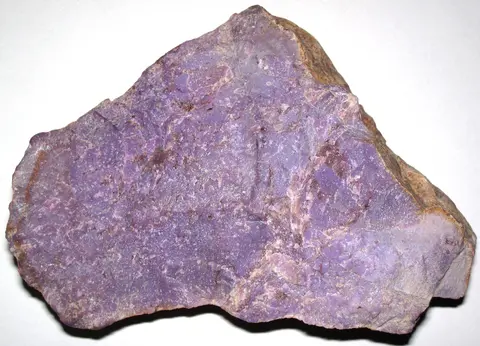
Purple jade (metaphonolite) Bursa Province, northwestern Turkey. Photo: James St. John, CC BY 2.0, via Wikimedia Commons.
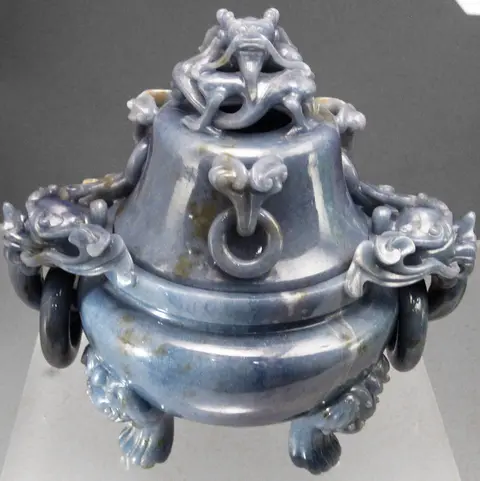
Blue jadeitite Chinese incense burner (Qing period, 1644-1911) 2 (49167297731). Photo: James St. John, CC BY 2.0, via Wikimedia Commons.
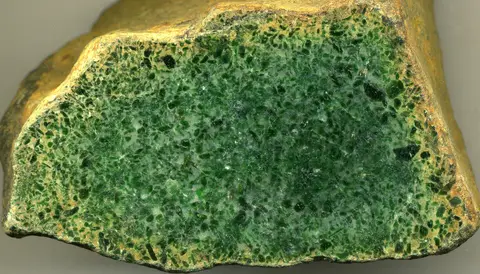
Jadeitite (jadeite jade) (Hpakan-Tawmaw Jade Tract, Hpakan Ultramafic Body, Naga-Adaman Ophiolite, Late Jurassic, 147 Ma; alluvial clast (placer jade) (15254439735). Photo: James St. John, CC BY 2.0, via Wikimedia Commons.
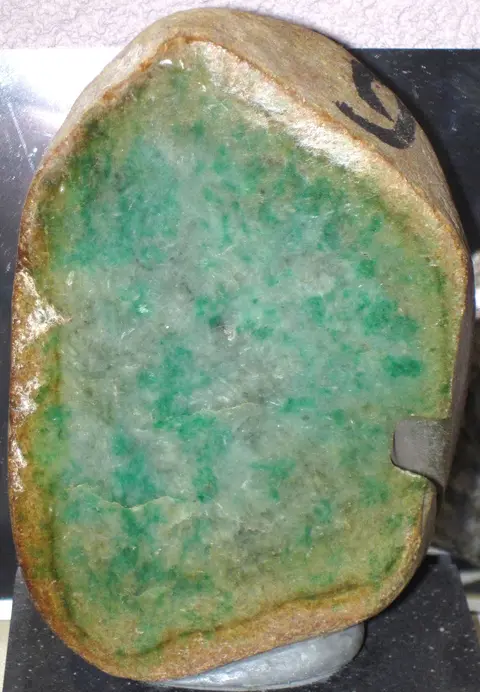
Jadeitite (jadeite jade) (Burma) 1 (24665206206). Photo: James St. John, CC BY 2.0, via Wikimedia Commons.
What jade is worth
Not enough data. We have not yet seen 5 or more current dealer listings for jade in any one form, so we show no range rather than guess.
These are dealer asking prices: what shops list jade for, not what it sells for and not an appraisal. Selling to a dealer usually brings well below retail, because the dealer has to resell it at a margin.
How to identify jade
Heavy for its size: jadeite (SG about 3.33) and nephrite (about 2.95) both feel denser than quartzite, serpentine or glass of the same size.
Hard enough that a steel knife blade will not scratch it (hardness 6 to 7); serpentine, marble and soapstone scratch easily.
Backlit with a flashlight, the inside shows a grainy (jadeite) or felted, fibrous (nephrite) texture rather than the clean bubbles of glass or the sparkly platelets of aventurine.
Polished jadeite often shows a slightly dimpled 'orange peel' surface under a loupe; nephrite takes an oily to greasy luster.
Color is rarely perfectly even: natural jade usually shows mottling, veins of color, or cloudy patches.
Rings with a clear tone when two pieces are gently tapped together, but this is unreliable and should not be used on bangles you care about.
Wyoming jade is nephrite from central Wyoming, especially around Lander and the Granite Mountains; nephrite is Wyoming's state gemstone. It is nephrite; known for fine dark green and black colors and boulders found on the surface in the mid twentieth century.
Alaska jade
Alaska jade is nephrite from northwestern Alaska, chiefly the Kobuk River and Jade Mountain area; jade is Alaska's state gem. It is nephrite, usually green with black specks, sold mainly as carvings and slabs.
Bc jade
BC jade is nephrite from British Columbia, Canada, today the world's largest commercial nephrite source. It is nephrite, typically spinach to apple green; much jade carved in China and New Zealand is BC rough.
Siberian jade
Siberian jade is nephrite from the East Sayan Mountains and Buryatia in Russia, noted for bright spinach green with black chromite dots and for white nephrite. It is nephrite; the bright green with black specks is a common Siberian look.
Where jade comes from
Hpakant, Kachin State, Myanmar
Source of nearly all gem jadeite on the market, including imperial green and lavender.
Motagua River valley, Guatemala
Jadeite worked by the Olmec and Maya; today produces green, blue-green, lavender and black material.
British Columbia, Canada
Largest modern producer of nephrite, mostly spinach green; much carved 'jade' worldwide is BC nephrite.
Hotan (Hetian), Xinjiang, China
Historic source of white 'mutton fat' nephrite prized in Chinese carving.
West Coast, South Island, New Zealand
Nephrite known as pounamu, owned and managed by Ngai Tahu.
East Sayan Mountains, Siberia, Russia
Bright spinach green nephrite with black chromite specks, plus white nephrite from Buryatia.
Wyoming and Alaska, USA
Nephrite from central Wyoming (including fine black and dark green) and the Kobuk River area of Alaska.
Itoigawa, Japan
Jadeite from the Itoigawa area, Japan's national stone; collecting is restricted.
Bleached and polymer-impregnated jadeite ('B jade')
Very common
Unnaturally clean, bright color with no brown or gray patches
Acid-etched 'spider web' or crazed surface pattern under a loupe
Duller tone when tapped
Polymer may glow chalky blue-white under UV
Proof needs FTIR testing in a lab
Dyed jadeite ('C jade')
Very common
Color concentrated in cracks and between grains when backlit
Even 'painted' green or lavender with no natural gradation
Acetone swab may lift color on cheap pieces
Green dye shows chromium-like but abnormal spectrum in a lab
Dyed quartzite sold as jade ('Malaysia jade')
Very common
Granular sugary texture with dye filling grain boundaries
SG about 2.65
Uniform bright green or purple
Serpentine sold as 'new jade', 'Korean jade' or 'Afghan jade'
Very common
Scratches with a steel knife
Light in the hand
Waxy look
Dyed marble or calcite sold as 'Mexican jade' or 'mountain jade'
Common
Scratches easily with a knife
Fizzes with a drop of household vinegar
Dye pooled in veins
Glass ('Peking glass', molded beads and pendants)
Common
Round gas bubbles under a loupe
Swirl marks and mold seams
Conchoidal chips on edges
No grain or fibers when backlit
Resin and plastic carvings
Occasional
Feels warm and very light
Hot point test melts it (destructive)
Soft, scratches with a fingernail edge or pin
Is my jade real? Tests you can do at home
Flashlight backlight
Press a small bright flashlight against the back of the piece in a dim room and look through it with a loupe.
Real
Jadeite shows interlocking grains; nephrite shows a felted, fibrous texture; natural color varies through the stone.
Fake or lookalike
Glass shows bubbles; dyed stone shows color webbed along cracks; aventurine shows glittering platelets.
Specific gravity with a kitchen scale
Weigh the piece dry, then weigh it suspended in a cup of water on the scale; divide dry weight by the gain in water weight.
Real
Nephrite reads about 2.9 to 3.0; jadeite about 3.3 to 3.4.
Fake or lookalike
Serpentine about 2.6, quartzite and chalcedony about 2.65, most glass 2.4 to 2.6.
Steel knife scratch
Press a steel knife point firmly on an unseen spot, such as the back of a carving or a drill hole.
Real
No scratch; you may leave a gray metal streak that wipes off.
Fake or lookalike
Serpentine, marble, soapstone and plastic scratch.
Can leave a small mark.
Loupe surface check
Look at a polished surface at 10x under a raking light.
Real
Jadeite shows a fine dimpled 'orange peel' polish; nephrite an even oily polish.
Fake or lookalike
B jade shows a crazed, acid-etched network; glass shows bubbles and mold lines.
UV torch
Shine a longwave UV torch on the piece in the dark.
Real
Natural untreated jade is usually inert or very weak.
Fake or lookalike
Polymer-impregnated B jade often glows chalky blue-white; some dyes glow too. Not proof on its own.
Acetone swab
Rub a cotton swab with acetone on an inconspicuous spot for a few seconds.
Real
Swab stays clean.
Fake or lookalike
Cheap dyed stone may leave green or purple on the swab; good dye jobs pass this test.
A stone that passes these tests is consistent with natural jade, not proven. For valuable pieces, a gem lab report settles treatment and origin.
Treatments
Waxing (almost always)
Surface wax improves luster; accepted as standard ('A jade') and does not lower value. Hot point near the surface makes wax sweat; lab FTIR.
Bleaching and polymer impregnation (B jade) (common)
Removes brown staining and fills the weakened structure with resin; value falls sharply and the piece can turn brittle and yellow with age. Etched surface under a loupe, sometimes UV glow; FTIR in a lab is definitive.
Dyeing (C jade) (common)
Adds or strengthens green or lavender color; value is a small fraction of natural color, and dye can fade. Color in fractures when backlit; lab spectroscopy.
Heating of brown jadeite (occasional)
Turns brownish yellow material redder; considered less serious than B or C treatment. Difficult; lab only.
What moves the price of jade
Jadeite or nephrite. Fine jadeite commands far more than nephrite of similar look; identity is the first thing a buyer checks.
Treatment status. A lab report showing natural, untreated (A jade) color is essential for any valuable jadeite; B and C jade sell at a deep discount.
Color. Intense, even emerald green (imperial) leads, followed by strong lavender, bright apple green and fine white for nephrite.
Translucency and texture. Fine-grained, semitransparent 'icy' or 'glassy' jadeite is worth far more than coarse opaque material.
Size and form. Bangles cut from a single piece and large matched bead strands use a lot of rough and price accordingly.
Carving and craftsmanship. Fine hand carving and antique pieces with documented age add value; machine carving adds little.
Damage. Cracks, especially in bangles, sharply reduce value.
Questions collectors ask about jade
How to know if it's real jade?
Check that a steel knife will not scratch it, that it feels heavy (SG 2.9 to 3.4), and that a flashlight shows grainy or fibrous texture rather than bubbles or glitter. Whether jadeite is untreated can only be proven by a gem lab.
What is the difference between jade and jadeite?
Jade is the umbrella name for two materials, jadeite and nephrite. Jadeite is a pyroxene, denser (about 3.33) and the source of imperial green; nephrite is an amphibole, slightly softer, lighter (about 2.95) and tougher.
What stone is mistaken for jade?
Serpentine, green aventurine, chrysoprase, prehnite, dyed quartzite, hydrogrossular garnet, vesuvianite and glass are the usual stand-ins. Density and a knife scratch rule out most of them.
How to test jade with a flashlight?
Hold a bright flashlight against the back in a dim room. Real jade shows a grainy or fibrous internal texture and uneven natural color; glass shows bubbles, and dyed stone shows color concentrated in cracks.
Is it illegal to own jade?
No, owning jade is legal. Some countries, including the United States, have at times restricted imports of Burmese jadeite under sanctions, and collecting jade on public land is regulated in places such as New Zealand and Itoigawa, Japan.
What is the most valuable form of jade?
Imperial jadeite: semitransparent, fine-grained jadeite with an intense, even emerald green, almost all from Myanmar. Value depends on color, translucency, size and proof of no treatment; see the price table above for current figures.
Sources
Prices: 12 current listings from FossilEra, The Gem Shop, seen 2026-11-20 to 2026-11-20. How we collect prices.


_(Hpakan-Tawmaw_Jade_Tract,_Hpakan_Ultramafic_Body,_Naga-Adaman_Ophiolite,_Late_Jurassic,_147_Ma;_alluvial_clast_(placer_jade)_(15254439735).jpg)