What emerald is worth
Not enough data. We have not yet seen 5 or more current dealer listings for emerald in any one form, so we show no range rather than guess.
Show 10 of the listings behind these numbers
These are dealer asking prices: what shops list emerald for, not what it sells for and not an appraisal. Selling to a dealer usually brings well below retail, because the dealer has to resell it at a margin.
How to identify emerald
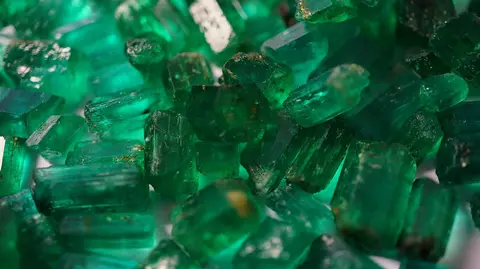
Emerald is defined by its green color from chromium or vanadium; it forms in different rocks than pegmatite beryl and is nearly always included and oil-treated. See beryl value for the species as a whole.
- Medium to dark green to slightly bluish green, with color often slightly uneven in bands along the prism.
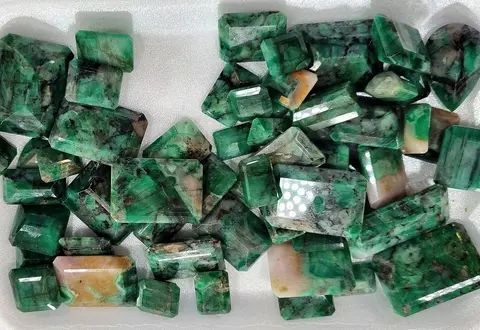
- Inclusions are normal: fractures, fluid pockets and mineral grains, the so-called 'jardin' (garden).
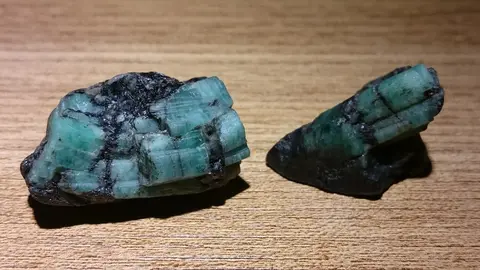
- Six-sided prism crystals, often in calcite veins in black shale (Colombia) or in mica schist (Zambia, Brazil).
- Weak dichroism, yellowish green to bluish green.
- SG about 2.72; feels light compared with tsavorite or green sapphire.
Where emerald comes from
- Muzo, Coscuez and Chivor, Colombia
- Classic source with a warm pure green and jagged three-phase inclusions.
- Kagem, Zambia
- High output of bluish green, often cleaner stones from schist.
- Panjshir Valley, Afghanistan
- Fine crystals and cut stones resembling Colombian material.
- Minas Gerais, Bahia and Goias, Brazil
- Commercial-grade emerald from schist, mostly lighter in tone.
- Swat Valley, Pakistan
- Small, saturated crystals in talc-carbonate rock.
- Ural Mountains, Russia
- Historic source of large crystals in mica schist.
Emerald lookalikes
Tsavorite is noticeably heavier (SG about 3.6) and has a brighter, more brilliant sparkle with no dichroism.
- Tsavorite RI about 1.74
- Singly refractive, so no color change when rotated under a polarizer
Strong dichroism and SG about 3.05, heavier than emerald.
- Higher birefringence shows doubled back facets in larger stones
Chrome diopside is softer (5.5) and heavier (SG 3.3), and facet edges show wear quickly.
- RI 1.67 to 1.70
- Usually small and very dark in larger sizes
Peridot is a yellowish olive green and shows strong doubling of back facets through the table.
peridot vs emerald
Jadeite is translucent to opaque with a greasy to waxy polish, never the transparent look of facet-grade emerald.
- SG 3.3
- Granular, interlocking texture under a loupe
jadeite vs emerald
Also mistaken for emerald: jade, imperial jade, tourmaline, green tourmaline, fluorite, green fluorite, colombian emerald, green sapphire, hiddenite, dioptase, diopside.
Fake, dyed and treated emerald
Green glass
Very common
- Round bubbles and swirls
- Too even in color
- No dichroism
Flux and hydrothermal lab emerald
Common
- Cleaner than expected for the size
- Flux veils or chevron growth lines under magnification
- Strong red fluorescence under longwave UV
- Lab report needed to be sure
Soude emerald and emerald triplets
Occasional
- Pale crown and pavilion joined by a green layer at the girdle
- Visible join line when viewed from the side
Heavily resin-filled low-grade emerald
Very common
- Flash of orange or blue color along fractures when tilted
- Fractures look 'healed' but show flattened bubbles
Is my emerald real? Tests you can do at home
-
Loupe check for natural inclusions
Examine the stone with a 10x loupe from several angles.
- Real
- Irregular fractures, fluid pockets and mineral crystals spread unevenly.
- Fake or lookalike
- Glass has round bubbles; flux synthetics show veils; composites show a glue plane.
-
Weight check by water displacement
Measure specific gravity with a 0.01 g scale and a cup of water (works best on stones over 2 carats).
- Real
- About 2.72 (2.67 to 2.78).
- Fake or lookalike
- Tsavorite 3.6, chrome diopside 3.3, peridot 3.3, chrome tourmaline 3.05.
-
Chelsea filter
View the stone through an inexpensive Chelsea color filter under strong incandescent light.
- Real
- Colombian and many other chromium emeralds look pink to red; some iron-rich Zambian stones stay greenish.
- Fake or lookalike
- Green glass and most lookalikes stay green. Synthetic emerald often turns an intense red, so a red result alone does not prove natural.
A stone that passes these tests is consistent with natural emerald, not proven. For valuable pieces, a gem lab report settles treatment and origin.
Treatments
- Cedar oil or resin filling (almost always)
- Hides surface-reaching fractures; minor oiling is accepted, significant filling cuts value sharply. Lab reports state none, minor, moderate or significant; flash colors suggest resin.
- Dyed or colored oil (rare)
- Adds green to pale beryl; considered deceptive and destroys value once found. Green color concentrated in fractures under a loupe.
What moves the price of emerald
- Color. Pure green to slightly bluish green in a medium to medium-dark tone is the most valued; yellowish or very light stones fall off quickly.
- Clarity enhancement. None or minor oil on a lab report adds a large premium.
- Origin. Colombian origin carries the highest premium, followed by Afghan and Zambian.
- Size. Fine stones over a few carats are scarce and priced much higher per carat.
- Transparency. Lively, transparent stones beat sleepy, heavily included ones of the same color.
Care and safety
Avoid ultrasonic and steam cleaners, solvents and hot water, which can remove oil and open fractures. Clean with lukewarm soapy water and a soft brush, and protect rings from hard knocks.
Questions collectors ask about emerald
- Why can't you wear emeralds every day?
- You can, with care. Emeralds almost always contain fractures filled with oil or resin, so a hard knock can chip them and ultrasonic cleaners, heat or solvents can remove the filler. Protective settings and gentle cleaning keep everyday wear safe.
- What is the rarest color of emerald?
- The most sought-after emerald color is a pure, intense green to very slightly bluish green in a medium-dark tone with high transparency, and that combination is rare. Most emeralds are lighter, more yellowish or cloudier.
- How do I know if my emerald is valuable?
- Look at color first (saturated, even green), then transparency, size and how many fractures reach the surface. A lab report confirming natural origin and the level of clarity enhancement matters a great deal; the price table above shows how these grades compare.
- How much is a natural emerald worth?
- It depends on color, clarity enhancement, size and origin, and the spread between commercial and fine stones is very wide. See the price table above for current observed ranges.
Sources
Prices: 10 current listings from iRocks (The Arkenstone), Throwin Stones, Trade Roots, seen 2026-11-20 to 2026-11-20. How we collect prices.