Dealer asking prices for dioptase, middle half of current listings, checked 2026-11-20. Bar shows the 25th to 75th percentile; the dark tick is the median.
These are dealer asking prices: what shops list dioptase for, not what it sells for and not an appraisal. Selling to a dealer usually brings well below retail, because the dealer has to resell it at a margin.
How to identify dioptase
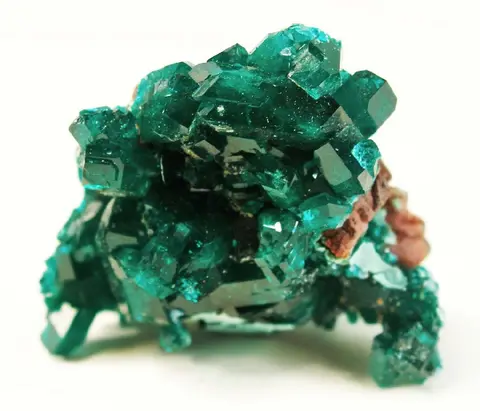
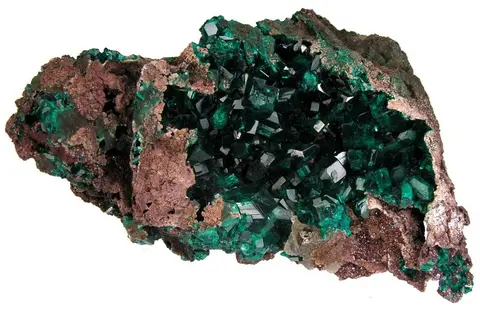
Dioptase is a hydrated copper silicate (CuSiO3·H2O) that forms short, intensely emerald green to bluish green rhombohedral crystals in the oxidized zones of copper deposits. Its color rivals emerald, but it is far softer and cleaves easily.
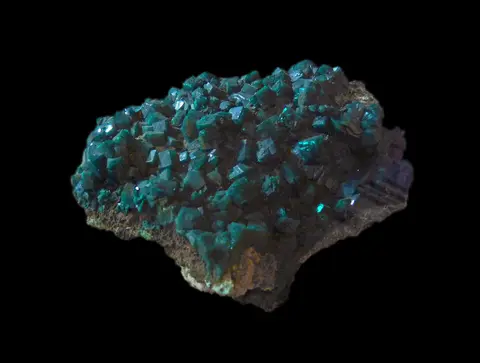
Intense emerald green to slightly bluish green color with a bright glassy luster.
Short six-sided prisms capped by rhombohedral faces, usually small and in sparkling clusters on matrix.
Perfect cleavage in three directions, so crystals chip and split easily.
Hardness 5: scratched by a steel knife and by quartz.
Green streak.
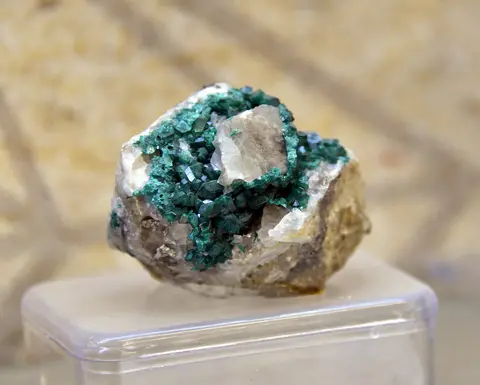
Often with calcite, quartz, plancheite, chrysocolla or other copper minerals.
Where dioptase comes from
Tsumeb, Namibia
Source of the finest large, lustrous crystals, often on white calcite.
Altyn-Tyube, Karaganda Region, Kazakhstan
Type locality; the first crystals were mistaken for emerald in the late 1700s.
Mindouli and Reneville area, Republic of Congo
Bright green crystal clusters on matrix, widely available to collectors.
Guchab and other Otavi Mountainland mines, Namibia
Additional Namibian specimen sources.
Arizona, USA
Small crystals from copper mines such as the Christmas mine.
Chrysocolla is blue-green, opaque and massive with no crystal faces.
Chrysocolla hardness 2 to 4
Often sticks slightly to the tongue, but do not test this way
Fake, dyed and treated dioptase
Glued or reassembled crystal clusters on matrix
Occasional
Glue shine or residue at the base of crystals under a loupe
Crystals sitting on matrix at odd angles with no growth contact
Dioptase sold as emerald or 'copper emerald'
Occasional
Scratched by a steel knife
Heavier than emerald
Rhombohedral cleavage
Green-dyed quartz or calcite drusy sold as dioptase
Rare
Color in cracks and pores
Acetone swab picks up dye
Quartz scratches glass, dioptase does not easily
Is my dioptase real? Tests you can do at home
Streak test
Rub a broken fragment, not the display crystals, on an unglazed tile.
Real
Pale green streak.
Fake or lookalike
Emerald and dyed quartz leave a white streak or none.
Can leave a small mark.
Knife scratch test
Gently draw a steel knife point across a hidden part of the specimen.
Real
Dioptase is scratched (hardness 5).
Fake or lookalike
Emerald and quartz are not scratched.
Can leave a small mark.
Loupe check of crystals and contacts
Examine crystal shapes and where crystals meet the matrix with a 10x loupe.
Real
Short prisms with rhombohedral tips grown directly from the matrix.
Fake or lookalike
Glue lines, hexagonal flat-ended prisms (beryl) or dye in cracks.
Acetone swab
Rub a cotton swab with acetone on a hidden spot.
Real
Swab stays clean.
Fake or lookalike
Dyed material leaves green on the swab.
A stone that passes these tests is consistent with natural dioptase, not proven. For valuable pieces, a gem lab report settles treatment and origin.
Treatments
Repair and gluing of specimens (occasional)
Restores broken clusters; undisclosed repair lowers value significantly. Loupe inspection for glue at contacts; UV light may show glue glowing.
Oiling or coating (occasional)
Brightens dull crystals; disliked by collectors. Greasy feel or residue.
What moves the price of dioptase
Crystal size and sharpness. Large, sharp, lustrous crystals bring the most; most specimens are clusters of small crystals.
Locality. Tsumeb pieces carry the strongest premium, followed by Altyn-Tyube and Congo.
Matrix contrast. Green crystals on white calcite or contrasting matrix are preferred.
Transparency and color. Gemmy, saturated green crystals are valued over dark, opaque ones.
Damage and repair. Chipped crystals and undisclosed repairs reduce value considerably.
Faceted stones. Faceted dioptase is a collector item because the cleavage makes cutting difficult; clean stones are small.
Care and safety
Dioptase cleaves easily and is brittle. Avoid ultrasonic cleaners, knocks and sudden temperature changes; it is not suitable for rings or everyday jewelry.
Sources
Prices: 12 current listings from Dakota Matrix Minerals, FossilEra, iRocks (The Arkenstone), seen 2026-11-20 to 2026-11-20. How we collect prices.