Dealer asking prices for malachite, middle half of current listings, checked 2026-11-20. Bar shows the 25th to 75th percentile; the dark tick is the median.
These are dealer asking prices: what shops list malachite for, not what it sells for and not an appraisal. Selling to a dealer usually brings well below retail, because the dealer has to resell it at a margin.
How to identify malachite
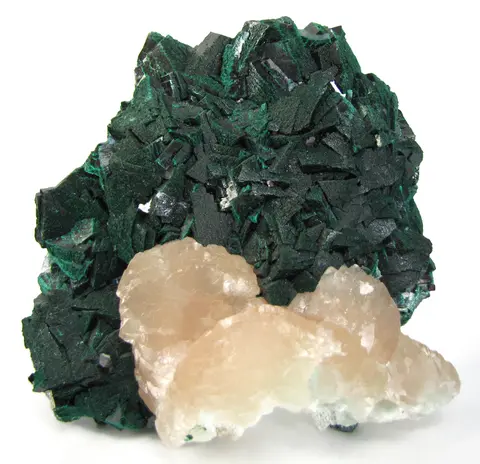
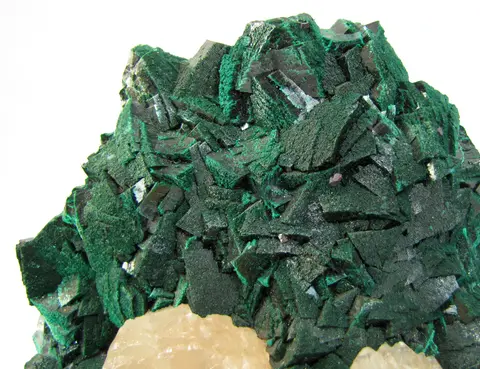
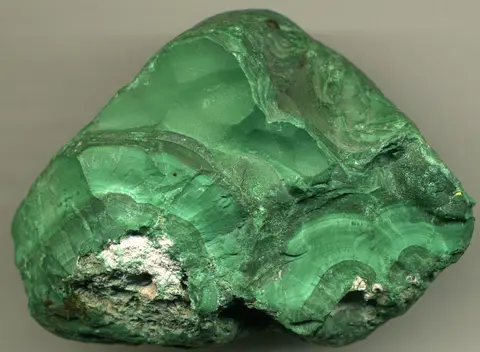
Malachite is a green copper carbonate hydroxide that forms where copper ore deposits weather near the surface. It is prized for its concentric light and dark green banding and is one of the most widely carved and polished ornamental stones.
Opaque green in light and dark bands, often in concentric circles, eyes or wavy stripes.
Heavy for its size (SG about 3.6 to 4.0), noticeably heavier than glass or plastic.
Soft: hardness 3.5 to 4, so a steel knife scratches it.
Leaves a pale green streak on unglazed porcelain.
Silky to glassy luster on polish; some fibrous pieces show a moving sheen (chatoyancy).
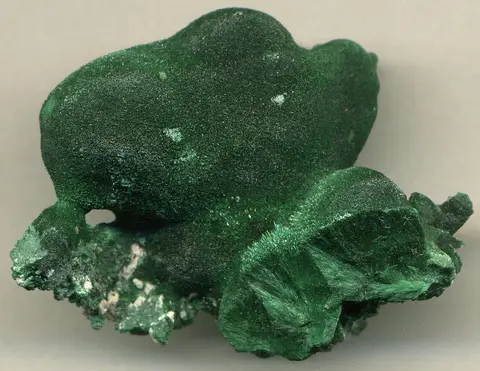
Often found with blue azurite and other copper minerals, or forming botryoidal, bubbly crusts.
Malachite varieties
Congo malachite
Congo malachite is malachite from the Katanga copperbelt of the Democratic Republic of the Congo, the main modern source of banded, stalactitic and botryoidal material. Same mineral; the name signals the source, which supplies most carving rough and polished slices with bullseye patterns.
Banded malachite
Banded malachite is massive malachite showing alternating light and dark green layers, the form used for most cabochons, beads and carvings. A texture rather than a separate source: banding comes from layered growth in cavities, and crisp high contrast bands raise value.
Chatoyant malachite
Chatoyant malachite is fibrous malachite whose parallel fibers produce a silky band of light that moves as the stone is tilted, sometimes called velvet or silky malachite. Shows a moving sheen from fibrous structure instead of plain banding; scarcer than ordinary banded malachite and cut to center the sheen.
Where malachite comes from
Katanga (Kolwezi, Likasi), Democratic Republic of the Congo
Main source of banded and stalactitic malachite used for carvings, slabs and beads today.
Ural Mountains, Russia
Historic source of huge masses used for veneers in the Hermitage Malachite Room and St Isaac's Cathedral; largely exhausted.
Bisbee and Morenci, Arizona, USA
Specimens with azurite and banded material, including azurite malachite cut stones.
Reconstituted malachite (crushed malachite in resin)
Very common
Bands break into small chips or fragments under a loupe
Lighter than solid malachite
Even, sharp edged patches of color
Resin or plastic imitation
Very common
Feels light and warm
Bands repeat or look printed
Hot point melts or smells of plastic (destructive)
Banded green glass
Occasional
Gas bubbles under a loupe
Steel knife does not scratch it (glass hardness about 5.5)
Azurite malachite assembled from separate pieces
Common
Straight glue boundaries between blue and green
Resin between fragments
Dyed green agate or howlite sold as malachite
Occasional
Too hard (agate scratches glass)
Acetone swab picks up dye
White streak
Is my malachite real? Tests you can do at home
Weight in hand
Hold the piece next to a glass or plastic object of the same size.
Real
Feels clearly heavy for its size.
Fake or lookalike
Plastic and resin feel light; reconstituted material is also lighter.
Specific gravity by water displacement
Weigh dry on a kitchen scale, weigh the displaced water, divide.
Real
About 3.6 to 4.0.
Fake or lookalike
Plastic about 1.2 to 1.5; reconstituted about 2.5 to 3; dyed agate 2.6.
Loupe the banding
Look at the bands with a 10x loupe.
Real
Smooth, continuous bands that curve around centers.
Fake or lookalike
Reconstituted shows fragments in resin; plastic shows bubbles or printed edges.
Streak test
Rub an unpolished edge on the back of a ceramic tile.
Real
Light green streak.
Fake or lookalike
Dyed agate and plastic leave white or no streak.
Can leave a small mark.
Steel scratch
Press a knife point on a hidden spot.
Real
Scratches (3.5 to 4).
Fake or lookalike
Dyed agate and glass resist the knife.
Can leave a small mark.
A stone that passes these tests is consistent with natural malachite, not proven. For valuable pieces, a gem lab report settles treatment and origin.
Treatments
Waxing or resin impregnation (common)
Seals pores and improves polish; acceptable for carvings, lowers value for specimens if heavy. Waxy feel, resin film in pits under a loupe.
Reconstitution (common)
Uses scrap malachite powder and chips in resin; sold far below solid material. Fragment texture under a loupe, low SG.
What moves the price of malachite
Solid versus reconstituted. Solid natural malachite outranks reconstituted and imitation by a wide margin.
Pattern. Crisp, high contrast bands, eyes and bullseyes rank highest.
Size and solidity. Large pieces without voids or cracks are scarce.
Specimen form. Stalactitic, botryoidal and silky chatoyant pieces and pseudomorphs draw collector interest.
Locality. Classic Russian, Tsumeb and Bisbee pieces carry a premium over common Congo material.
Workmanship. Inlay, veneer and carving quality drive decorative object value.
Care and safety
Malachite contains copper. Polished pieces are safe to handle; the hazard is dust from cutting, sanding or drilling, so work wet with a mask and wash hands. Do not use it in drinks or elixirs.
Soft and sensitive to acids, ammonia and heat; it scratches and loses polish quickly in daily wear. Wipe with a damp cloth and dry it; avoid ultrasonic and steam cleaners.
Questions collectors ask about malachite
Is malachite stone worth anything?
Yes, solid natural malachite with sharp banding, good size and few voids sells well, especially carvings and classic locality specimens. Reconstituted and imitation pieces are worth far less. See the price table above for current observations.
Why is malachite so toxic?
It is a copper compound, and copper is harmful if swallowed or inhaled as dust. Handling polished malachite is fine; cutting or sanding it dry is where the risk comes from.
Why can't malachite get wet?
Brief contact with water does not harm it, but malachite is soft and slightly porous, so soaking, acidic water and cleaning products dull the polish. Wipe and dry it rather than soaking.
How to identify malachite?
Look for opaque green concentric banding, a heavy feel, a light green streak and softness to steel. Check the bands with a loupe to rule out reconstituted fragments and plastic.
What is reconstituted malachite?
It is malachite powder and small chips bonded with resin and pressed into blocks, then cut like solid stone. It shows broken fragments under a loupe and is lighter than solid malachite.
Where can I find malachite in real life?
In the weathered upper parts of copper deposits, often on mine dumps in districts such as Arizona, the Congo and Zambia copperbelt, and the Urals. Always get permission before collecting on mine property.
Sources
Prices: 67 current listings from Dakota Matrix Minerals, FossilEra, iRocks (The Arkenstone), Kingsley North, Throwin Stones, seen 2026-11-20 to 2026-11-20. How we collect prices.