RockValues

Azurite value and identification

Dealers list azurite specimens at $15 to $27; cabochons run about $3 to $4 per carat.

Prices checked . Page updated .
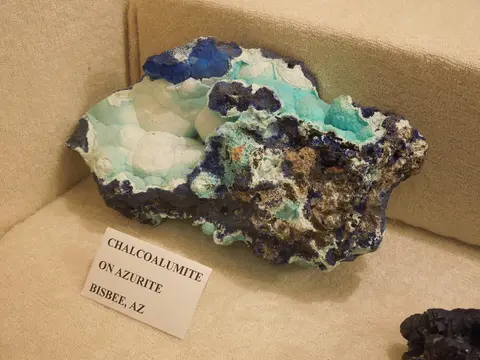
Azurite: 2012 Tucson Gem & Mineral Show 34
2012 Tucson Gem & Mineral Show 34. Photo: Simeon87, CC BY-SA 3.0, via Wikimedia Commons.
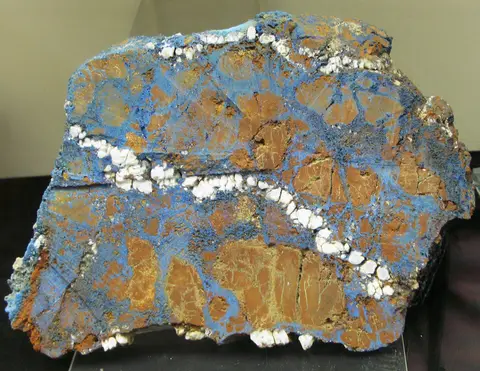
Azurite: Azurit mit Quarzschnüren - Grube Königstiel bei Braubach
Azurit mit Quarzschnüren - Grube Königstiel bei Braubach. Photo: Ra'ike (see also: de:Benutzer:Ra'ike ), CC BY-SA 3.0, via Wikimedia Commons.
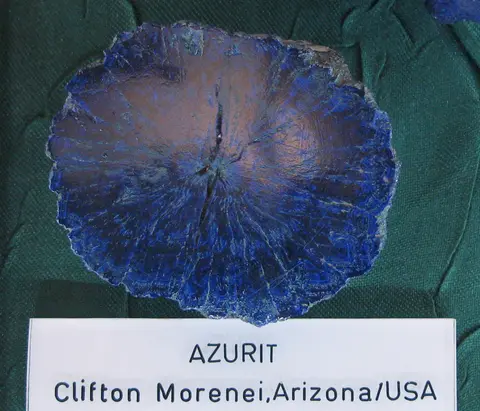
Azurite: Azurit - Clifton Morenei, Arizona, USA
Azurit - Clifton Morenei, Arizona, USA. Photo: Ra'ike (see also: de:Benutzer:Ra'ike ), CC BY-SA 3.0, via Wikimedia Commons.
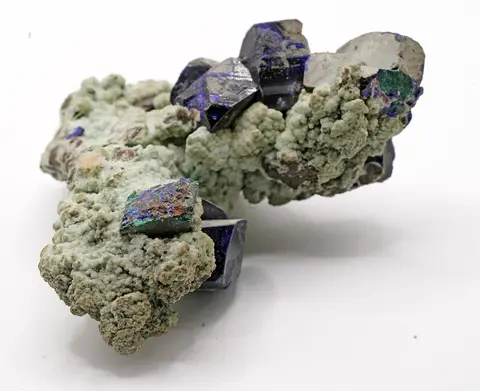
Azurite: 17349,Azurit Malachit Duftit Quarzit,Tsumeb,S.W.Afrika,287g (1)
17349,Azurit Malachit Duftit Quarzit,Tsumeb,S.W.Afrika,287g (1). Photo: Holger Krause, CC BY-SA 4.0, via Wikimedia Commons.

What azurite is worth

Dealer asking prices for azurite, middle half of current listings, checked 2026-11-20. Bar shows the 25th to 75th percentile; the dark tick is the median.
Form and sizeTypical asking priceRange chartMedianListings
Specimens (per piece)$15 to $27$255 from 2 dealers
Cabochons (per carat)$2.97 to $4$3.925 from 1 dealer
over 10 ct$2.97 to $4$3.925 from 1 dealer
Geodes and nodules (per piece)Not enough data (3 listings, need 5)
Show 12 of the listings behind these numbers
Sample dealer listings for Azurite
ListingSizeLocalityAskingSeen
Sparkling Azurite & Malachite Specimen - 2"+
FossilEra
5.1 cm$7
Lustrous Azurite Crystal on Matrix - Morocco
FossilEra
Morocco$15
.9" Deep Blue Azurite Crystal Aggregation - Morocco
FossilEra
Morocco$25
1.15" Deep Blue Azurite Crystal Aggregation - Morocco
FossilEra
2.9 cmMorocco$27
1.29" Vivid Blue Cut/Polished Azurite Nodule - Siberia
FossilEra
3.3 cm$45
Bluebird Azurite with Crysacola 12 carats
Trade Roots
12 ct$48
1.29" Vivid Blue Cut/Polished Azurite Nodule - Siberia
FossilEra
3.3 cm$59
SOLD Bluebird Azurite with Crysacola 22 carats
Trade Roots
22 ct$65
Bluebird Azurite with Crysacola 21 carats
Trade Roots
21 ct$85
Bluebird Azurite with Crysacola 25.5 carats
Trade Roots
25.5 ct$100
Vibrant Blue Azurite Suns on Siltstone - Australia
FossilEra
Australia$115
1.68" Vivid Blue Cut/Polished Azurite Nodule - Siberia
FossilEra
4.3 cm$125

These are dealer asking prices: what shops list azurite for, not what it sells for and not an appraisal. Selling to a dealer usually brings well below retail, because the dealer has to resell it at a margin.

How to identify azurite

Azurite is a deep blue copper carbonate hydroxide, Cu3(CO3)2(OH)2, that forms in the weathered upper zones of copper deposits. It often alters to green malachite and is found with it.

  • Intense azure to deep 'Prussian' blue that no other common mineral matches.
  • Light blue streak on an unglazed porcelain tile.
  • Soft: a steel knife scratches it easily (hardness 3.5 to 4).
  • Heavy for its size: SG about 3.8.
  • Crystals are glassy, often tabular or prismatic and very dark blue; also forms rosettes, nodules, crusts and earthy masses.
  • Commonly found with green malachite, sometimes as malachite pseudomorphs after azurite crystals.

Azurite varieties

Bisbee azurite

Bisbee azurite comes from the Copper Queen and other mines of the Warren district at Bisbee, Arizona, one of the classic copper localities. Same mineral; the Bisbee locality name carries a collector premium for crystals, rosettes and azurite-malachite.

Azurite rose

Azurite roses are rounded rosette aggregates of tabular azurite crystals arranged like petals. A crystal habit of azurite rather than a different material.

Where azurite comes from

Tsumeb, Namibia
Among the finest large, lustrous azurite crystals ever found.
Bisbee, Arizona, USA
Classic American locality for azurite crystals, rosettes and azurite-malachite.
Morenci, Arizona, USA
Azurite and malachite, including banded material for cabochons.
Chessy-les-Mines, near Lyon, France
Historic source of fine crystals; azurite was once called chessylite.
Milpillas mine, Sonora, Mexico
Bright modern crystals and malachite pseudomorphs since the 2000s.
Touissit, Morocco
Lustrous crystal groups.
Anhui Province, China
Modern sources of azurite crystals and balls.
Malbunka mine, Northern Territory, Australia
Flat radiating azurite 'suns' in clay.

Azurite lookalikes

Lapis lazuli

Lapis has gold pyrite flecks and white calcite, and is lighter in the hand (SG 2.7 to 2.9).

  • Hardness 5 to 5.5
  • Rock rather than single mineral
  • Light blue streak like azurite

azurite vs lapis lazuli

Sodalite

Sodalite has a white streak and is much lighter (SG about 2.3).

  • Hardness 5.5 to 6
  • White veins common

Chrysocolla

Chrysocolla is greenish blue, very light (SG about 2) and often sticks to a damp finger.

  • Hardness 2 to 4

Shattuckite

Shattuckite is a paler, more turquoise blue and often fibrous.

  • SG about 4.1

Also mistaken for azurite: vivianite, chalcanthite, cavansite, papagoite.

Fake, dyed and treated azurite

  • Reconstituted azurite-malachite (crushed material in resin)

    Very common

    • Angular fragments in a resin matrix under a loupe
    • Light weight
    • Hot point smells of plastic (destructive)
  • Dyed howlite or magnesite sold as azurite

    Occasional

    • White streak
    • Dye pooled in veins
    • Lower SG (about 2.5 to 3.0)
  • Stabilized azurite with resin

    Common

    • Plastic-like luster
    • Surface feels slightly warm and waxy
    • Common on beads and cabochons because azurite is soft
  • Blue glass sold as azurite crystals

    Rare

    • Too hard to scratch with a knife
    • White streak
    • Bubbles

Is my azurite real? Tests you can do at home

  1. Streak test

    Rub an unseen edge on the back of an unglazed porcelain tile.

    Real
    Light blue streak.
    Fake or lookalike
    Sodalite, dyed howlite and glass give a white streak.

    Can leave a small mark.

  2. Specific gravity

    Weigh dry and suspended in water on a kitchen scale; divide dry weight by the weight gain.

    Real
    About 3.8.
    Fake or lookalike
    Lapis 2.7 to 2.9, sodalite about 2.3, resin composites much lower.
  3. Steel knife scratch

    Draw a knife point lightly across an unseen spot.

    Real
    Scratches easily, leaving a blue powder.
    Fake or lookalike
    Glass and sodalite resist the knife.

    Can leave a small mark.

  4. Loupe

    Examine a polished surface at 10x.

    Real
    Natural crystalline texture or bands, no resin between grains.
    Fake or lookalike
    Reconstituted pieces show fragments floating in resin.

A stone that passes these tests is consistent with natural azurite, not proven. For valuable pieces, a gem lab report settles treatment and origin.

Treatments

Resin stabilization (common)
Makes soft, porous azurite usable in jewelry; acceptable if disclosed but lowers value against untreated material. Loupe, warm waxy feel; lab FTIR.
Reconstitution (common)
Powder or chips bonded in resin; low value. Fragments in matrix under a loupe; low SG.
Waxing or oiling of crystal specimens (occasional)
Restores luster on dull crystals; frowned on by collectors. Greasy feel, residue in crevices.

What moves the price of azurite

  1. Crystal quality. Sharp, lustrous, deep blue crystals with no malachite alteration lead.
  2. Locality. Tsumeb, Bisbee and Chessy specimens carry strong collector premiums.
  3. Size. Large single crystals and big intact rosettes are scarce.
  4. Aesthetics and association. Good contrast with malachite or matrix adds value.
  5. Damage. Azurite is soft; chips and scratches cut value.
  6. Treatment. Natural unstabilized material is worth more than resin-treated or reconstituted.

Care and safety

Azurite is a copper mineral. Handling is fine, but do not inhale dust from cutting or grinding, and wash hands after handling rough material.

Azurite is soft and slowly alters to malachite with humidity. Keep it dry and away from heat, acids and ultrasonic cleaners; dust with a soft brush.

Questions collectors ask about azurite

What is the difference between lapis lazuli and azurite?
Lapis lazuli is a rock made mostly of lazurite with gold pyrite flecks and white calcite; azurite is a copper carbonate. Azurite is softer (3.5 to 4) and noticeably heavier (SG about 3.8 versus 2.7 to 2.9).
What is the difference between malachite and azurite?
Both are copper carbonates and often grow together. Azurite is deep blue with a light blue streak; malachite is green with a green streak and often shows concentric bands.

Sources

Prices: 14 current listings from FossilEra, iRocks (The Arkenstone), Trade Roots, seen 2026-11-20 to 2026-11-20. How we collect prices.