What papagoite is worth
Not enough data. We have not yet seen 5 or more current dealer listings for papagoite in any one form, so we show no range rather than guess.
These are dealer asking prices: what shops list papagoite for, not what it sells for and not an appraisal. Selling to a dealer usually brings well below retail, because the dealer has to resell it at a margin.
How to identify papagoite
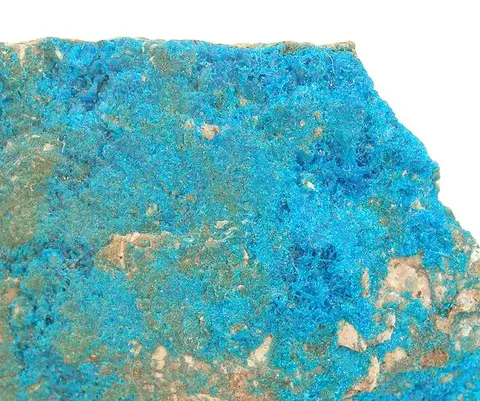
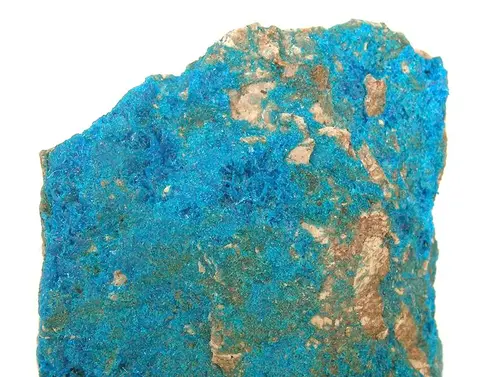
- Strong, pure cerulean to sky blue, brighter and less green than most copper minerals.
- Forms thin crusts, small spherical aggregates or microscopic crystals rather than large crystals.
- Best-known collector form is blue inclusions or phantoms inside clear quartz crystals from Messina, South Africa.
- At Ajo it coats fractures in altered granodiorite with aurichalcite, shattuckite, ajoite and barite.
- Hardness 5 to 5.5, harder than chrysocolla.
Where papagoite comes from
- New Cornelia Mine, Ajo, Pima County, Arizona, USA
- Type locality, described in 1960 and named for the Hia C-ed O'odham (Sand Papago) people; the only US source.
- Messina (Musina) district, Limpopo, South Africa
- Quartz crystals with blue papagoite and blue-green ajoite inclusions, the main source of specimens today.
- Sinclair mine, near Luderitz, Namibia
- Minor occurrence.
Papagoite lookalikes
Ajoite is blue-green to turquoise green; papagoite is a purer, brighter blue.
- Both occur together in Messina quartz and at Ajo
- Ajoite hardness about 3.5
Shattuckite is darker royal blue and usually fibrous or granular.
- SG about 4.1
- Common at Ajo
Chrysocolla is softer, more greenish blue and often dull or earthy.
- Hardness 2 to 4
- SG 1.9 to 2.4
Azurite is deeper blue, forms distinct crystals and is softer at 3.5 to 4.
- SG about 3.8
- Light blue streak
Gem silica is translucent blue chalcedony with no distinct crust or inclusion form.
Fake, dyed and treated papagoite
Ajoite or other blue-green inclusion quartz sold as papagoite
Common
- Green rather than pure blue inclusions
- Seller cannot name the locality
Dyed or blue-filled quartz sold as papagoite quartz
Occasional
- Blue color in surface-reaching cracks only
- Even blue tint through the whole crystal
- Acetone swab picks up color
Chrysocolla or blue chalcedony sold as papagoite
Occasional
- Softness (chrysocolla)
- Translucent body color with no crust structure
Is my papagoite real? Tests you can do at home
-
Loupe on inclusions
Look at the blue areas inside quartz with a 10x loupe.
- Real
- Distinct blue inclusion zones or phantoms sealed inside the crystal.
- Fake or lookalike
- Dye lines following cracks that reach the surface.
-
Acetone swab on cracks
Rub acetone on a cotton swab along surface-reaching cracks.
- Real
- No color transfer.
- Fake or lookalike
- Dyed quartz may leave blue on the swab.
Can leave a small mark.
-
Color comparison in daylight
Compare the blue against a known ajoite or chrysocolla photo or specimen in daylight.
- Real
- Pure, bright cerulean blue.
- Fake or lookalike
- Ajoite and chrysocolla look greener.
A stone that passes these tests is consistent with natural papagoite, not proven. For valuable pieces, a gem lab report settles treatment and origin.
What moves the price of papagoite
- Color intensity. Saturated, bright blue inclusions or crusts are the main factor.
- Host quartz quality. For Messina specimens, clear, well-terminated, undamaged quartz with sharply defined blue zones.
- Locality. Documented Ajo or Messina material; most Messina specimens on the market are older stock.
- Associations. Papagoite with ajoite in the same crystal is attractive to collectors.
- Size. Larger blue areas visible to the eye are uncommon.