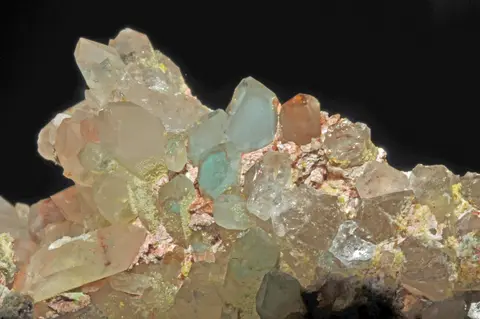
What ajoite is worth
Not enough data. We have not yet seen 5 or more current dealer listings for ajoite in any one form, so we show no range rather than guess.
These are dealer asking prices: what shops list ajoite for, not what it sells for and not an appraisal. Selling to a dealer usually brings well below retail, because the dealer has to resell it at a margin.
How to identify ajoite
- Blue-green to turquoise-green color
- In quartz: blue-green clouds, phantoms or tufts inside clear crystals
- On matrix: tiny bladed crystals or crusts, often with shattuckite or papagoite
- Soft on its own (hardness about 3.5), but protected when enclosed in quartz
- Color is even and soft rather than the patchy bright blue of chrysocolla
Where ajoite comes from
- New Cornelia mine, Ajo, Pima County, Arizona, USA
- The type locality, with crusts and sprays alongside shattuckite and papagoite.
- Messina (Musina) district, Limpopo, South Africa
- Source of quartz crystals with ajoite inclusions and phantoms; the main collector material.
- Wessels mine, Kalahari manganese field, South Africa
- Uncommon ajoite with other copper minerals.
Ajoite lookalikes
Papagoite is a deeper cerulean blue rather than blue-green.
- Also from Ajo and Messina
- Hardness 5 to 5.5
Shattuckite is a darker royal blue and usually fibrous.
- SG about 4.1
- Often occurs with ajoite at Ajo
Chrysocolla is usually a brighter, patchier blue and is the common, far cheaper inclusion.
- Often sold mislabeled as ajoite
- Needs analysis for certainty
Green chlorite in quartz
Chlorite phantoms are olive to dark green, not blue-green.
- Very common inclusion in quartz
- Dull, earthy look
Fake, dyed and treated ajoite
Quartz with chrysocolla, chlorite or other inclusions sold as ajoite
Common
- Color is wrong (olive green or bright patchy blue)
- Locality other than Messina or Ajo
- No reputable source
Dyed crackle quartz sold as ajoite quartz
Occasional
- Color sits in cracks rather than forming phantoms
- Acetone swab picks up color
Is my ajoite real? Tests you can do at home
-
Loupe on inclusions
Examine the quartz with a 10x loupe under strong light.
- Real
- Blue-green clouds, phantoms or tufts suspended inside the crystal.
- Fake or lookalike
- Dye sits in surface-reaching cracks; chlorite looks olive and granular.
-
Acetone swab
Rub a cotton swab dampened with acetone on cracks and surface.
- Real
- Swab stays clean.
- Fake or lookalike
- Dyed quartz may leave color on the swab.
-
Color check
Compare the color in daylight with photos of verified Messina pieces.
- Real
- Soft blue-green to turquoise.
- Fake or lookalike
- Olive green, royal blue or bright patchy blue suggests another mineral.
A stone that passes these tests is consistent with natural ajoite, not proven. For valuable pieces, a gem lab report settles treatment and origin.
Treatments
- Polishing of quartz (common)
- Rough quartz with ajoite is cut and polished into points, spheres and windows; polishing shows inclusions better. Obvious; not a concern for identity.
What moves the price of ajoite
- Inclusion color and amount. Strong, well-defined blue-green phantoms bring the most.
- Clarity of host quartz. Clear quartz showing the inclusions sharply beats cloudy pieces.
- Locality and provenance. Verified Messina or Ajo material is required for top value.
- Natural vs polished. Undamaged natural crystals are favored by mineral collectors; polished pieces sell to a different market.
- Rarity of supply. The Messina mines produced in limited periods, so fine pieces are scarce.