Dealers list lapis lazuli tumbled stones at $145 to $180 per pound.
Prices checked . Page updated .
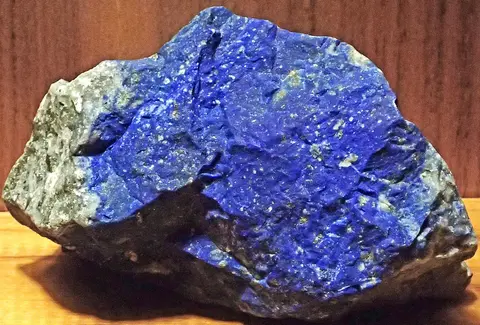
Lapis lazuli in pyritic limestone (Rio Tascadero Limestone, Lower Cretaceous; Flor de los Andes Mine, Andes Mountains, Chile) (49166160572). Photo: James St. John, CC BY 2.0, via Wikimedia Commons.
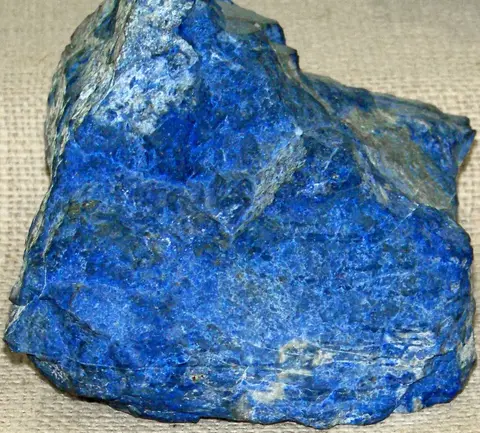
Lapis lazuli (Rio Tascadero Limestone, Lower Cretaceous; Flor de los Andes Mine, Andes Mountains, Chile) (49166048431). Photo: James St. John, CC BY 2.0, via Wikimedia Commons.
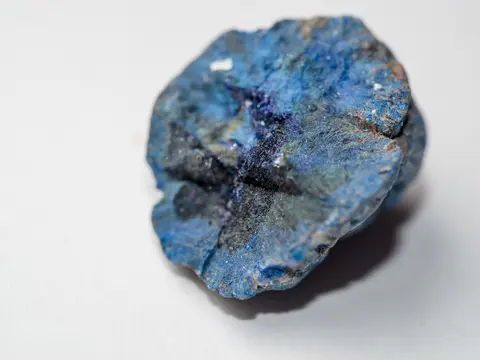
Lapis lazuli (11968672163). Photo: James Petts from London, England, CC BY-SA 2.0, via Wikimedia Commons.
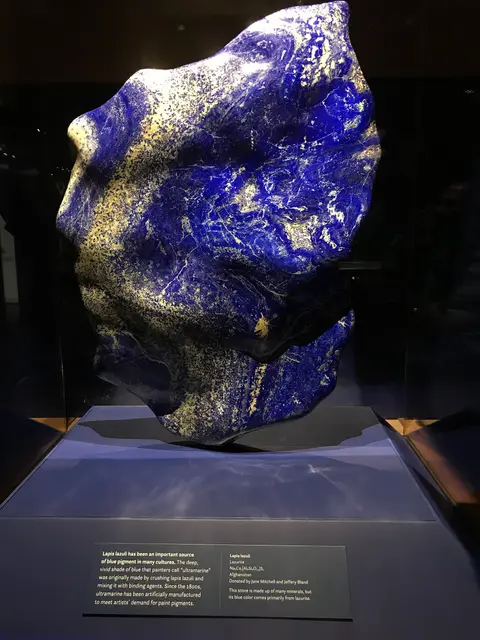
Lapis Lazuli at Natural History Museum Washington D.C. Photo: HappyDonkey64, CC BY-SA 4.0, via Wikimedia Commons.
What lapis lazuli is worth
Dealer asking prices for lapis lazuli, middle half of current listings, checked 2026-11-20. Bar shows the 25th to 75th percentile; the dark tick is the median.
These are dealer asking prices: what shops list lapis lazuli for, not what it sells for and not an appraisal. Selling to a dealer usually brings well below retail, because the dealer has to resell it at a margin.
How to identify lapis lazuli
Lapis lazuli is a deep blue metamorphic rock made mostly of lazurite, a sulfur-bearing sodium calcium aluminosilicate, mixed with white calcite, brassy pyrite and other minerals.
Opaque deep blue to violet blue, often with white calcite patches or streaks
Small brassy gold pyrite flecks scattered irregularly through the stone
Granular texture with no visible crystals; polishes to a waxy to glassy luster
Hardness 5 to 5.5: a steel knife scratches it, but a copper coin does not
Light blue streak on an unglazed porcelain tile
Feels moderately heavy (SG about 2.7 to 2.9), heavier than sodalite
Lapis lazuli varieties
Denim lapis
Denim lapis is a trade name for lighter, faded blue lapis with many white calcite specks, resembling worn denim. It is lower grade lapis with more calcite and lighter color, popular for beads and less expensive jewelry.
Chilean lapis
Chilean lapis is lapis lazuli from the Andes of the Coquimbo Region, Chile, typically lighter blue with abundant white and grey calcite. It usually has more matrix and less deep color than Afghan lapis, and is used widely in carvings and souvenirs.
Afghan lapis
Afghan lapis is lapis lazuli from the Sar-e-Sang mines in Badakhshan, Afghanistan, the historic source of the world's finest lapis. It sets the standard for deep, even violet blue with fine pyrite and little calcite, though Afghan mines also produce lower grades.
Siberian lapis
Siberian lapis comes from the Lake Baikal region of Russia, especially the Sludyanka area. It ranges from medium blue to pale with white matrix and is less commonly seen on the market than Afghan or Chilean lapis.
Where lapis lazuli comes from
Sar-e-Sang, Badakhshan, Afghanistan
Mined for over 6,000 years and still the source of the finest deep violet blue lapis with fine pyrite.
Coquimbo Region, Chile
Andean lapis, usually lighter blue with abundant white and grey calcite.
Lake Baikal region, Siberia, Russia
Lapis from the Sludyanka area, from medium blue to pale, often with white matrix.
Blue concentrated in white calcite areas and cracks
Unnaturally even inky blue
Dyed jasper or quartzite sold as Swiss lapis
Common
No pyrite flecks
Scratches glass easily
Clear quartz grains visible under a loupe where dye is thin
Dyed howlite or magnesite
Common
White streak
Dye rubs off with acetone
Grey web veining showing through
Gilson imitation lapis
Occasional
Lower SG (about 2.35 to 2.45)
Very even color with evenly distributed, angular pyrite
Porous; may absorb water
Reconstituted lapis (powder bonded with resin)
Common
Uniform color with no calcite variation
Tiny resin bubbles under a loupe
Hot point leaves a resin smell (destructive test)
Blue glass with metallic flecks
Occasional
Gas bubbles
Flecks are regular and sparkly, not brassy pyrite
Glassy, cold feel and uniform translucent edges
Sodalite sold as lapis
Occasional
White veining
No pyrite
Lighter weight
Is my lapis lazuli real? Tests you can do at home
Acetone swab for dye
Rub a hidden spot firmly with a cotton swab dampened with acetone nail polish remover.
Real
The swab stays clean.
Fake or lookalike
Dyed lapis, howlite and jasper leave blue on the swab.
Streak test
Rub an unpolished edge across the back of an unglazed porcelain tile.
Real
Light blue streak.
Fake or lookalike
Dyed howlite and jasper leave a white streak.
Can leave a small mark.
Loupe check of pyrite and texture
Examine flecks and white areas with a 10x loupe.
Real
Irregular brassy pyrite grains and natural calcite patches with blue softly blended.
Fake or lookalike
Glass has bubbles and sparkly flakes; reconstituted material shows a uniform paste with resin.
Specific gravity
Weigh the piece in air, then suspended in water on a kitchen scale, and divide weight in air by the weight lost in water.
Real
About 2.7 to 2.9.
Fake or lookalike
Sodalite about 2.2, Gilson imitation about 2.4, dyed howlite about 2.5.
Glass scratch
Try to scratch a glass bottle with an edge of the stone.
Real
Lapis does not readily scratch glass (hardness 5 to 5.5).
Fake or lookalike
Dyed jasper or quartzite scratches glass easily.
Can leave a small mark.
A stone that passes these tests is consistent with natural lapis lazuli, not proven. For valuable pieces, a gem lab report settles treatment and origin.
Treatments
Dyeing (common)
Improves the blue of pale or calcite rich material. Dyed lapis is worth much less than natural top color. Acetone swab and dye concentrated in cracks and calcite areas.
Waxing or oiling (common)
Improves luster and deepens color slightly; widely accepted when light. A hot point near the surface makes wax sweat (destructive); usually lab confirmed.
Resin stabilization (common)
Fills porosity in low grade lapis so it can be cut; reduces value. Resin sheen and lower SG; lab confirmation.
Reconstitution (occasional)
Lapis powder bonded with resin; valued far below solid lapis. Uniform texture and resin bubbles under a loupe.
What moves the price of lapis lazuli
Color. Even, deep violet blue is the top grade; lighter or greenish blue grades much lower.
Calcite content. Little or no white calcite is preferred; heavy calcite mottling lowers value.
Pyrite. Fine, evenly scattered pyrite is accepted or liked; large patches of pyrite or none at all affect taste and price.
Origin. Afghan material sets the standard; Chilean and Siberian lapis usually trade lower except for top pieces.
Treatment. Undyed, unstabilized lapis is worth more than dyed or reconstituted material.
Size and form. Large solid carving blocks and spheres of even color are scarce.
Care and safety
Lapis is soft and porous. Avoid ultrasonic and steam cleaners, household chemicals, perfume and long soaking; clean with a damp cloth and dry it straight away.
Questions collectors ask about lapis lazuli
How do I tell if my lapis lazuli is real?
Real lapis has irregular brassy pyrite flecks, natural white calcite patches and a light blue streak, and an acetone swab stays clean. Dyed fakes stain the swab or leave a white streak, and imitations are lighter in the hand.
Where does lapis lazuli come from?
The most important source is the Sar-e-Sang mines in Badakhshan, Afghanistan, worked for thousands of years. Lapis also comes from Chile, the Lake Baikal region of Russia, Pakistan and Tajikistan.
What is the rarest color of lapis lazuli?
An even, deep violet blue with little white calcite and fine scattered pyrite is the rarest and most valued grade, mostly from Afghanistan. Pale, greenish or calcite heavy lapis is common.
How much is real lapis lazuli worth?
Value depends on color depth, how much calcite is present, origin and whether it is dyed or stabilized; even deep blue Afghan material is worth far more than pale or dyed lapis. See the price table above for current figures.
Does lapis lazuli glow under UV light?
The blue lazurite itself is usually inert, but white calcite areas may glow pinkish or orange under longwave UV. A strong even glow across the blue suggests a different stone, such as sodalite, or a treatment.
Why can't lapis lazuli go in water?
A quick rinse does no harm, but lapis is porous, often waxed or dyed, and contains calcite and pyrite, so long soaking can dull the polish, lift dye and stain or rust pyrite. Wipe it with a damp cloth and dry it.
Sources
Prices: 21 current listings from FossilEra, Kingsley North, Throwin Stones, seen 2026-11-20 to 2026-11-20. How we collect prices.