Blue aventurine vs lapis lazuli
Lapis has gold pyrite flecks and white calcite patches, and is softer (5 to 5.5).
Side by side
| Property | Blue aventurine | Lapis lazuli |
|---|---|---|
| Hardness (Mohs) | 6.5 to 7 | 5 to 5.5 |
| Specific gravity | 2.64 to 2.69 | 2.7 to 2.9 |
| Luster | Vitreous | Dull to vitreous, waxy when polished |
| Streak | White | Light blue |
| Crystal system | Trigonal (quartz), as a granular aggregate | Rock (lazurite is cubic) |
| Cleavage | None | None in the rock |
| Refractive index | 1.54 to 1.55 (spot reading) | About 1.50 |
| Formula | SiO2 with included platelets (fuchsite, hematite, goethite or other minerals) | Rock; main mineral lazurite (Na,Ca)8(AlSiO4)6(SO4,S,Cl)2 |
| Typical dealer asking price | Not enough data | $147 to $182 (tumbled stones) |
How to tell them apart
- SG 2.7 to 2.9
Blue quartz rocks scratch glass easily (hardness 7) and have a glittery or grainy quartz look.
- SG about 2.65
- No pyrite flecks
Photos of each
Blue aventurine
Lapis lazuli
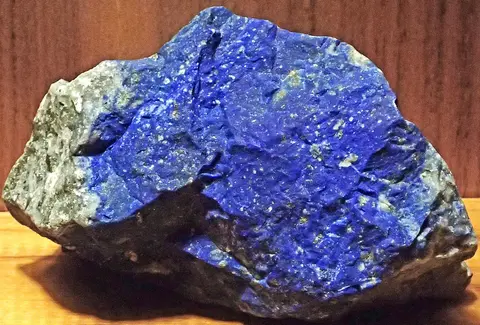

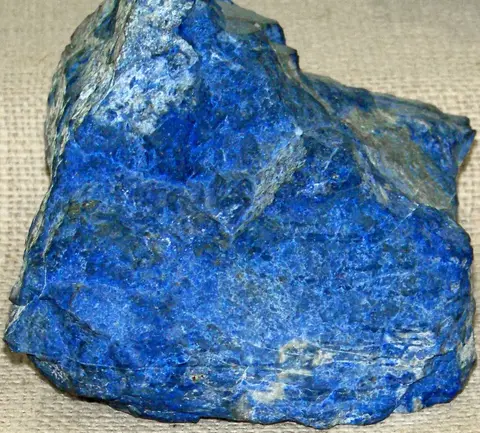

More on each: blue aventurine value and identification and lapis lazuli value and identification.