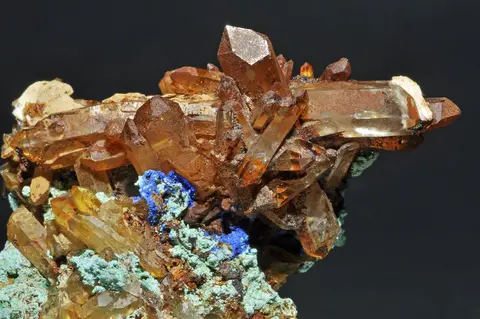
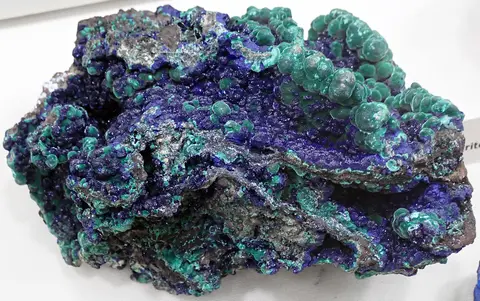
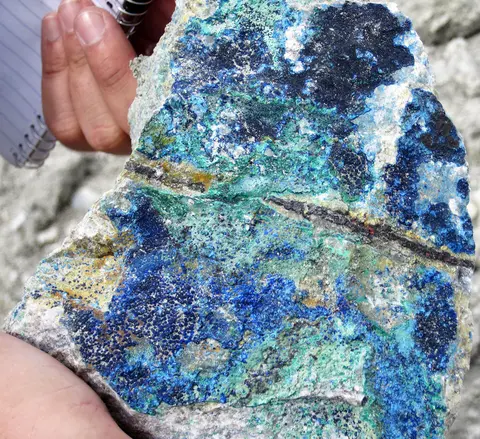
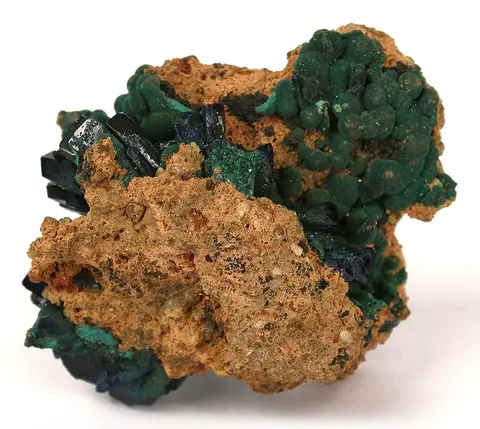
These are dealer asking prices: what shops list azurite malachite for, not what it sells for and not an appraisal. Selling to a dealer usually brings well below retail, because the dealer has to resell it at a margin.
How to identify azurite malachite
It is a mixture of two copper carbonates rather than pure azurite, and is often banded blue and green where azurite has partly altered to malachite. See azurite value for the species as a whole.
Is my azurite malachite real? Tests you can do at home
Specific gravity
Weigh dry and in water.
Real
About 3.7 to 3.9.
Fake or lookalike
Reconstituted and dyed pieces much lower.
Loupe
Examine at 10x.
Real
Natural bands and crystal textures blending into each other.
Fake or lookalike
Angular chips set in resin.
Streak
Rub an unseen edge on unglazed porcelain.
Real
Blue or green streak.
Fake or lookalike
White streak from dyed stone.
Can leave a small mark.
A stone that passes these tests is consistent with natural azurite malachite, not proven. For valuable pieces, a gem lab report settles treatment and origin.
Treatments
Resin stabilization (common)
Standard for jewelry; lowers value somewhat. Lab.
What moves the price of azurite malachite
Natural versus reconstituted. Solid natural material is worth far more.
Color contrast. Sharp deep blue and bright green bands.
Size. Large solid slabs and specimens.
Questions collectors ask about azurite malachite
How much is azurite and malachite worth?
Natural, solid azurite-malachite with strong color contrast is worth much more than reconstituted or heavily stabilized material, and fine crystal specimens from classic localities lead. See the price table above for observed figures.
Sources
Prices: 1 current listings from FossilEra, seen 2026-11-20 to 2026-11-20. How we collect prices.