RockValues

Turquoise value and identification

Dealers list turquoise nuggets at $2.50 to $10 per gram; rough runs about $5 to $17 per gram.

Prices checked . Page updated .

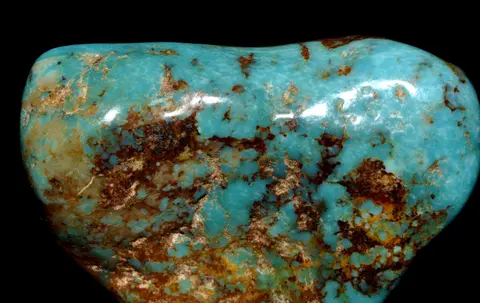
Turquoise: Turquoise polie (USA)
Turquoise polie (USA). Photo: Parent Géry, Public domain, via Wikimedia Commons.
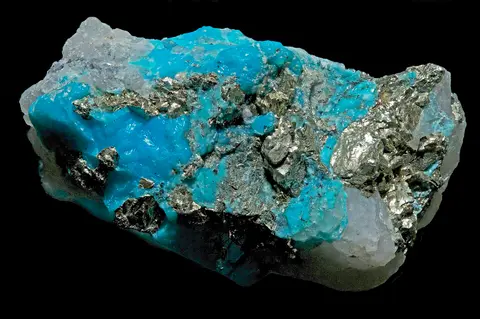
Turquoise: Turquoise, pyrite, quartz 300-4-FS
Turquoise, pyrite, quartz 300-4-FS. Photo: Parent Géry, CC BY-SA 3.0, via Wikimedia Commons.
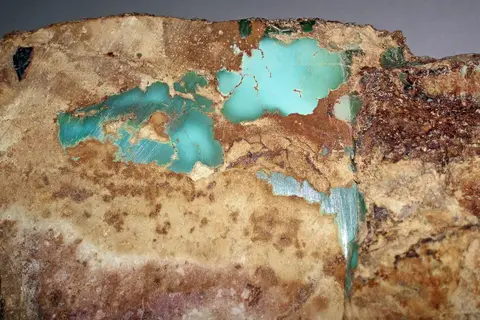
Turquoise: Turquoise (Royston Mining District, northwest of Tonopah, Nevada, USA) - 50968157587
Turquoise (Royston Mining District, northwest of Tonopah, Nevada, USA) - 50968157587. Photo: James St. John, CC BY 2.0, via Wikimedia Commons.
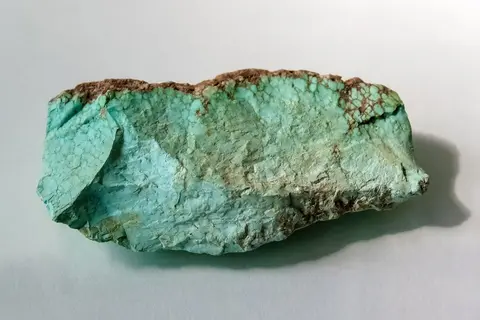
Turquoise: Rough turquoise from Arizona
Rough turquoise from Arizona. Photo: W.carter, CC BY-SA 4.0, via Wikimedia Commons.

What turquoise is worth

Dealer asking prices for turquoise, middle half of current listings, checked 2026-11-20. Bar shows the 25th to 75th percentile; the dark tick is the median.
Form and sizeTypical asking priceRange chartMedianListings
Rough (per gram)$5 to $17$1062 from 1 dealer
Cabochons (per carat)$4.85 to $8.43$6.6749 from 1 dealer
over 10 ct$4.72 to $7.11$5.9138 from 1 dealer
3 to 10 ct$8.11 to $16$8.7511 from 1 dealer
Nuggets (per gram)$2.55 to $10$2.7118 from 2 dealers
Slabs and polished pieces (per piece)$18 to $355$1948 from 2 dealers
Tumbled stones (per pound)Not enough data (2 listings, need 5)
Specimens (per piece)Not enough data (1 listing, need 5)

By variety

Median dealer asking price by variety (rough).
VarietyMedianListings
Sleeping Beauty turquoise$20 per gram9
Kingman turquoise$6.50 per gram8
Number 8 turquoise$10 per gram5
Royston turquoiseNot enough data2
Nevada turquoiseNot enough data1
Show 12 of the listings behind these numbers
Sample dealer listings for Turquoise
ListingSizeLocalityAskingSeen
Number 8 Mine V, Sand
Trade Roots
1 g$1
Sleeping Beauty, B Grade Turquoise Chips
Trade Roots
1 g$1
Turquoise Nuggets, Stabilized Blue
Trade Roots, stabilized
1 g$2
Sleeping Beauty, A Grade Turquoise Chips
Trade Roots
1 g$2
Turquoise Sand Extra Fine
Trade Roots
1 g$2
Turquoise Sand, Mixed Variety Polished
Trade Roots
1 g$2.50
Number 8 Mine IV, Stabilized
Trade Roots, stabilized
1 g$3
Kingman Turquoise, Stabilized Blue Green to Green
Trade Roots, stabilized
1 gKingman$3
Arizona Blue
Trade Roots
1 gUnited States$4
Kingman Turquoise, Stabilized Blue with Light Matrix
Trade Roots, stabilized
1 gKingman$4
Bisbee Blue C Grade
Trade Roots
1 g$4
Candelaria Spiderweb Calcacidrite
Trade Roots
1 g$5

These are dealer asking prices: what shops list turquoise for, not what it sells for and not an appraisal. Selling to a dealer usually brings well below retail, because the dealer has to resell it at a margin.

How to identify turquoise

Turquoise is a hydrous copper aluminum phosphate that forms in the dry, near-surface zone of copper deposits, usually as veins and nuggets rather than visible crystals. Copper gives the blue, iron and zinc push it toward green, and the host rock often stays in the stone as dark or brown matrix.

  • Opaque sky blue to blue-green to apple green, with a waxy to dull luster on rough and a soft polish on cut stones.
  • Matrix, when present, follows real fractures: brown limonite, black chert or iron oxide webbing, or brassy pyrite, set slightly lower or higher than the turquoise on a polished face.
  • Color sits evenly through the stone; it does not pool in cracks or along the edges of the matrix lines.
  • Feels dense for its size but lighter than most metal ores; specific gravity about 2.6 to 2.9.
  • Hardness 5 to 6: a steel needle marks soft, chalky turquoise but struggles on hard, high-grade material.
  • Porous untreated stones darken slightly when wet or when worn against skin for years.
  • Under a loupe, natural turquoise shows a fine granular texture with tiny white specks or rounded spots, not uniform plastic smoothness.

Turquoise varieties

Number 8 turquoise

Turquoise from the Number 8 mine near Carlin, Eureka County, Nevada, known for spiderweb matrix in golden brown to black. A classic Nevada spiderweb turquoise; the mine is no longer producing and documented stones are collected by mine name.

Lone Mountain turquoise

Turquoise from the Lone Mountain mine in Esmeralda County, Nevada, known for hard blue stones, some with fine black spiderweb matrix. A Nevada mine name valued by collectors for hard, natural blue turquoise; the name matters only with provenance.

Carico Lake turquoise

Turquoise from Carico Lake in Lander County, Nevada, best known for bright spring green to lime green color, often with black matrix. Carico Lake is the classic green Nevada turquoise; its color comes from iron and zinc in place of some copper.

Pilot Mountain turquoise

Turquoise from Pilot Mountain, Mineral County, Nevada, ranging from blue to green, often with brown to black matrix. A Nevada mine name known for blue-green material with matrix; collector value depends on documentation.

Egyptian turquoise

Turquoise from the Sinai Peninsula of Egypt, mined at Serabit el-Khadim and Wadi Maghareh since the early dynasties. One of the oldest worked turquoise sources; most stones are greenish blue and the name is sometimes applied loosely to Persian material in old trade usage.

Blue Gem turquoise

Turquoise from the Blue Gem mine near Battle Mountain, Lander County, Nevada, ranging from deep blue to blue-green. An older Nevada mine name valued by collectors; color varies more than in single-color mines.

Fox turquoise

Turquoise from the Fox mine area in Lander County, Nevada, one of Nevada's largest producers, mostly green-blue with matrix. Large production made Fox one of the most common Nevada turquoises in Southwest jewelry; it is greener and more commercial than the scarce mine names.

Nevada turquoise

A broad origin label for turquoise from any of the many small mines in Nevada, historically the leading US producing state. Nevada material tends to be harder and greener on average than Arizona turquoise, with a wide range of matrix types; the label says state, not mine.

Chinese turquoise

Turquoise mined in China, chiefly Hubei, which supplies most of the turquoise sold worldwide today. Quality covers the full range from treated commercial stock to hard natural stones; a large share of 'Chinese turquoise' beads is actually dyed magnesite or howlite.

Candelaria turquoise

Turquoise from the Candelaria district, Mineral and Esmeralda counties, Nevada, known for light to medium blue. A historic Nevada silver district that also produced turquoise sold under the Candelaria name.

Cripple Creek turquoise

Turquoise sold under the name of the Cripple Creek district in Colorado, typically blue-green to green with matrix. A Colorado mine name; production is small and origin claims should be backed by documentation.

Blue Diamond turquoise

Turquoise from the Blue Diamond mine in Nevada, sold by mine name and typically blue to blue-green with matrix. One of many small Nevada mine names; value depends on documentation and grade.

Damele turquoise

Turquoise from the Damele mine near Battle Mountain, Lander County, Nevada, known for light green to yellow-green color with dark web matrix. Damele material often contains faustite and variscite, which shifts the color toward lime and yellow-green rather than blue.

Kingman spiderweb turquoise

Kingman turquoise with a black web of host rock matrix running through the blue. The same Kingman turquoise, distinguished by its spiderweb pattern; much is stabilized and some is color enhanced.

Easter Blue turquoise

A trade and mine name for blue to blue-green Nevada turquoise. Sold by name like other Nevada mines; the name adds value only with documentation.

Godber turquoise

Turquoise from the Godber mine in Lander County, Nevada, known for fine spiderweb matrix in high grades. A small Nevada mine whose best spiderweb pieces are sought by collectors alongside Lander Blue and Number 8.

Royal web turquoise

A trade name used for turquoise with a fine web matrix, sold as Nevada material. Like other web names, it describes a look as much as a mine; ask for documentation of the source.
Where turquoise comes from

Nishapur, Khorasan, Iran
Worked for thousands of years; the source of the even 'Persian blue' color that set the standard for the whole trade.
Arizona, USA
Byproduct of copper mining at Globe (Sleeping Beauty), Kingman, Bisbee and Morenci; each mine has a recognizable color and matrix.
Nevada, USA
Hundreds of small mines (Lander Blue, Number 8, Royston, Carico Lake, Lone Mountain and others), often harder and greener than Arizona material, with collector demand by mine name.
Hubei, China
The largest source in today's market, from pale to deep blue with spiderweb matrix; quality ranges from chalky treated stock to hard natural nuggets.
Sinai Peninsula, Egypt
Mines at Serabit el-Khadim and Wadi Maghareh, worked since early dynastic Egypt; mostly greenish blue.
Cerrillos Hills, New Mexico, USA
Historic Native American source; blue to green material used in pre-Columbian trade across the Southwest and Mexico.

Turquoise lookalikes

Dyed howlite

Scrape or swab a hidden spot: dye sits in the cracks and on the surface, and the core of a chip is white.

  • Hardness 3.5, scratched easily by steel
  • SG 2.5 to 2.6
  • Dark veining is gray and flat, not raised matrix
  • The most common turquoise imitation in beads

turquoise vs howlite

Dyed magnesite

White shows in drill holes and chips, and acetone on a cotton swab often picks up blue.

  • Hardness 3.5 to 4.5
  • SG about 3.0, slightly heavier than turquoise
  • Porous, takes dye in an even candy blue
  • Matrix lines are often dyed black or brown along cracks

Chrysocolla

Much softer: a fingernail or copper coin can mark pure chrysocolla, and it often shows bright cyan with brown or black streaks of other copper minerals.

  • Hardness 2 to 4 unless silicified
  • SG 1.9 to 2.4, lighter in hand
  • Often occurs with malachite and azurite

chrysocolla vs turquoise

Variscite

Variscite is green to apple green with no copper blue, and its matrix in Utah nodules is often yellow crandallite or brown wardite.

  • Hardness 3.5 to 4.5
  • SG about 2.57
  • RI 1.56 to 1.59, lower than turquoise
  • Sold with turquoise as 'variquoise' when the two are mixed

Larimar

Larimar shows white and blue patterns like light on water and a fibrous, silky texture; turquoise is granular.

  • Larimar is blue pectolite from the Dominican Republic
  • Hardness 4.5 to 5
  • Translucent in thin areas

larimar vs turquoise

Amazonite

Amazonite shows white streaks and flat cleavage flashes under light; turquoise has no flashing cleavage planes.

  • Hardness 6 to 6.5
  • SG about 2.56
  • Glassy to pearly luster, translucent edges

amazonite vs turquoise

Malachite

Malachite is a deeper green with concentric light and dark bands; turquoise does not band like that.

  • Hardness 3.5 to 4
  • SG 3.6 to 4.0, clearly heavier

malachite vs turquoise

Also mistaken for turquoise: lander blue turquoise, royston turquoise, lapis lazuli, gem silica, hemimorphite.

Fake, dyed and treated turquoise

  • Dyed howlite or magnesite sold as turquoise

    Very common

    • White core visible at drill holes, chips or on a scratch
    • Color concentrated in cracks and along matrix lines
    • Blue rubs off on an acetone swab
    • Too even, candy-bright color at a low price
  • Resin or plastic 'block' turquoise

    Very common

    • Feels warm and light in the hand
    • Mold seams, flow lines or bubbles under a loupe
    • A hot needle sinks in and smells of burnt plastic (destructive)
    • Repeating matrix pattern across many beads
  • Reconstituted turquoise (powder and chips bonded with resin)

    Common

    • Angular chips of different blues packed together under a loupe
    • Uniform granular texture with no natural veining
    • Often sold as 'block' or 'compressed' in cheap jewelry
  • Matrix composites and blended material, including turquoise chips set in dyed resin or with added metallic veins

    Common

    • Metallic or purple lines with perfectly sharp edges
    • Resin fills between pieces that shine differently from the turquoise
    • Sold under trade names rather than mine names
  • Gilson created turquoise and other manufactured turquoise

    Occasional

    • Under magnification, fine dark angular particles in a lighter ground
    • Very uniform color batch to batch
    • Lab testing (FTIR) separates it
  • 'African turquoise' (dyed jasper or chert)

    Common

    • Not turquoise at all; a green-blue speckled jasper
    • Hardness about 7, scratches glass
    • Brown and black spots in a mottled green base
  • Glass and ceramic imitations

    Occasional

    • Bubbles or swirl marks under a loupe
    • Glassy luster on chips with sharp conchoidal fracture
    • Too heavy and cold for a resin fake, too glossy for turquoise

Is my turquoise real? Tests you can do at home

  1. Acetone swab for dye

    Rub a cotton swab with nail polish remover on a hidden spot such as a drill hole or the back of a cabochon for 20 seconds.

    Real
    Natural turquoise leaves the swab clean.
    Fake or lookalike
    Dyed howlite, magnesite or treated turquoise often leaves blue or green on the cotton.

    Can leave a small mark.

  2. Loupe inspection at drill holes and chips

    Look at drill holes, chips and the matrix lines with a 10x loupe.

    Real
    Color is the same at the surface and inside the hole; matrix is natural rock with its own texture.
    Fake or lookalike
    White interior on dyed stones, bubbles or flow lines on plastic, chips in resin on reconstituted material.
  3. Steel needle scratch on a hidden spot

    Press a steel needle or knife point lightly on the back of the stone and pull.

    Real
    Hard natural turquoise resists or shows only a faint line; soft chalky turquoise may mark.
    Fake or lookalike
    Howlite, magnesite and plastic take an easy, deep scratch; plastic may curl.

    Can leave a small mark.

  4. Hot needle test

    Heat a needle in a lighter flame, keep the stone well away from your face, and touch it to the back of the stone for a second.

    Real
    Natural untreated turquoise is not affected by a brief touch; stabilized turquoise may smell faintly of resin.
    Fake or lookalike
    Plastic melts, leaves a pit and gives off an acrid plastic smell.

    Damages the stone: test only an inconspicuous spot or a piece you do not mind marking.

  5. Weight and warmth in the hand

    Hold the piece next to a stone of known identity and similar size.

    Real
    Turquoise feels moderately dense and cool at first touch.
    Fake or lookalike
    Plastic feels light and warms quickly; magnesite feels a little heavier.

A stone that passes these tests is consistent with natural turquoise, not proven. For valuable pieces, a gem lab report settles treatment and origin.

Treatments

Stabilization (resin impregnation) (almost always)
Porous turquoise is soaked with clear epoxy or plastic so it can be cut, polished and worn without crumbling or changing color. Most turquoise on the market is stabilized; it is acceptable when disclosed but valued below natural, untreated stones of the same look. Labs use FTIR to find the resin. At home, a hot needle may give a resin smell; unusually glassy polish on soft-looking material is a hint.
Dyeing (common)
Adds or deepens blue in pale or chalky turquoise, and is often combined with stabilization. Dyed turquoise is worth far less than stones with natural color. Acetone swab picks up color; color concentrated in cracks and around matrix under a loupe.
Zachery treatment (occasional)
A proprietary process that hardens medium-grade turquoise and improves color with little visible change. It lowers value against natural stones but is hard to spot. Lab only; potassium shows up in chemical analysis. Not detectable at home.
Waxing and oiling (common)
A surface treatment that deepens color and improves luster temporarily; considered minor but can fade with heat and cleaning. A hot needle near the surface may sweat wax; color lightens after gentle warming or with time.
Backing (common)
Thin slabs are glued to epoxy or steel backing to strengthen them for inlay; standard practice and affects value little when disclosed. Visible black or gray layer on the back of loose stones.

What moves the price of turquoise

  1. Natural vs treated. Natural, untreated turquoise with no stabilization or dye is the top category; stabilized and dyed stones sit well below.
  2. Mine of origin. Documented stones from closed or small American mines such as Lander Blue, Number 8 and Bisbee carry a large premium over unattributed material.
  3. Color. Even, saturated blue is preferred in most markets; fine greens from certain Nevada mines also sell well to collectors.
  4. Hardness and polish. Hard, gem-grade turquoise that takes a glossy polish without treatment is worth much more than soft, chalky stone.
  5. Matrix. Fine, even spiderweb matrix adds value; blotchy or crumbly matrix lowers it.
  6. Size. Large clean nuggets and cabochons of high grade are scarce.
  7. Jewelry maker and age. In finished pieces, the silversmith, hallmark and age can matter as much as the stone.

Care and safety

Porous and soft: keep it away from oils, perfume, hand cream, cleaning chemicals and ultrasonic cleaners. Wipe with a damp cloth and let it dry; do not soak it. Strong heat or long sun on a hot dashboard can change color.

Questions collectors ask about turquoise

How do you test for turquoise at home?
Check drill holes and chips with a loupe for white cores or bubbles, swab a hidden spot with acetone to look for dye, and try a light steel needle scratch on the back. Plastic and dyed howlite fail one of these quickly; separating stabilized from natural turquoise needs a lab.
What is the tongue test for turquoise?
It is a folk test claiming porous natural turquoise sticks slightly to the tongue. It is unreliable, since stabilized turquoise and many fakes behave the same way, and putting stones in your mouth is not a safe habit; use a loupe and acetone swab instead.
Why can't turquoise get wet?
Natural turquoise is porous, so water carrying soap, skin oil or chemicals soaks in and can change its color over time. A quick wipe with a damp cloth is fine; soaking, swimming and dishwashing with it on are what cause damage.
What stone is mistaken for turquoise?
Dyed howlite and dyed magnesite are the most common, followed by chrysocolla, variscite, amazonite and plastic. A white core in chips or blue on an acetone swab gives away the dyed ones.
Jade vs turquoise: how do they differ?
Jade is translucent at thin edges, tough and green to many colors, with a hardness near 6 to 7; turquoise is opaque, sky blue to green and porous. Jade has no brown or black spiderweb matrix.
How much is real turquoise worth?
Value depends on whether it is natural or stabilized, the mine of origin, color, hardness and matrix pattern; documented untreated stones from famous closed mines sit at the top. See the price table above for current observed prices.

Sources

Prices: 154 current listings from FossilEra, Throwin Stones, Trade Roots, seen 2026-11-20 to 2026-11-20. How we collect prices.