Howlite vs turquoise
Natural turquoise is blue to green throughout; dyed howlite shows white where chipped or drilled.
Side by side
| Property | Howlite | Turquoise |
|---|---|---|
| Hardness (Mohs) | 3 to 3.5 | 5 to 6 |
| Specific gravity | 2.45 to 2.58 | 2.6 to 2.9 |
| Luster | Subvitreous to dull, earthy in rough | Waxy to subvitreous; dull on porous material |
| Streak | White | White to pale greenish blue |
| Crystal system | Monoclinic | Triclinic (crystals are microscopic; normally massive) |
| Cleavage | None | Perfect and good in two directions, not seen in massive material |
| Refractive index | 1.61 to 1.65 (spot reading about 1.61) | |
| Formula | Ca2B5SiO9(OH)5 | CuAl6(PO4)4(OH)8·4H2O |
| Typical dealer asking price | Not enough data | $5 to $17 (rough) |
How to tell them apart
- Turquoise hardness 5 to 6
- SG 2.6 to 2.9
Scrape or swab a hidden spot: dye sits in the cracks and on the surface, and the core of a chip is white.
- Hardness 3.5, scratched easily by steel
- SG 2.5 to 2.6
- Dark veining is gray and flat, not raised matrix
- The most common turquoise imitation in beads
Photos of each
Howlite
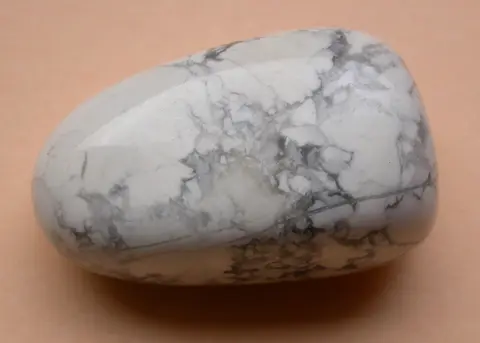

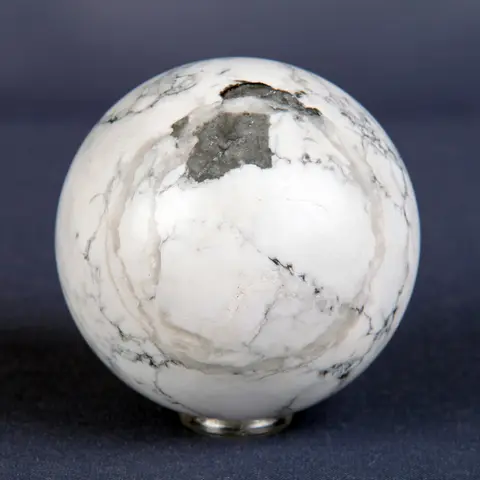

Turquoise
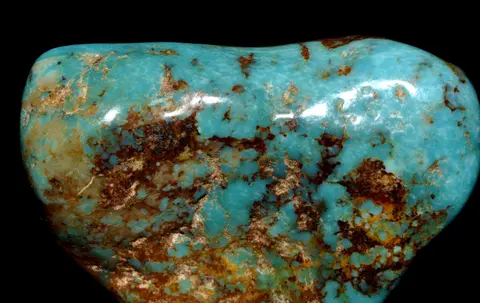

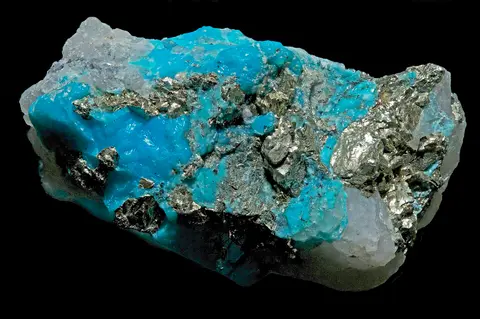

More on each: howlite value and identification and turquoise value and identification.