RockValues

Howlite value and identification

Howlite is a calcium borosilicate hydroxide (Ca2B5SiO9(OH)5), usually found as white chalky nodules with gray to black veining. It is porous and takes dye easily, so it is widely dyed to imitate turquoise and other stones.

Prices checked . Page updated .
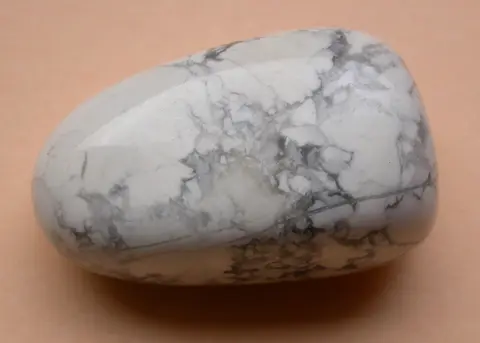
Howlite: Howlite - tumble polished stone
Howlite - tumble polished stone. Photo: Ra'ike (see also: de:Benutzer:Ra'ike ), CC BY 3.0, via Wikimedia Commons.
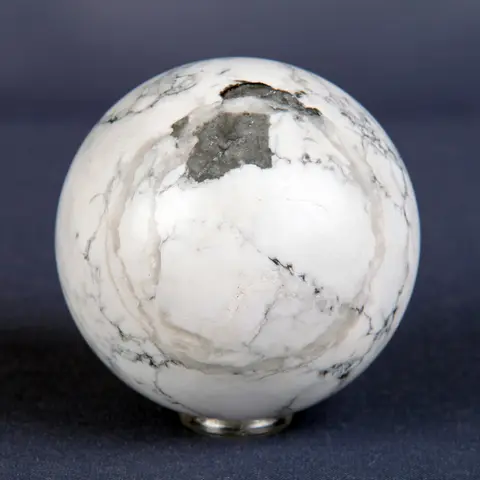
Howlite: Howlite sphere
Howlite sphere. Photo: AlexeiAVA, CC BY 4.0, via Wikimedia Commons.
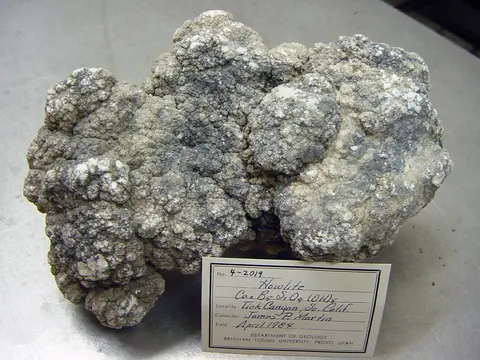
Howlite: Howlite-BYU
Howlite-BYU. Photo: Unknown author (public domain), Public domain, via Wikimedia Commons.

What howlite is worth

Not enough data. We have not yet seen 5 or more current dealer listings for howlite in any one form, so we show no range rather than guess.

Show 8 of the listings behind these numbers
Sample dealer listings for Howlite
ListingSizeLocalityAskingSeen
Large Tumbled White Howlite Stones
FossilEra
$4
Polished White Howlite Worry Stones - 1.5" Size
FossilEra
3.8 cm$5
1.7" Polished White Howlite Pocket Stone
FossilEra
4.3 cm$7
1.5" Polished White Howlite Heart
FossilEra
3.8 cm$9
Howlite, Tumbling Rough, per lb (Per Pound)
The Gem Shop
5.1 cm$12
Howlite, Tumbling Rough, 5 lb lot (Per Lot)
The Gem Shop
5.1 cm$30
3.6" Polished Tick Canyon Howlite Nodule - California
FossilEra
9.1 cmCalifornia$79
3.3" Polished Tick Canyon Howlite Nodule - California
FossilEra
8.4 cmCalifornia$79

These are dealer asking prices: what shops list howlite for, not what it sells for and not an appraisal. Selling to a dealer usually brings well below retail, because the dealer has to resell it at a margin.

How to identify howlite

  • White to gray-white with a fine web of gray, brown or black veins.
  • Porous, chalky texture in rough nodules; dull to subvitreous polish.
  • Soft: a steel knife scratches it easily (Mohs 3 to 3.5).
  • Light for its size (SG about 2.5).
  • Usually opaque; thin edges may be faintly translucent.
  • Natural howlite is never blue; blue, green or bright colored howlite is dyed.

Where howlite comes from

Nova Scotia, Canada
Type locality near Windsor, where the mineral was described in 1868 and named for the chemist Henry How.
Southern California, USA
Borate deposits such as Tick Canyon in Los Angeles County produced well-known howlite nodules.

Howlite lookalikes

Magnesite

Magnesite is harder and heavier and is often sold as howlite.

  • Magnesite hardness 3.5 to 4.5
  • SG about 3.0
  • Similar white with gray veins

Turquoise

Natural turquoise is blue to green throughout; dyed howlite shows white where chipped or drilled.

  • Turquoise hardness 5 to 6
  • SG 2.6 to 2.9

turquoise vs howlite

White marble

Marble shows sugary crystals and fizzes in acid.

  • Hardness 3
  • Granular texture

Dalmatian stone

Dalmatian stone has distinct black spots, not veins, and is harder.

  • Igneous rock, mostly feldspar and quartz

Also mistaken for howlite: sleeping beauty turquoise, dry creek turquoise, red jasper, dalmatian jasper, zebra jasper.

Fake, dyed and treated howlite

  • Magnesite sold as howlite

    Very common

    • Slightly heavier and harder
    • Very hard to tell at home; much commercial howlite is magnesite
  • Dyed howlite sold as turquoise

    Very common

    • White shows in drill holes and chips
    • Dye pools in the dark veins
    • Acetone swab may turn blue
  • Dyed howlite sold as lapis, coral or other stones

    Common

    • White core under the surface
    • Color in cracks
  • Plastic or resin howlite beads

    Occasional

    • Very light and warm
    • Mold seams
    • Repeating vein pattern

Is my howlite real? Tests you can do at home

  1. Drill hole check

    Look inside drill holes and at chips with a loupe.

    Real
    White throughout.
    Fake or lookalike
    Dyed howlite shows a white core under blue or another color; plastic shows smooth molded holes.
  2. Acetone swab

    Rub a cotton swab with acetone on the back or a drill hole.

    Real
    Plain white howlite leaves no color.
    Fake or lookalike
    Dyed howlite often leaves blue, green or red on the swab.
  3. Knife scratch

    Try a steel knife on an inconspicuous spot.

    Real
    Howlite scratches easily.
    Fake or lookalike
    Turquoise resists more; magnesite is slightly harder; dalmatian stone resists entirely.

    Can leave a small mark.

  4. Weight and temperature

    Hold beads in your palm for a few seconds.

    Real
    Cool and moderately heavy.
    Fake or lookalike
    Plastic feels light and warms quickly.

A stone that passes these tests is consistent with natural howlite, not proven. For valuable pieces, a gem lab report settles treatment and origin.

Treatments

Dyeing (common)
Turns howlite into turquoise, lapis or coral imitations; worth little and must be disclosed. White core, color in veins, acetone swab.
Waxing or resin coating (common)
Seals porous beads and improves polish. Plastic-like surface feel.

What moves the price of howlite

  1. Whiteness. Clean white body with crisp contrasting veins.
  2. Pattern. Even, attractive web veining.
  3. Size. Large clean nodules for carving.
  4. Natural material. Genuine howlite is inexpensive; dyed and magnesite substitutes are cheaper still.
  5. Finish. Good polish on carvings and beads.

Care and safety

Porous and soft: avoid oils, perfumes and dyes that can stain it, and store away from harder stones.

Questions collectors ask about howlite

Turquoise vs howlite: how do you tell them apart?
Natural howlite is white with gray veins and is never blue, so blue howlite is dyed. Dyed howlite shows white in drill holes and chips, often leaves color on an acetone swab, and is softer than turquoise.

Sources

Prices: 8 current listings from FossilEra, The Gem Shop, seen 2026-11-20 to 2026-11-20. How we collect prices.