RockValues

Magnesite value and identification

Dealers list magnesite slabs and polished pieces at $19 to $57.

Prices checked . Page updated .
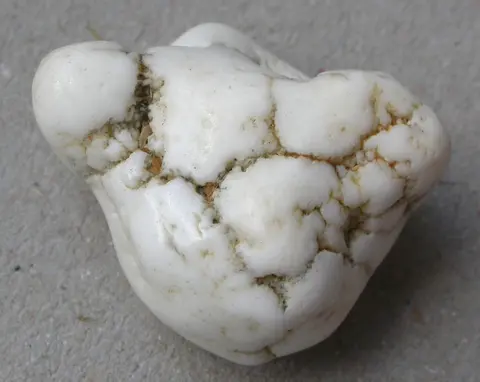
Magnesite: MagnesiteSaxe
MagnesiteSaxe. Photo: Didier Descouens, CC BY-SA 4.0, via Wikimedia Commons.
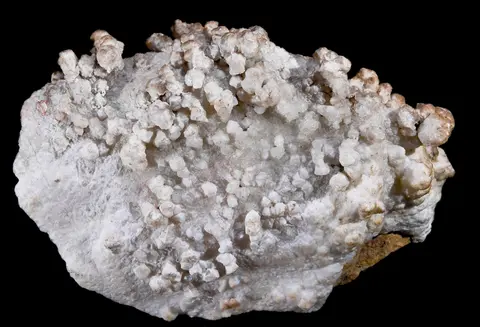
Magnesite: Magnesite-tumble polished stone
Magnesite-tumble polished stone. Photo: Ra'ike (see also: de:Benutzer:Ra'ike ), CC BY 2.5, via Wikimedia Commons.
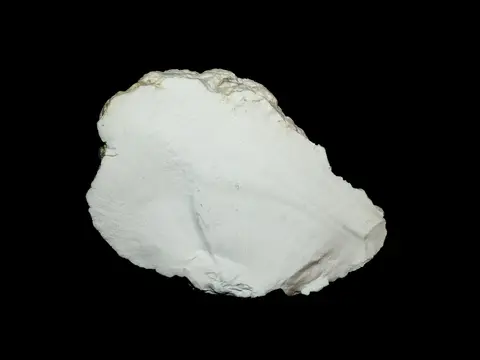
Magnesite: Magnesite nodule from Bernartice, Czech Republic
Magnesite nodule from Bernartice, Czech Republic. Photo: Zbynek Burival, CC BY-SA 4.0, via Wikimedia Commons.
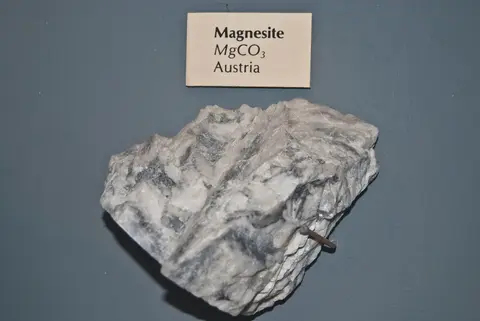
Magnesite: Magnesite Austria
Magnesite Austria. Photo: Cs california, CC BY-SA 3.0, via Wikimedia Commons.

What magnesite is worth

Dealer asking prices for magnesite, middle half of current listings, checked 2026-11-20. Bar shows the 25th to 75th percentile; the dark tick is the median.
Form and sizeTypical asking priceRange chartMedianListings
Slabs and polished pieces (per piece)$19 to $57$346 from 1 dealer
Carvings and shapes (per piece)Not enough data (4 listings, need 5)
Spheres (per piece)Not enough data (3 listings, need 5)
Show 12 of the listings behind these numbers
Sample dealer listings for Magnesite
ListingSizeLocalityAskingSeen
1.7" Polished Pinolite Palm Stone - Austria
FossilEra
4.3 cmAustria$12
2.2" Polished Pinolite Palm Stone - Austria
FossilEra
5.6 cmAustria$15
1.7" Polished Wild Horse Magnesite Section - Arizona
FossilEra
4.3 cmArizona$19
2.25" Polished Wild Horse Magnesite Slice - Arizona
FossilEra
5.7 cmArizona$19
1.9" Polished Wild Horse Magnesite Slice - Arizona
FossilEra
4.8 cmArizona$19
2.6" Polished Pinolite Palm Stone - Austria
FossilEra
6.6 cmAustria$19
2.4" Polished Pinolite Palm Stone - Austria
FossilEra
6.1 cmAustria$23
1.6" Polished Pinolite Sphere - Austria
FossilEra
4.1 cmAustria$25
5.65" Polished Magnesite Section - Western Australia
FossilEra
14.4 cmWestern Australia$49
1.95" Polished Pinolite Pendant (Necklace) - 925 Sterling Silver
FossilEra
5 cm$55
4.6" Polished Magnesite Section - Western Australia
FossilEra
11.7 cmWestern Australia$59
4.6" Polished Wild Horse Magnesite Slab - Arizona
FossilEra
11.7 cmArizona$65

These are dealer asking prices: what shops list magnesite for, not what it sells for and not an appraisal. Selling to a dealer usually brings well below retail, because the dealer has to resell it at a margin.

How to identify magnesite

Magnesite is magnesium carbonate (MgCO3), a calcite-group mineral mined as the main ore of magnesia for refractories. Most of it is white, chalky to porcelain-like masses; transparent crystals are rare collector pieces, and porous white magnesite is widely dyed to imitate turquoise.

  • Massive form is bright white to gray, dense and porcelain-like, often in nodular cauliflower shapes with a dull to faintly glossy surface.
  • Crystals, when present, are rhombohedrons, colorless to yellow or brown, with perfect rhombohedral cleavage.
  • Harder than calcite (about 4): a fingernail and a copper coin will not scratch it, but a steel knife will.
  • Does not fizz in household vinegar at room temperature, unlike calcite.
  • Feels a little heavier than howlite or chalk (SG about 3.0).
  • Massive material often contains a fine network of darker veins, which is why it is easily mistaken for howlite.

Where magnesite comes from

Brumado, Bahia, Brazil
Source of the best transparent colorless to pale yellow rhombohedral crystals, the main collector material.
Liaoning, China
One of the world's largest magnesite mining districts, supplying industrial ore and much of the massive white material used for beads.
Styria, Austria
Historic crystalline magnesite deposits such as Veitsch, important in industry.
Euboea, Greece
Major deposits of white cryptocrystalline magnesite in serpentinite.
California and Nevada, USA
Massive white magnesite veins in serpentinite and sedimentary deposits.

Magnesite lookalikes

Howlite

Howlite is lighter in the hand and slightly softer; the two are hard to tell apart by eye and both are dyed as turquoise imitations.

  • Howlite SG about 2.5 vs 3.0
  • Howlite hardness about 3.5
  • Howlite is a calcium borosilicate

Calcite

Calcite fizzes in vinegar and is scratched by a copper coin; magnesite does not fizz and resists the coin.

  • Calcite hardness 3
  • Calcite SG 2.71

Dolomite

Dolomite fizzes weakly in vinegar when powdered; magnesite barely reacts even then.

  • Dolomite SG 2.85
  • Crystals often curved, saddle-shaped

Magnetite

Only the names are similar: magnetite is black, metallic and strongly magnetic, while magnesite is white and nonmagnetic.

  • Magnetite SG 5.2
  • Magnetite hardness 5.5 to 6.5
  • Black streak

magnesite vs magnetite

Also mistaken for magnesite: turquoise, sleeping beauty turquoise, kingman turquoise, tibetan turquoise, persian turquoise, dry creek turquoise, hubei turquoise, variscite.

Fake, dyed and treated magnesite

  • Dyed magnesite sold as turquoise

    Very common

    • Dye concentrated in veins and cracks
    • Color on an acetone swab
    • Bright white inside drill holes or chips
    • Even, saturated blue or green in cheap beads
  • Magnesite sold as white turquoise

    Common

    • Turquoise is blue to green; bright white beads sold as white turquoise are usually magnesite or howlite
    • Does not fizz in vinegar, unlike calcite fillers
    • SG about 3.0
  • Dyed magnesite sold as other gems (lapis, coral, sugilite, malachite)

    Common

    • Knife scratches it
    • Acetone swab picks up dye
    • White core at drill holes

Is my magnesite real? Tests you can do at home

  1. Vinegar test

    Put a drop of household vinegar on a hidden spot and watch closely with a loupe.

    Real
    No fizzing at room temperature.
    Fake or lookalike
    Calcite fizzes clearly; dolomite fizzes weakly when scratched to powder.

    Can leave a small mark.

  2. Copper coin and knife scratch

    Try to scratch a hidden spot with a copper coin, then with a steel knife.

    Real
    Coin does not scratch it; knife does.
    Fake or lookalike
    Calcite is scratched by the coin; chalk by a fingernail.

    Can leave a small mark.

  3. Acetone swab for dye

    Rub a swab soaked in acetone on a drill hole or hidden spot.

    Real
    Natural white magnesite leaves no color.
    Fake or lookalike
    Dyed magnesite sold as turquoise or other gems often leaves blue or green on the swab.
  4. Magnet test

    Bring a magnet close to the piece.

    Real
    No attraction.
    Fake or lookalike
    Magnetite is strongly attracted.

A stone that passes these tests is consistent with natural magnesite, not proven. For valuable pieces, a gem lab report settles treatment and origin.

Treatments

Dyeing (common)
Used to make imitations of turquoise and other gems; the dyed product has low value. Acetone swab, dye in cracks and white core at drill holes.
Resin stabilization (common)
Strengthens porous material before dyeing and polishing. Plastic-like luster; lab testing.

What moves the price of magnesite

  1. Crystal form and transparency. Transparent, sharp rhombohedral crystals from Brumado are the most collected.
  2. Size. Larger clear crystals are uncommon.
  3. Color. Colorless to pale yellow crystals; massive white material has low value.
  4. Damage. Cleavage makes edges chip easily; undamaged crystals bring more.
  5. Associations. Crystals with quartz or on matrix add interest.

Sources

Prices: 14 current listings from FossilEra, seen 2026-11-20 to 2026-11-20. How we collect prices.