


Turquoise
Turquoise has copper blue tones and higher RI; variscite stays green to blue-green.
- Turquoise hardness 5 to 6
- RI 1.61 to 1.65
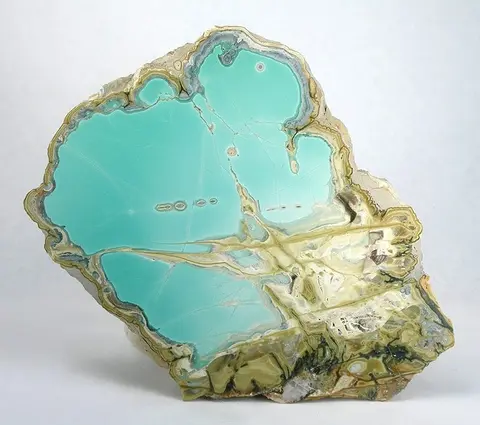
Dealers list variscite slabs and polished pieces at $105 to $345.
Prices checked . Page updated .
| Form and size | Typical asking price | Range chart | Median | Listings |
|---|---|---|---|---|
| Slabs and polished pieces (per piece) | $103 to $343 | $150 | 6 from 1 dealer | |
| Rough (per gram) | Not enough data (4 listings, need 5) | |||
| Cabochons (per carat) | Not enough data (3 listings, need 5) | |||
| Tumbled stones (per pound) | Not enough data (1 listing, need 5) | |||
| Listing | Size | Locality | Asking | Seen |
|---|---|---|---|---|
| Australian Variscite Trade Roots | 1 g | $2 | ||
| Nevada Green Variscite Trade Roots | 1 g | United States | $3 | |
| Utah Green Variscite Trade Roots | 1 g | United States | $3 | |
| Broken Arrow Variscite Trade Roots | 1 g | $5 | ||
| Broken Arrow Varacite 16.5 carats Trade Roots | 16.5 ct | $65 | ||
| 3.1" Polished Section Of Clay Canyon Variscite - Old Collection Stock FossilEra | 7.9 cm | $79 | ||
| Broken Arrow Varacite 17 carats Trade Roots | 17 ct | $85 | ||
| 3.3" Polished Pastel Green Variscite Section - Amatrice Hill, Utah FossilEra | 8.4 cm | Amatrice Hill, Utah | $99 | |
| Broken Arrow Varacite 28 carats Trade Roots | 28 ct | United States | $110 | |
| 4.4" Polished Aluminum Phosphate (Variscite) Section - Australia FossilEra | 11.2 cm | Australia | $115 | |
| 4.5" Polished Variscite Section - Australia FossilEra | 11.4 cm | Australia | $185 | |
| 3.8" Polished Pastel Green Lucin Variscite (205.1 g) - Utah FossilEra | 9.7 cm | Utah | $195 |
These are dealer asking prices: what shops list variscite for, not what it sells for and not an appraisal. Selling to a dealer usually brings well below retail, because the dealer has to resell it at a margin.
Variscite is a hydrated aluminum phosphate (AlPO4·2H2O) that forms green nodules and veins where phosphate-rich water alters aluminum-rich rock. It is cut into cabochons and often confused with turquoise, but contains no copper.
Turquoise has copper blue tones and higher RI; variscite stays green to blue-green.
Chrysoprase is harder (about 7) and scratches glass; variscite does not.
Jadeite is much heavier (SG about 3.33) and harder.
White core and dye in cracks.
Chrysocolla is bluer and softer, often with copper staining.
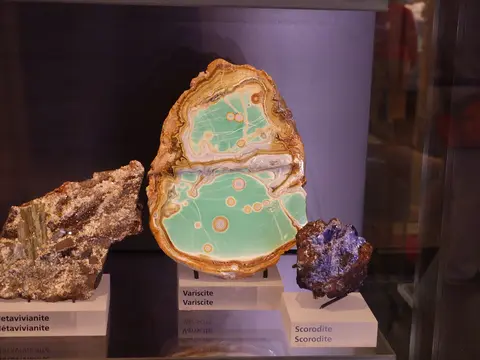
Also mistaken for variscite: royston turquoise, wavellite, scorodite.
Occasional
Common
Rare
Try to scratch a glass bottle with a sharp edge of the stone.
Can leave a small mark.
Rub acetone on a cotton swab against a hidden area.
Can leave a small mark.
Inspect holes, chips and matrix contacts with a 10x loupe.
A stone that passes these tests is consistent with natural variscite, not proven. For valuable pieces, a gem lab report settles treatment and origin.
Porous: keep away from oils, cosmetics and cleaning chemicals, and avoid heat, which can dull the color.
Prices: 14 current listings from FossilEra, Trade Roots, seen 2026-11-20 to 2026-11-20. How we collect prices.