
Dyed magnesite
Uniform candy blue with dark dyed cracks; white shows inside.
- SG about 3.0
- Hardness 3.5 to 4.5
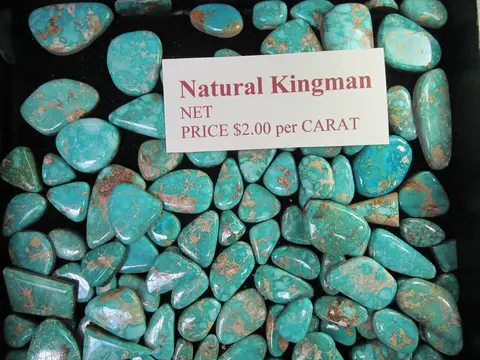
Dealers list Kingman turquoise cabochons at $4.50 to $7.50 per carat; rough runs about $5 to $11 per gram.
A variety of turquoise. Prices checked .
| Form and size | Typical asking price | Range chart | Median | Listings |
|---|---|---|---|---|
| Cabochons (per carat) | $4.55 to $7.69 | $7.13 | 9 from 1 dealer | |
| over 10 ct | $4.45 to $7.31 | $6.90 | 8 from 1 dealer | |
| Rough (per gram) | $5 to $11 | $6.50 | 8 from 1 dealer | |
| Nuggets (per gram) | $15 to $15 | $15 | 5 from 1 dealer | |
| Slabs and polished pieces (per piece) | Not enough data (2 listings, need 5) | |||
| Specimens (per piece) | Not enough data (1 listing, need 5) | |||
| Listing | Size | Locality | Asking | Seen |
|---|---|---|---|---|
| Kingman Turquoise, Stabilized Blue Green to Green Trade Roots, stabilized | 1 g | Kingman | $3 | |
| Kingman Turquoise, Stabilized Blue with Light Matrix Trade Roots, stabilized | 1 g | Kingman | $4 | |
| Kingman Turquoise, Stabilized 1970s Spiderweb Slabs Trade Roots, stabilized | 1 g | Kingman | $5 | |
| Kingman Turquoise, Stabilized Clear Blue Trade Roots, stabilized | 2.5 cm | Kingman | $5 | |
| Kingman Turquoise Inlay Material Trade Roots | 1 g | Kingman | $5 | |
| Kingman Turquoise Birdseye Slabs ca. 1970's Trade Roots | 1 g | Kingman | $6 | |
| Kingman Turquoise, Old Man Mine, Cut Pieces CA 1980's Trade Roots | 1 g | Kingman | $6 | |
| Kingman Duval Turquoise Trade Roots | 1 g | Kingman Duval | $7 | |
| Kingman Old 1970's Turquoise Mountain Stabilized Super High Grade Spider Web Trade Roots, stabilized | 1 g | $10 | ||
| Kingman Turquoise Nuggets Trade Roots | 1 g | Kingman | $10 | |
| Kingman Old 1970's Turquoise Mountain Trade Roots | 1 g | $15 | ||
| Kingman Turquoise Black Spiderweb Trade Roots | 1 g | Kingman | $20 |
These are dealer asking prices: what shops list kingman turquoise for, not what it sells for and not an appraisal. Selling to a dealer usually brings well below retail, because the dealer has to resell it at a margin.
Turquoise from the Mineral Park district near Kingman, Mohave County, Arizona, one of the largest and oldest turquoise sources in North America.
Kingman produced huge volumes in a wide range from sky blue to deep blue, often with black matrix, pyrite or quartz; the Kingman name is also used by a large processing business, so not every stone sold as Kingman was mined there. See turquoise value for the species as a whole.
Uniform candy blue with dark dyed cracks; white shows inside.
Origin cannot be proven by eye; ask for source documentation.
Also mistaken for kingman turquoise: bisbee turquoise, turquoise mountain.
Common
Common
Rub acetone on a cotton swab against the back of the stone or a drill hole.
Can leave a small mark.
Examine matrix lines with a 10x loupe.
A stone that passes these tests is consistent with natural kingman turquoise, not proven. For valuable pieces, a gem lab report settles treatment and origin.
Prices: 28 current listings from FossilEra, Trade Roots, seen 2026-11-20 to 2026-11-20. How we collect prices.