Dealer asking prices for calcite, middle half of current listings, checked 2026-11-20. Bar shows the 25th to 75th percentile; the dark tick is the median.
These are dealer asking prices: what shops list calcite for, not what it sells for and not an appraisal. Selling to a dealer usually brings well below retail, because the dealer has to resell it at a margin.
How to identify calcite
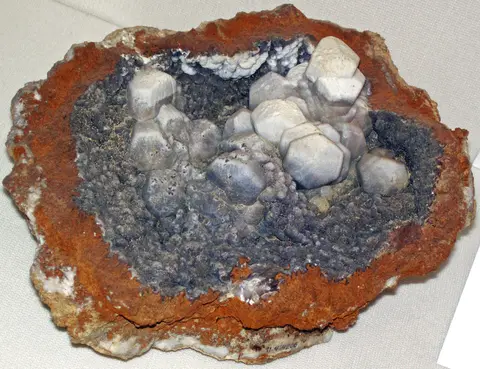
Calcite is calcium carbonate (CaCO3), the most common carbonate mineral and the main component of limestone and marble. It forms in more crystal shapes than almost any other mineral and comes in nearly every color.
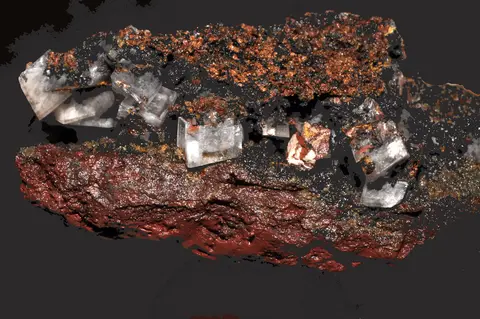
Breaks into rhombs: perfect cleavage in three directions not at right angles, so broken pieces look like slanted boxes.
Soft: a steel knife scratches it easily, and it will not scratch glass (Mohs 3).
Clear pieces show a strong double image of a line or text seen through them.
Fizzes in acid; at home, a drop of warm household vinegar on powder or a fresh scratch gives slow bubbling.
Vitreous luster, often pearly on cleavage faces; white streak.
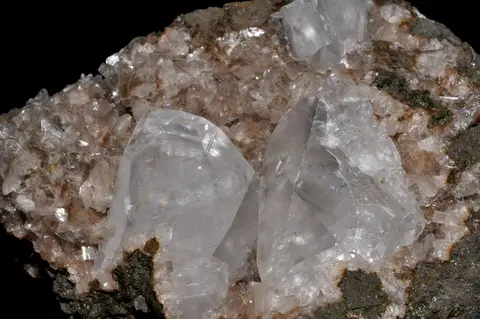
Common habits: rhombohedrons, pointed scalenohedrons (dogtooth), flat nailhead tips, and massive banded rough sold for carving.
Dogtooth calcite is calcite in sharp, pointed scalenohedral crystals that resemble canine teeth. Named for crystal shape, not color; the same mineral grown as long pointed scalenohedrons.
Red calcite
Red calcite is massive calcite colored brick red to orange red, usually by fine hematite or iron oxide inclusions. Same mineral with iron oxide pigment; usually opaque and massive rather than crystalline.
Golden calcite
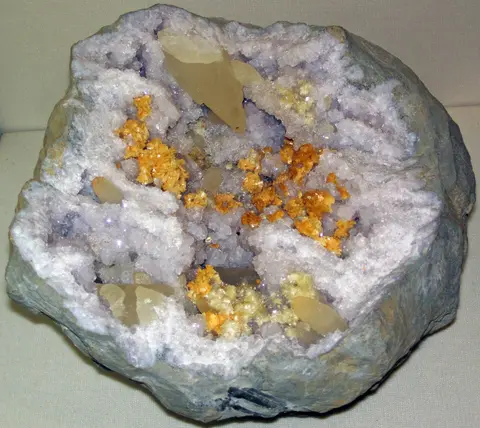
Golden calcite is a trade name for yellow to golden calcite colored by trace iron, sold both as crystals and massive pieces. A color name rather than a distinct variety; overlaps with honey calcite and the golden crystals of the Tri-State district and Elmwood.
Elmwood calcite
Elmwood calcite is golden to amber calcite from the Elmwood mine near Carthage, Tennessee, known for lustrous scalenohedral crystals often paired with purple fluorite. A locality name; collectors pay for the Elmwood source, crystal sharpness and associations.
Stellar beam calcite
Stellar beam calcite is a shop trade name for long, golden scalenohedral calcite crystals, often doubly terminated or twinned. A marketing name for elongated dogtooth calcite; the mineral is ordinary calcite.
Tri-state calcite
Tri-State calcite comes from the old lead and zinc mines of the Tri-State district where Missouri, Kansas and Oklahoma meet, famous for large golden scalenohedrons. A locality name; the district is mined out, so specimens come from old collections.
Where calcite comes from
Helgustadir, Iceland
Type source of Iceland spar, the clear optical calcite used in early polarizing prisms.
Chihuahua, Mexico
Source of much of the massive orange, honey, green and blue calcite sold as carving rough, tumbles and spheres.
Tri-State district (Missouri, Kansas, Oklahoma), USA
Old lead and zinc mines produced large golden scalenohedral crystals, often with sphalerite and galena.
Elmwood mine, Tennessee, USA
Golden to amber scalenohedrons, sometimes with purple fluorite; prized classic specimens.
Dalnegorsk, Russia
Lustrous, often colorless to white crystal groups with associated minerals.
Banded carvings soft enough for a knife to scratch
Fizzes with acid; true onyx is chalcedony and does not
Clear calcite sold as quartz or citrine
Occasional
Will not scratch glass
Rhombic cleavage steps on broken edges
Strong double image through clear areas
Glass or resin sold as rare calcite colors
Rare
No double image
Round gas bubbles under a loupe
No cleavage steps on chips
Is my calcite real? Tests you can do at home
Scratch test with a steel knife and glass
Try to scratch an inconspicuous spot with a steel knife, then try to scratch a glass plate with a sharp edge of the stone.
Real
The knife scratches calcite easily; calcite will not scratch glass.
Fake or lookalike
Quartz, glass and harder lookalikes resist the knife and may scratch glass.
Can leave a small mark.
Vinegar fizz test
Scrape a pinch of powder onto a dish, add a few drops of warm household vinegar and watch with a loupe.
Real
Steady small bubbles form on the powder.
Fake or lookalike
Quartz, chalcedony, fluorite, gypsum and glass do not bubble; dolomite bubbles only weakly.
Can leave a small mark.
Double image test
Lay a clear piece on a printed line or a single dot and look straight down through it.
Real
Clear calcite shows two distinct images, and one moves as you rotate the stone.
Fake or lookalike
Glass and quartz show one image at this thickness.
Cleavage check with a loupe
Look at chips and broken edges under a 10x loupe.
Real
Flat, mirror-like steps at slanted angles, the start of rhombs.
Fake or lookalike
Glass and quartz show curved shell-like fracture.
UV torch
Shine a longwave UV torch on the piece in a dark room.
Real
Many calcites glow red, pink, orange or white; mangano calcite usually glows pink to red.
Fake or lookalike
A lack of glow does not prove a fake, but dyed or glass pieces usually stay dark or glow evenly.
A stone that passes these tests is consistent with natural calcite, not proven. For valuable pieces, a gem lab report settles treatment and origin.
Treatments
Dyeing (common)
Gives cheap white calcite bright colors; dyed pieces sell as decor and are worth far less than natural color. Color concentrated in cracks, acetone swab, color that does not match any natural calcite.
Waxing or oiling (common)
Polished massive calcite is often waxed to hide scratches and boost luster; little effect on value but hides wear. Greasy feel, luster that dulls when cleaned.
Acid cleaning (occasional)
Specimens are sometimes etched out of a calcite matrix, or calcite itself is lightly etched, which can frost faces and lower specimen value. Frosted or rounded crystal edges.
What moves the price of calcite
Crystal quality. Sharp, lustrous, undamaged crystals with good form are worth far more than massive rough.
Locality. Classic or closed localities such as Elmwood, the Tri-State district and Iceland command a premium.
Color. Natural cobalt pink, saturated mangano pink and bright golden colors sell above white and pale material.
Clarity. Optically clear Iceland spar is valued for transparency and freedom from cracks.
Associations. Calcite with fluorite, sphalerite, native silver or other minerals on matrix adds interest and value.
Size. Large crystals and large carvings cost more, but massive calcite is abundant, so size alone adds less than form.
Damage. Calcite chips and cleaves easily; bruised edges and broken tips cut value sharply.
Treatment. Dyed pieces are worth little compared with natural color.
Care and safety
Soft and easily cleaved: keep away from harder stones, avoid knocks and sudden temperature changes, and never clean with acids or vinegar. Rinse in plain water and dry.
Questions collectors ask about calcite
Dolomite vs calcite: how do you tell them apart?
Calcite fizzes readily with dilute acid, while dolomite barely reacts unless powdered. Dolomite is slightly harder (3.5 to 4) and its crystals often have curved, saddle-shaped faces.
Citrine vs calcite: how do you tell them apart?
Citrine is quartz, hardness 7, and scratches glass; calcite is hardness 3 and a steel knife scratches it. Clear calcite also shows a strong double image and breaks into rhombs, which citrine never does.
Rose quartz vs pink calcite: what is the difference?
Rose quartz scratches glass and has a glassy, slightly cloudy look with no cleavage. Pink calcite is soft, often shows cleavage planes or banding, and fizzes with acid; mangano calcite also glows pink under UV.
Sources
Prices: 251 current listings from Dakota Matrix Minerals, FossilEra, iRocks (The Arkenstone), The Gem Shop, Throwin Stones, seen 2026-11-20 to 2026-11-20. How we collect prices.