What gypsum is worth
Show 12 of the listings behind these numbers
These are dealer asking prices: what shops list gypsum for, not what it sells for and not an appraisal. Selling to a dealer usually brings well below retail, because the dealer has to resell it at a margin.
How to identify gypsum
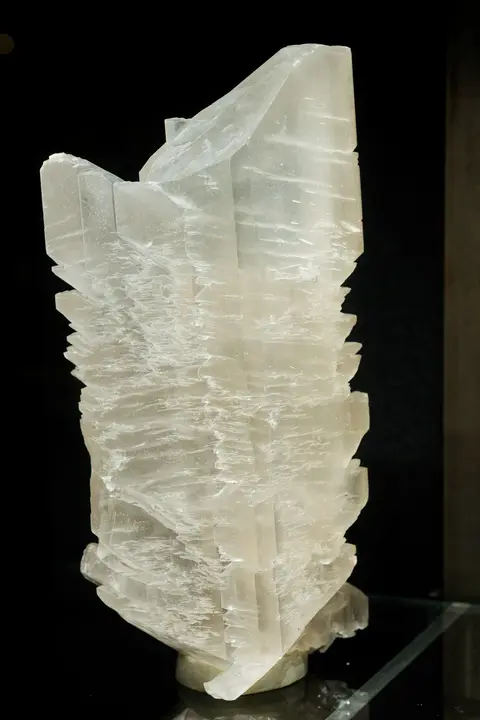
Gypsum is hydrated calcium sulfate, CaSO4·2H2O, a soft evaporite mineral that forms in drying lakes, sea basins and caves. Collectors know it as clear selenite blades, silky satin spar, fine-grained alabaster and sandy desert rose rosettes.
- Hardness 2: a fingernail leaves a scratch.
- Perfect cleavage in one direction; thin flakes peel off and bend slightly without springing back.
- Pearly luster on cleavage faces, silky in fibrous satin spar, vitreous on clear crystals.
- Feels warm and light in the hand (SG about 2.3).
- No fizz in vinegar, unlike calcite.
- Crystals are flat tabular blades, often with swallowtail twins or rosettes.
Gypsum varieties
Gypsum rose
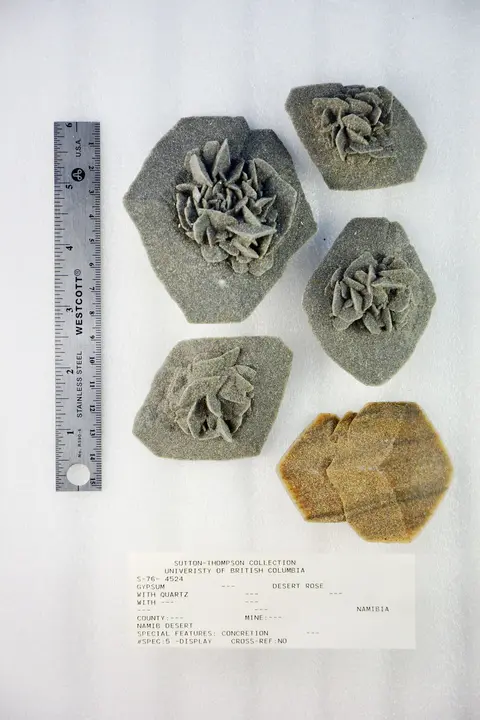
Gypsum rose is another name for rosette-shaped gypsum crystal clusters, including sandy desert roses and cleaner lens-shaped rosettes. It is gypsum grown as radiating blades from a center, the same mineral in a flower-like habit.
Fishtail selenite
Fishtail selenite is a twinned selenite crystal whose two halves meet at a notch, giving a swallowtail or fishtail shape. It is selenite in a contact twin, valued for the distinctive V-shaped notch at the end.
Naica selenite
Naica selenite is selenite from the Naica mine in Chihuahua, Mexico, the site of the Cave of the Crystals with the largest known selenite crystals. It is selenite identified by locality; specimens come from mine workings rather than the protected giant crystal cave.
Where gypsum comes from
- Naica, Chihuahua, Mexico
- Cave of the Crystals with selenite beams over 10 m long; specimens come from other parts of the mine.
- Great Salt Plains, Oklahoma, USA
- Hourglass selenite crystals with sand inclusions dug by the public at a wildlife refuge.
- Morocco
- Source of most satin spar sold as selenite wands, towers and lamps.
- Chihuahua, Mexico and the Sahara (Tunisia, Algeria)
- Sandy gypsum desert roses.
- Volterra, Italy
- Fine white alabaster carved since Etruscan times.
- Red River Floodway, Manitoba, Canada
- Amber colored selenite crystals collected from clay.
Gypsum lookalikes
Calcite is harder (3), breaks into rhombs, and bubbles in vinegar; gypsum does neither.
- Fingernail does not scratch calcite
- Clear calcite shows strong double image
calcite vs gypsum
Halite breaks into cubes and dissolves quickly in water; gypsum is barely soluble.
- Halite hardness 2.5
- Three cleavages at right angles
gypsum vs halite
Ulexite transmits a sharp image through its fibers (TV stone); satin spar does not.
- Hardness 2.5
- Lighter, SG about 1.96
Quartz scratches glass and cannot be marked by a fingernail or knife.
Talc
Talc feels soapy and is softer (1).
- Greasy feel
- Platy and foliated habit
Also mistaken for gypsum: barite, colemanite.
Fake, dyed and treated gypsum
Satin spar sold as selenite
Very common
- Opaque white with silky fibrous sheen
- Fibers run along the wand length
- True selenite is clear and splits in flat sheets
Dyed satin spar and selenite in bright colors
Common
- Unnatural blue, pink, purple or bright orange
- Color concentrated along fibers and cracks
- Color rubs off on a damp cotton swab
Calcite onyx sold as alabaster ('Egyptian alabaster')
Common
- Harder than a fingernail
- Fizzes in vinegar
- Banded translucent look
Cast resin figurines sold as alabaster
Occasional
- Uniform look with no grain
- Mold seams
- Warm, plastic feel and light weight
Is my gypsum real? Tests you can do at home
-
Fingernail scratch
Press a fingernail firmly into an inconspicuous spot.
- Real
- Leaves a groove or white mark.
- Fake or lookalike
- Calcite, glass and quartz are not marked.
Can leave a small mark.
-
Vinegar drop
Place a drop of household white vinegar on a hidden spot and watch closely with a loupe, then rinse and dry.
- Real
- No bubbles.
- Fake or lookalike
- Calcite and calcite onyx produce slow fizzing.
Can leave a small mark.
-
Acetone swab for dye
Rub a cotton swab with acetone or nail polish remover on a hidden area.
- Real
- Swab stays clean.
- Fake or lookalike
- Dyed pieces color the swab.
-
Image transmission check
Lay a polished piece across printed text.
- Real
- Satin spar blurs the text.
- Fake or lookalike
- Ulexite shows the text sharply on its top surface.
A stone that passes these tests is consistent with natural gypsum, not proven. For valuable pieces, a gem lab report settles treatment and origin.
Treatments
- Dyeing (common)
- Adds bright color to satin spar and alabaster; dyed pieces are low value decor. Acetone swab; color concentrated along fibers or cracks.
- Waxing or sealing of alabaster (common)
- Improves polish and protects the soft surface; accepted for carvings. Waxy feel; hot water not advised to test.
What moves the price of gypsum
- Variety and clarity. Water-clear selenite crystals are worth more than massive or cloudy gypsum.
- Size and completeness. Large undamaged crystals, complete rosettes and terminated blades.
- Locality. Naica, Red River and other classic localities carry premiums.
- Inclusions and form. Hourglass sand inclusions, swallowtail twins and phantoms add interest.
- Damage. Scratches and chipped edges are easy and lower value sharply.
- Workmanship. For alabaster carvings, the carving and artist matter more than the stone.
Care and safety
Gypsum is soft and slightly soluble. Do not wash in water or leave in damp places; clean with a dry soft brush. Keep away from harder minerals in storage and away from heat, which can turn it cloudy.
Questions collectors ask about gypsum
- Onyx vs alabaster: what is the difference?
- True alabaster is fine-grained gypsum, soft enough to scratch with a fingernail and inert in vinegar. Decorative onyx is usually banded calcite, which is harder and fizzes in vinegar.
- Moonstone vs selenite: how do you tell them apart?
- Moonstone is a feldspar with hardness 6 that scratches glass and shows a floating blue or white sheen. Selenite is gypsum, so a fingernail scratches it, and it splits into thin flat sheets.
Sources
Prices: 41 current listings from FossilEra, Throwin Stones, seen 2026-11-20 to 2026-11-20. How we collect prices.