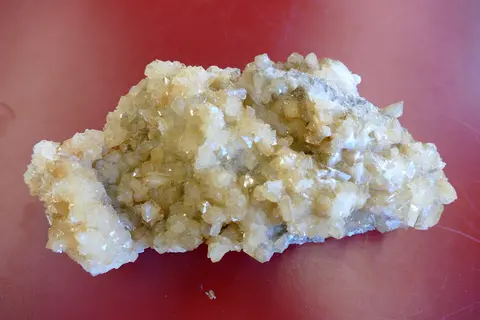
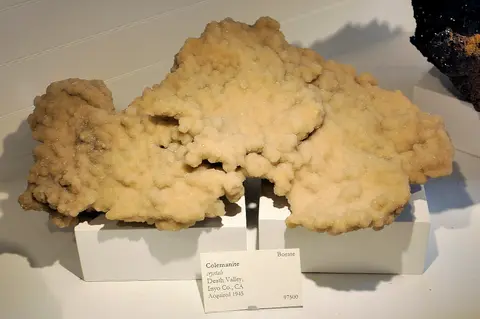
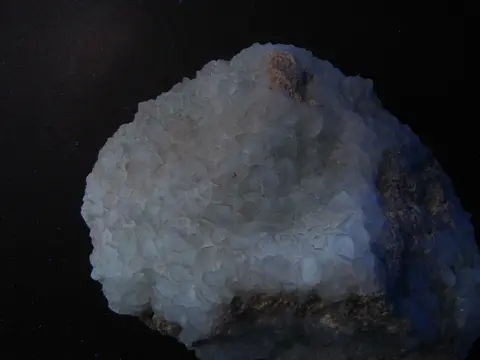
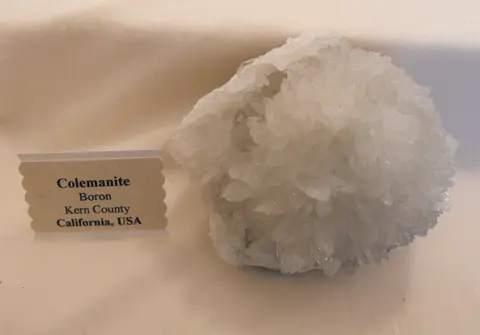
Colemanite is a hydrated calcium borate that forms in dried lake beds, and it is one of the main ores of boron. Collectors know it as clear to white, glassy prismatic crystals and crystal-lined nodules from California and Turkey.
These are dealer asking prices: what shops list colemanite for, not what it sells for and not an appraisal. Selling to a dealer usually brings well below retail, because the dealer has to resell it at a margin.
How to identify colemanite
Colorless to milky white, glassy crystals, short prismatic and often in druses or lining nodules.
One perfect cleavage that gives flat, bright breaks.
Hardness 4.5: a steel knife scratches it with some effort, it does not scratch glass.
Light in the hand (SG 2.42), lighter than calcite.
Does not fizz in vinegar, unlike calcite.
Found in borate deposits with ulexite, borax and other borates.
Where colemanite comes from
Death Valley region, California, USA
Type locality near Furnace Creek, described in 1884 and named for William Tell Coleman, owner of the Harmony Borax Works. Ryan and the Furnace Creek area produced classic crystals and geodes.
Boron (Kramer district), California, USA
Large borate open pit; colemanite occurs with other borates.
Emet and Bigadic, western Turkey
Major commercial colemanite producer and a modern source of crystal clusters and nodules.
Calico Hills, California, USA
Historic borate mining area with colemanite nodules.