Dealer asking prices for celestite, middle half of current listings, checked 2026-11-20. Bar shows the 25th to 75th percentile; the dark tick is the median.
These are dealer asking prices: what shops list celestite for, not what it sells for and not an appraisal. Selling to a dealer usually brings well below retail, because the dealer has to resell it at a margin.
How to identify celestite
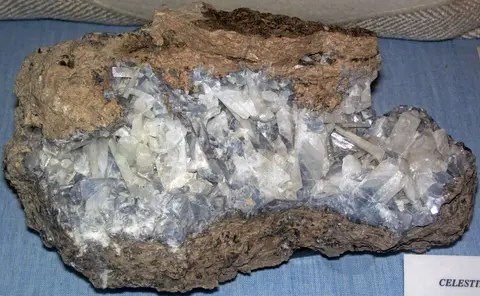
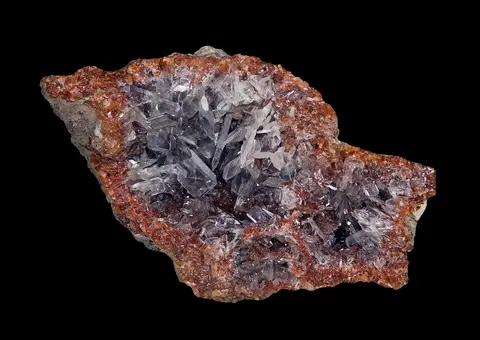
Celestite (official mineral name celestine) is strontium sulfate, a soft, heavy mineral best known for pale sky blue crystals lining geodes. It is the main ore of strontium.
Pale sky blue to colorless, white or pale gray crystals; also pale orange, brown or greenish.
Surprisingly heavy for a pale, glassy crystal (SG about 3.96), much heavier than calcite or quartz.
Soft: hardness 3 to 3.5, scratched easily by a steel knife and will not scratch glass.
Tabular to prismatic orthorhombic crystals, often in clusters inside geodes and nodules.
Perfect cleavage in one direction plus a good second cleavage, so chips break with flat, stepped faces.
Vitreous luster, pearly on cleavage surfaces.
Does not fizz in vinegar, unlike calcite and aragonite.
Celestite varieties
Madagascar celestite
Madagascar celestite is celestine from the Sakoany area of northwestern Madagascar, sold mostly as geodes, geode halves and crystal clusters in pale to medium blue. Same mineral as all celestite; it is singled out because it supplies most of the blue geodes on the market, usually in larger, more affordable pieces than classic European or North American material.
Where celestite comes from
Sakoany area, Mahajanga, Madagascar
Source of most celestite geodes and clusters on the market, with pale to medium blue crystals.
Put-in-Bay, South Bass Island, Ohio, USA
Crystal Cave is a huge geode lined with celestite crystals, a well known tourist site.
Agrigento, Sicily, Italy
Classic sharp, transparent crystals growing with bright yellow sulfur.
Monroe County, Michigan, USA
Quarries near Maybee have produced blue celestite crystals in dolomite.
Coahuila, Mexico
Produces bladed and tabular crystals, often pale blue.
Yate, near Bristol, England
Historic celestine mining area with nodules and crystal-lined cavities.
Crystals are hexagonal pointed quartz terminations
Scratches glass easily
Blue sits in cracks and on the surface; acetone may lift dye
Angelite sold as celestite
Occasional
Opaque massive blue-gray stone with no crystals
Lighter in hand than celestite
Glued or reassembled geodes and clusters
Occasional
Glue lines along breaks
Crystals that sit at odd angles to the cavity wall
Mismatched matrix on either side of a join
Is my celestite real? Tests you can do at home
Vinegar fizz test
Put a drop of white vinegar on an inconspicuous spot and watch with a loupe for a minute, then rinse.
Real
No bubbles.
Fake or lookalike
Calcite and aragonite produce small bubbles.
Weight in hand
Compare against a quartz or calcite piece of similar size.
Real
Feels noticeably heavier.
Fake or lookalike
Quartz and calcite feel light; barite feels even heavier.
Scratch test with steel and glass
Try to scratch a hidden spot with a steel nail, and try to scratch a glass plate with an edge.
Real
Steel scratches it; it cannot scratch glass.
Fake or lookalike
Quartz and aquamarine scratch glass and resist steel.
Can leave a small mark.
Specific gravity with a kitchen scale
Weigh the piece dry, then hanging in water on a thread; divide dry weight by the weight gain. Use matrix-free pieces.
Real
About 3.9 to 4.0.
Fake or lookalike
Calcite 2.71, quartz 2.65, anhydrite about 2.97, barite about 4.5.
A stone that passes these tests is consistent with natural celestite, not proven. For valuable pieces, a gem lab report settles treatment and origin.
Treatments
Cleaning (common)
Removal of clay and iron staining from geodes; accepted practice. Not usually detectable.
Repair and reassembly (occasional)
Glued crystals or rejoined geode halves lower value when not disclosed. Glue lines and mismatched surfaces under a loupe or UV light.
What moves the price of celestite
Color. Deeper, even sky blue is worth more than pale gray, white or patchy material.
Crystal size and sharpness. Large, transparent, undamaged crystals with clean terminations command the most.
Form. Whole geodes and attractive clusters sell above loose points and broken pieces.
Locality. Classic Sicilian crystals with sulfur and old Ohio or Michigan pieces carry collector premiums.
Damage and repair. Celestite is soft and chips easily; bruised tips and glued breaks reduce value.
Size. Large display geodes command more than small clusters.
Care and safety
Celestite is soft with perfect cleavage, so handle it by the matrix and avoid knocks. Keep it out of strong direct sunlight, which can fade the blue over time, and clean with a soft brush or brief rinse in lukewarm water rather than ultrasonic cleaners.
Sources
Prices: 10 current listings from FossilEra, iRocks (The Arkenstone), seen 2026-11-20 to 2026-11-20. How we collect prices.