


Calcite
Calcite cleaves into slanted rhombs, not cubes, and does not dissolve in plain water.
- Hardness 3
- SG 2.71
- Fizzes with vinegar
Dealers list halite specimens at $25 to $45.
Prices checked . Page updated .
| Form and size | Typical asking price | Range chart | Median | Listings |
|---|---|---|---|---|
| Specimens (per piece) | $25 to $45 | $35 | 9 from 1 dealer |
| Variety | Median | Listings |
|---|---|---|
| Pink halite | $25 per piece | 5 |
| Blue halite | Not enough data | 4 |
| Listing | Size | Locality | Asking | Seen |
|---|---|---|---|---|
| 1.95" Pink Halite Crystal Cluster - Trona, California FossilEra | 5 cm | Trona, California | $15 | |
| 2.55" Pink Halite Crystal Cluster - Trona, California FossilEra | 6.5 cm | Trona, California | $15 | |
| 4.5" Pink Halite Crystal Cluster - Trona, California FossilEra | 11.4 cm | Trona, California | $25 | |
| 1.7" Vibrant Blue Halite Crystal - Eastern Turkey FossilEra | 4.3 cm | Eastern Turkey | $35 | |
| 1.8" Vibrant Blue Halite Crystal - Eastern Turkey FossilEra | 4.6 cm | Eastern Turkey | $35 | |
| 2" Vibrant Blue Halite Crystal - Eastern Turkey FossilEra | 5.1 cm | Eastern Turkey | $35 | |
| 1.15" Vibrant Blue Halite Crystal - Eastern Turkey FossilEra | 2.9 cm | Eastern Turkey | $45 | |
| 3.05" Pink Halite Crystal Cluster - Trona, California FossilEra | 7.8 cm | Trona, California | $55 | |
| 3.7" Pink Halite Crystal Cluster - Trona, California FossilEra | 9.4 cm | Trona, California | $59 |
These are dealer asking prices: what shops list halite for, not what it sells for and not an appraisal. Selling to a dealer usually brings well below retail, because the dealer has to resell it at a margin.
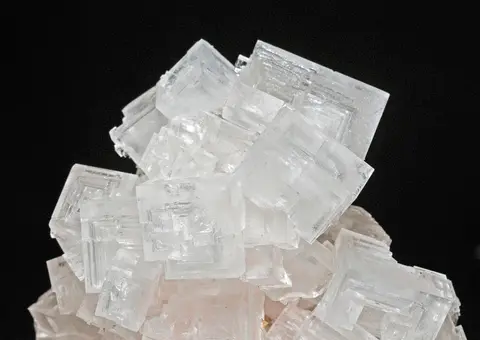
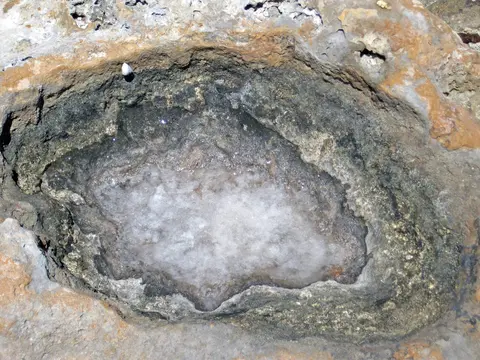
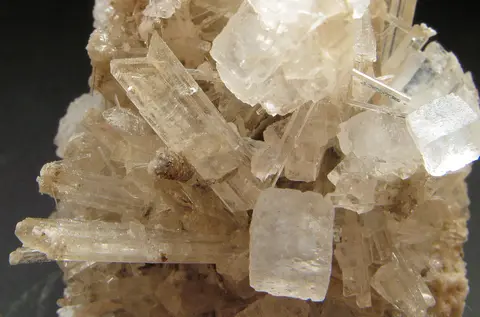
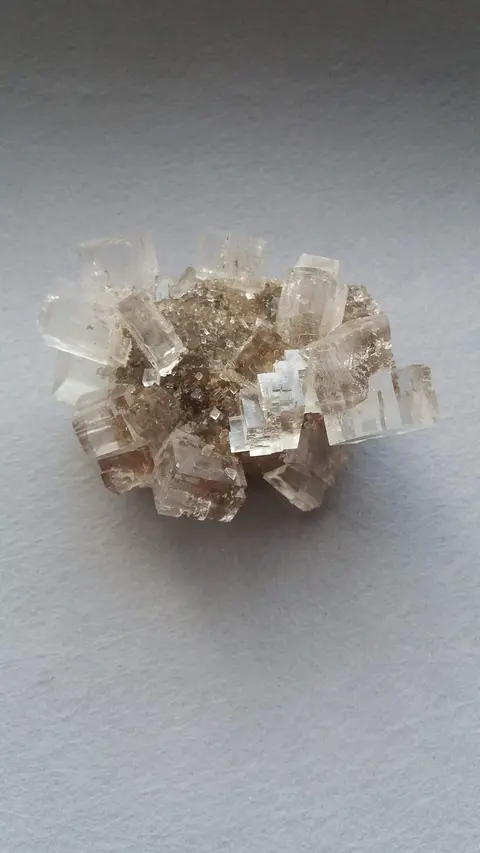
Halite is natural rock salt, sodium chloride (NaCl), formed by evaporation of seawater and salt lakes. It is the mineral form of table salt.
Pink halite is halite colored pink to red by trapped brine containing salt-loving microorganisms, best known from Searles Lake, California. Its color comes from organic pigments in brine inclusions rather than a different composition.
Blue halite is halite colored blue to violet by defects in the crystal lattice created by natural radiation, typically from potassium in nearby sylvite. Same composition as colorless halite; the color is from radiation damage and can fade if heated.
Calcite cleaves into slanted rhombs, not cubes, and does not dissolve in plain water.
Gypsum is softer (2), flexes in thin sheets and does not dissolve quickly in water.
Fluorite is harder (4), heavier (3.18), cleaves into octahedra and is insoluble.
Sylvite (potassium chloride) looks almost identical and often occurs with halite; it is slightly lighter and softer, and separating them reliably needs testing.
Also mistaken for halite: gypsum, borax, iceland spar.
Common
Very common
Rare
Put one drop of water on an unseen spot and wipe after a minute.
Can leave a small mark.
Look at broken edges and corners with a loupe.
Draw a copper coin edge across a hidden spot.
Can leave a small mark.
Wipe the surface lightly with a barely damp tissue.
Can leave a small mark.
A stone that passes these tests is consistent with natural halite, not proven. For valuable pieces, a gem lab report settles treatment and origin.
Halite dissolves in water and absorbs moisture from the air. Never wash it; dust with a dry brush. Store in a sealed container or display case with silica gel in humid climates. Natural blue halite can lose its color if heated.
Prices: 9 current listings from FossilEra, seen 2026-11-20 to 2026-11-20. How we collect prices.