


Calcite
Calcite breaks into perfect rhombs along three cleavage directions; aragonite does not.
- Calcite hardness 3, aragonite 3.5 to 4
- Calcite SG 2.71, aragonite 2.94
- Calcite often shows strong double refraction in clear pieces
Dealers list aragonite specimens 5 to 10 cm (2 to 4 in) at $17 to $35.
Prices checked . Page updated .
| Form and size | Typical asking price | Range chart | Median | Listings |
|---|---|---|---|---|
| Specimens (per piece) | $25 to $65 | $35 | 17 from 1 dealer | |
| 5 to 10 cm (2 to 4 in) | $17 to $35 | $25 | 9 from 1 dealer | |
| 10 to 20 cm (4 to 8 in) | $69 to $91 | $79 | 6 from 1 dealer | |
| Spheres (per piece) | $19 to $190 | $25 | 6 from 1 dealer | |
| Tumbled stones (per pound) | Not enough data (4 listings, need 5) | |||
| Slabs and polished pieces (per piece) | Not enough data (4 listings, need 5) | |||
| Carvings and shapes (per piece) | Not enough data (1 listing, need 5) | |||
| Cut stones (per carat) | Not enough data (1 listing, need 5) | |||
These are dealer asking prices: what shops list aragonite for, not what it sells for and not an appraisal. Selling to a dealer usually brings well below retail, because the dealer has to resell it at a margin.
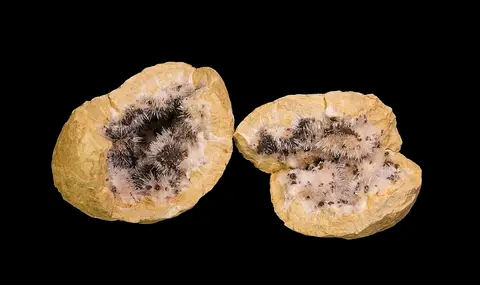
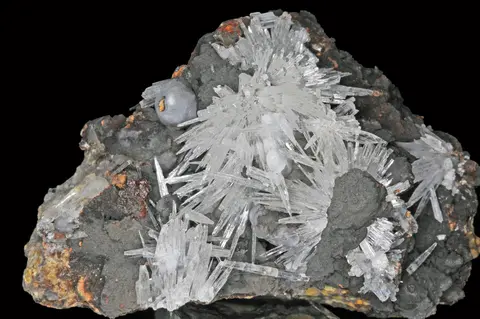
Aragonite is calcium carbonate, the same chemistry as calcite but with an orthorhombic structure. It forms needles, columns, coral-like branches and six-sided twinned clusters, and it is also the mineral that builds pearls and many shells.
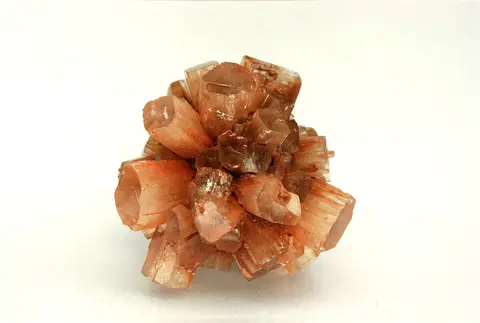
Aragonite star clusters are radiating groups of brown to orange-brown twinned aragonite crystals, sold mainly from Morocco. Same mineral; the name describes the radiating, star-like cluster habit rather than a different composition.
Sputnik aragonite is a trade name for aragonite clusters whose crystals radiate in all directions like the arms of the Sputnik satellite. Same mineral as other aragonite; the name refers to the spherical, all-direction radiating habit, mostly from Moroccan clusters.
Moroccan aragonite is the brown, tan and orange-brown clustered aragonite from Morocco that dominates the mineral shop market. A locality name for ordinary aragonite; the typical form is pseudohexagonal twinned prisms grouped in radiating clusters.
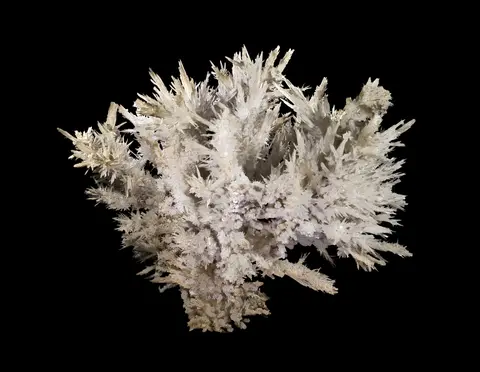
Flos ferri (Latin for flower of iron) is white aragonite grown as branching, coral-like stalactitic forms in iron mine cavities. Same mineral, but grown as delicate branching tubes instead of crystals; named for the iron deposits where it is found.
Calcite breaks into perfect rhombs along three cleavage directions; aragonite does not.
Caribbean calcite is banded light blue, white and brown in layers rather than solid blue needles or nodules.
Larimar is harder (4.5 to 5), does not fizz in vinegar and shows white, turtle-back webbing.
Amazonite is much harder (6), shows flat cleavage flashes and white grid streaks, and does not fizz.
Also mistaken for aragonite: cerussite, natrolite, creedite.
Occasional
Occasional
Occasional
Put a drop of household vinegar on a hidden spot and watch with a loupe, then rinse with water.
Can leave a small mark.
Try a copper coin, then a steel knife, on an inconspicuous spot.
Can leave a small mark.
Look at broken edges and chips with a loupe.
Shine a UV torch on the piece in a dark room and switch it off after a few seconds.
A stone that passes these tests is consistent with natural aragonite, not proven. For valuable pieces, a gem lab report settles treatment and origin.
Aragonite is soft and dissolves in acids. Keep it away from vinegar, lemon juice and acidic cleaners, and dust delicate clusters with a soft brush instead of washing.
Prices: 37 current listings from FossilEra, iRocks (The Arkenstone), Throwin Stones, seen 2026-11-20 to 2026-11-20. How we collect prices.