What larimar is worth
Not enough data. We have not yet seen 5 or more current dealer listings for larimar in any one form, so we show no range rather than guess.
Show 12 of the listings behind these numbers
These are dealer asking prices: what shops list larimar for, not what it sells for and not an appraisal. Selling to a dealer usually brings well below retail, because the dealer has to resell it at a margin.
How to identify larimar
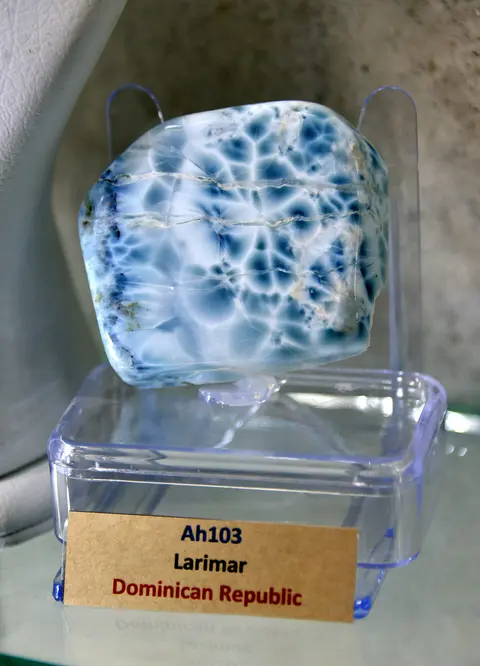
- Light blue, sky blue, sea green-blue or deep volcanic blue mixed with white in cloudy, flame-like or turtle-back patterns.
- Fibrous, radiating structure: under a loupe or on rough you can see silky, needle-like fibers, and polished stones can show a faint silky sheen.
- Hardness 4.5 to 5: a steel knife scratches it and it cannot scratch glass.
- Translucent at thin edges to opaque, never transparent like aquamarine.
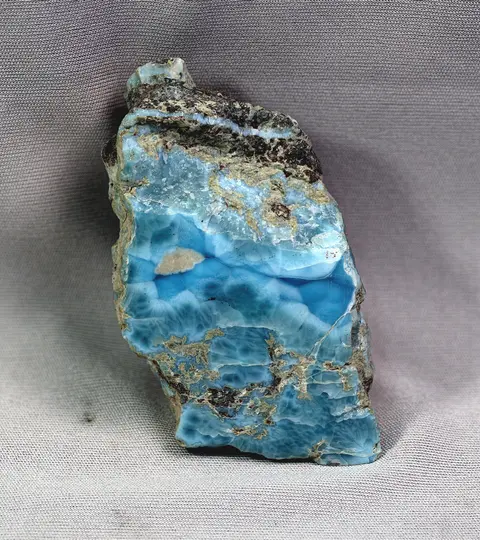
- Natural pieces often show reddish brown hematite or gray matrix spots and dendrites.
- Feels moderately heavy (SG about 2.8) and cool to the touch, unlike warm, light plastic.
Where larimar comes from
- Los Chupaderos, Barahona Province, Dominican Republic
- The only commercial source: pectolite in cavities of volcanic rock in the Sierra de Bahoruco, worked by small underground shafts. Rediscovered in 1974 and named from Larissa plus mar, Spanish for sea.
Larimar lookalikes
Turquoise is evenly colored or webbed with brown or black matrix, not cloudy white and blue patterns, and has no fibrous structure.
- Turquoise hardness 5 to 6
- Turquoise is often stabilized or dyed
- Turquoise greener tones and waxy luster
larimar vs turquoise
Blue hemimorphite forms botryoidal or layered crusts with a bubbly, banded pattern rather than larimar's flame and turtle-back pattern.
- Hemimorphite SG about 3.4 to 3.5, heavier
- Mostly from China, sold as a larimar alternative
Amazonite shows a grid of white streaks and flat, shiny cleavage flashes and is greener.
- Hardness 6 to 6.5, scratches glass weakly
- SG about 2.56
amazonite vs larimar
Caribbean calcite is softer (3), fizzes with vinegar on powder, and mixes blue aragonite with white and brown calcite.
- Comes mainly from Pakistan
- Often marketed in the same colors as larimar
caribbean calcite vs larimar
Blue aragonite is a more uniform, bright blue with a crystalline or fibrous texture and fizzes in vinegar.
- Hardness 3.5 to 4
- Commonly from China
blue aragonite vs larimar
Chalcedony is harder (about 7), scratches glass, and has a smooth waxy translucence without fibers.
- SG about 2.6
- Even color or fine banding
Aquamarine is transparent and hard (7.5 to 8), while larimar is opaque to translucent and soft.
- Aquamarine forms hexagonal crystals
- No white patterning
larimar vs aquamarine
Also mistaken for larimar: peruvian opal, blue lace agate, aragonite, hemimorphite.
Fake, dyed and treated larimar
Glass or ceramic larimar imitations
Common
- Round bubbles under a loupe
- Pattern too regular or repeated between stones
- No fibrous structure; glossy glass luster
Resin or plastic larimar
Common
- Feels light and warm in hand
- Pattern looks painted or swirled like paint
- Hot point test smells of plastic (destructive, test only a hidden spot)
Dyed howlite or magnesite
Occasional
- Dye concentrated in cracks
- Gray web veining typical of howlite
- Acetone swab can pick up blue
Other blue stones sold as larimar
Common
- Caribbean calcite, blue aragonite and blue hemimorphite labeled as larimar
- Fizzing in vinegar points to calcite or aragonite
- Any source other than the Dominican Republic is a warning sign
Reconstituted larimar
Occasional
- Angular fragments set in resin
- Uniform glossy resin between pieces under a loupe
Is my larimar real? Tests you can do at home
-
Loupe check for fibers
Look at the surface and any broken edge with a 10x loupe under bright light.
- Real
- Fine, silky fibers and radiating structure, with natural irregular patterning.
- Fake or lookalike
- Glass shows bubbles and swirls; resin looks smooth with painted-looking color.
-
Vinegar fizz test
Put a drop of white vinegar on an inconspicuous spot, watch with a loupe for a minute, then rinse.
- Real
- No bubbles.
- Fake or lookalike
- Caribbean calcite and blue aragonite produce small bubbles.
-
Temperature and weight in hand
Hold the stone against your cheek or the inside of your wrist and weigh it in your palm.
- Real
- Feels cool at first and moderately heavy.
- Fake or lookalike
- Plastic and resin feel warm and light. Glass can also feel cool, so combine with other tests.
-
Steel scratch test
Try to scratch a hidden spot on the back with a steel needle.
- Real
- Steel leaves a fine scratch with some effort.
- Fake or lookalike
- Plastic scratches very easily; chalcedony and aquamarine resist steel.
Can leave a small mark.
-
Hot point test
Touch a hot needle to a hidden spot on the back and smell carefully from a distance.
- Real
- No change and no smell.
- Fake or lookalike
- Plastic or resin melts slightly and smells acrid.
Damages the stone: test only an inconspicuous spot or a piece you do not mind marking.
A stone that passes these tests is consistent with natural larimar, not proven. For valuable pieces, a gem lab report settles treatment and origin.
Treatments
- Waxing or polishing compounds (common)
- Improves surface luster on cabochons; accepted practice. Not usually significant for value.
- Resin stabilization (occasional)
- Allows fractured or porous material to be cut; lowers value when disclosed. Glossy filled cracks under a loupe; lab confirmation.
- Dyeing (rare)
- Deepens pale material to imitate darker grades; undisclosed dyeing is fraud. Color concentrated in cracks and along fibers; acetone swab.
What moves the price of larimar
- Color depth. Deep volcanic blue is the top grade, followed by sky blue; pale, white-heavy or greenish stones are lower.
- Pattern. Clear turtle-back or flame patterns with good contrast are preferred over cloudy or blotchy patterns.
- Matrix and inclusions. Clean blue areas without brown or gray matrix spots command more.
- Size and cut. Large, clean cabochons are scarce; well domed, symmetrical stones sell better.
- Supply. Single-source production from small hand-dug mines keeps fine material scarce.
- Setting. In finished jewelry, the metal and workmanship add to the stone value.
Care and safety
Larimar is fairly soft (4.5 to 5) and can scratch or chip, so store it apart from harder gems. Prolonged strong sunlight and heat are reported to fade its blue, so keep it out of hot sun and away from heat. Clean with mild soapy water, not ultrasonic or steam cleaners or harsh chemicals.
Questions collectors ask about larimar
- How to tell if larimar is real?
- Real larimar shows a fibrous, silky texture and irregular blue and white patterns, does not fizz in vinegar, and feels cool and moderately heavy. Glass shows bubbles, resin feels warm and light, and calcite or aragonite imitations fizz.
- Why is larimar so expensive?
- It comes from one small area of the Dominican Republic, is mined by hand from narrow shafts, and deep blue material is a small part of the output. Value depends mostly on color depth, pattern and clarity; see the price table above.
- How much should I pay for larimar?
- Pay according to color depth, pattern quality, size and setting, with deep volcanic blue at the top. See the price table above for observed prices.
- What is so special about larimar?
- It is blue pectolite, and gem-quality blue pectolite is essentially known from only one region in the Dominican Republic. Its sea-like blue and white patterns do not occur in any other gem.
- Is larimar worth anything?
- Yes, genuine larimar is a valued gemstone, with value set by color depth, pattern, size and lack of matrix spots. See the price table above for current figures.
- Can larimar stone get wet?
- Brief contact with water while washing hands or cleaning is fine. Avoid long soaking, chlorine, chemicals and steam cleaning, and dry it after cleaning.
Sources
Prices: 15 current listings from FossilEra, seen 2026-11-20 to 2026-11-20. How we collect prices.