

Blue lace agate
Blue lace agate shows fine white lacy bands.
- Same material
Dealers list blue chalcedony tumbled stones at $460 to $640 per pound.
A variety of chalcedony. Prices checked .
| Form and size | Typical asking price | Range chart | Median | Listings |
|---|---|---|---|---|
| Tumbled stones (per pound) | $459 to $638 | $561 | 5 from 1 dealer |
| Listing | Size | Locality | Asking | Seen |
|---|---|---|---|---|
| Blue CHALCEDONY Crystal Chips - Small Crystals, Gemstones, Jewelry Making, Tumbled Crystals, E1804 Throwin Stones | 2.5 cm | $5.40 | ||
| Blue CHALCEDONY Crystals - Tumbled Healing Stones, Self Care Gift, E1424 (Extra Small) Throwin Stones | 2.5 cm | $7.20 | ||
| Blue CHALCEDONY Crystals - Tumbled Healing Stones, Self Care Gift, E1424 (Small) Throwin Stones | 2.5 cm | $8.10 | ||
| Blue CHALCEDONY Crystals - Tumbled Healing Stones, Self Care Gift, E1424 (Medium) Throwin Stones | 2.5 cm | $9.90 | ||
| Blue CHALCEDONY Crystals - Tumbled Healing Stones, Self Care Gift, E1424 (Large) Throwin Stones | 2.5 cm | $11 | ||
| Blue CHALCEDONY Crystals - Tumbled Healing Stones, Self Care Gift, E1424 (Extra Large) Throwin Stones | 2.5 cm | $14 |
These are dealer asking prices: what shops list blue chalcedony for, not what it sells for and not an appraisal. Selling to a dealer usually brings well below retail, because the dealer has to resell it at a margin.
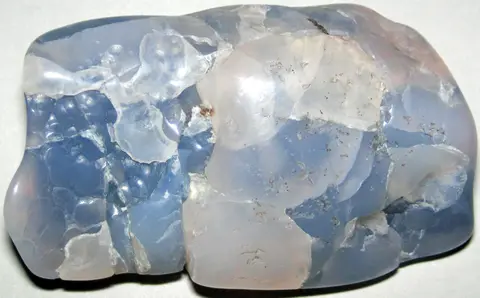
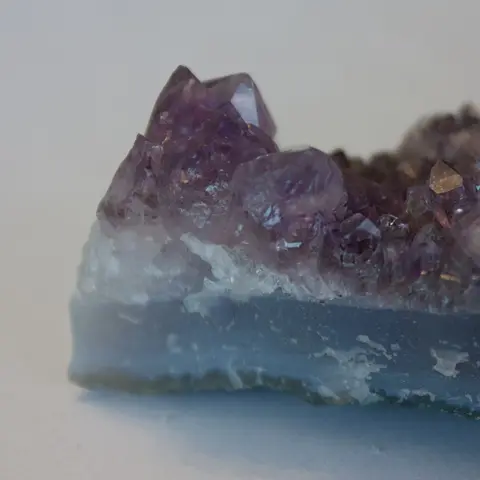
Blue chalcedony is natural light blue to lavender chalcedony, often botryoidal, whose color comes from light scattering in its fine structure rather than a pigment.
Chalcedony with a natural soft blue or lavender color; vivid blue chalcedony is usually dyed. See chalcedony value for the species as a whole.
Blue lace agate shows fine white lacy bands.
Blue quartz is crystalline and grainy rather than smooth and waxy.
A steel knife scratches calcite.
Also mistaken for blue chalcedony: larimar, blue moonstone, smithsonite.
Very common
Occasional
Compare with known natural blue chalcedony in daylight.
Rub acetone on a drill hole or the back.
A stone that passes these tests is consistent with natural blue chalcedony, not proven. For valuable pieces, a gem lab report settles treatment and origin.
Prices: 6 current listings from Throwin Stones, seen 2026-11-20 to 2026-11-20. How we collect prices.