RockValues

Hemimorphite value and identification

Dealers list hemimorphite specimens 5 to 10 cm (2 to 4 in) at $110 to $645.

Prices checked . Page updated .
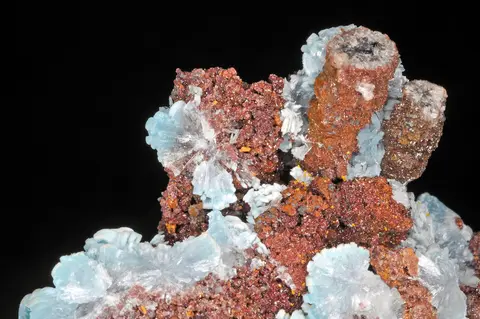
Hemimorphite: Hemimorphite, wulfénite 300-3-0134
Hemimorphite, wulfénite 300-3-0134. Photo: Parent Géry, CC BY-SA 3.0, via Wikimedia Commons.
Hemimorphite: Hemimorphite Specimen 9
Hemimorphite Specimen 9. Photo: Photo by and (c)2015 Derek Ramsey ( Ram-Man ), CC BY-SA 4.0, via Wikimedia Commons.
Hemimorphite: Hemimorphite crystals
Hemimorphite crystals. Photo: Masha Milshina, CC BY 4.0, via Wikimedia Commons.
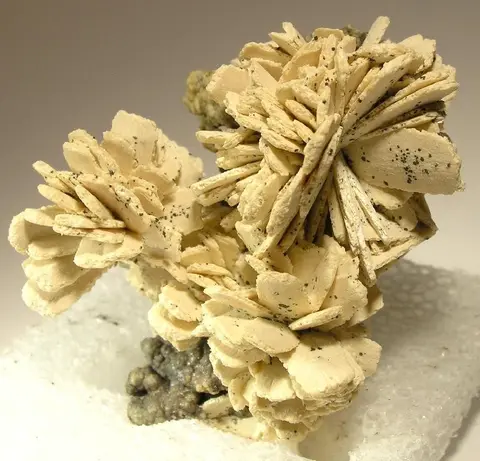
Hemimorphite: Ellestadite-(F)-Hemimorphite-48321
Ellestadite-(F)-Hemimorphite-48321. Photo: Robert M. Lavinsky, CC BY-SA 3.0, via Wikimedia Commons.

What hemimorphite is worth

Dealer asking prices for hemimorphite, middle half of current listings, checked 2026-11-20. Bar shows the 25th to 75th percentile; the dark tick is the median.
Form and sizeTypical asking priceRange chartMedianListings
Specimens (per piece)$36 to $298$16514 from 3 dealers
5 to 10 cm (2 to 4 in)$111 to $644$4786 from 3 dealers
under 5 cm (2 in)$17 to $175$1655 from 2 dealers
Show 12 of the listings behind these numbers
Sample dealer listings for Hemimorphite
ListingSizeLocalityAskingSeen
Hemimorphite with Fluorite #AH59604
Dakota Matrix Minerals
4 cmMex-Tex mine, Bingham, Socorro Co., New Mexico, United States$15
1.4" Sparkling Hemimorphite Crystal Cluster - Congo
FossilEra
3.6 cmCongo$17
2.1" Powder Blue Hemimorphite Formation - 79 Mine, Arizona
FossilEra
5.3 cm79 Mine, Arizona$22
Hemimorphite #AH59601
Dakota Matrix Minerals
6 cmMex-Tex mine, Bingham, Socorro Co., New Mexico, United States$25
2.1" Powder Blue Hemimorphite Formation - 79 Mine, Arizona
FossilEra
5.3 cm79 Mine, Arizona$25
2.85" Powder Blue Hemimorphite Formation - 79 Mine, Arizona
FossilEra
7.2 cm79 Mine, Arizona$25
2.6" Powder Blue Hemimorphite Formation - 79 Mine, Arizona
FossilEra
6.6 cm79 Mine, Arizona$29
3.2" Powder Blue Hemimorphite Formation - 79 Mine, Arizona
FossilEra
8.1 cm79 Mine, Arizona$35
.7" Vibrant Blue Veszelyite Crystals on Hemimorphite - China
FossilEra
China$35
Plattnerite on Hemimorphite #SW68265
Dakota Matrix Minerals
7 cmMina Ojuela, Mapimi, Durango, Mexico$40
6" Lustrous Hemimorphite Crystal Cluster - Congo
FossilEra
15.2 cmCongo$125
7.3" Lustrous Hemimorphite Crystal Cluster with Mimetite - Congo
FossilEra
18.5 cmCongo$165

These are dealer asking prices: what shops list hemimorphite for, not what it sells for and not an appraisal. Selling to a dealer usually brings well below retail, because the dealer has to resell it at a margin.

How to identify hemimorphite

Hemimorphite is a hydrated zinc silicate formed in the oxidized upper parts of zinc deposits. It occurs as colorless to white bladed crystals and as blue to blue-green botryoidal crusts.

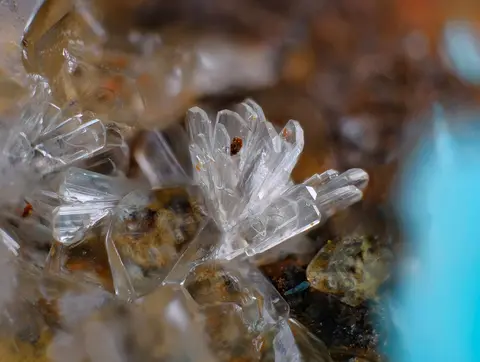
  • Thin, flat, bladed crystals in fan-shaped or comb-like groups, colorless to white
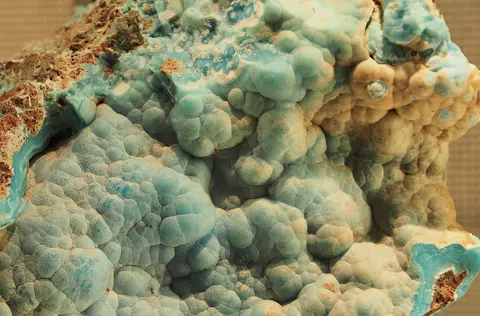
  • Blue to blue-green botryoidal crusts with a smooth, glossy or silky surface
  • Crystals are hemimorphic: the two ends of a crystal have different shapes
  • Glassy to slightly pearly luster
  • Steel knife scratches it with effort; copper does not
  • Found with smithsonite, limonite and other zinc minerals

Hemimorphite varieties

Blue hemimorphite

Blue hemimorphite is hemimorphite colored pale to bright blue, usually as botryoidal crusts on brown limonite matrix. Same mineral; most hemimorphite crystals are colorless or white, while the blue form usually grows as rounded botryoidal crusts rather than bladed crystals.

Where hemimorphite comes from

Yunnan, China
Main source of bright blue botryoidal hemimorphite on matrix, often sold as display specimens and cabochon rough.
Ojuela mine, Mapimi, Durango, Mexico
Fine colorless bladed crystal sprays on limonite.
Santa Eulalia, Chihuahua, Mexico
Colorless crystals and blue crusts from zinc and lead mines.
Moresnet, Belgium, and Altenberg, Germany
Historic European zinc deposits with classic hemimorphite.

Hemimorphite lookalikes

Smithsonite

Smithsonite is much heavier (SG about 4.4) and slightly softer (4 to 4.5).

  • Smithsonite is zinc carbonate
  • Same deposits, similar blue crusts
  • Smithsonite fizzes in warm acid; hemimorphite does not

Larimar

Larimar shows white, turtle-back webbing and a fibrous, chatoyant texture instead of smooth botryoidal layers.

  • Larimar is blue pectolite
  • Only from the Dominican Republic
  • Similar hardness (4.5 to 5)

hemimorphite vs larimar

Chrysocolla

Chrysocolla is lighter (SG 1.9 to 2.4), softer and usually more green-blue.

  • Often earthy or crumbly

Turquoise

Turquoise is lighter (SG 2.6 to 2.9), harder (5 to 6) and opaque with a waxy luster.

  • Often with brown or black matrix lines

Also mistaken for hemimorphite: blue aragonite, adamite.

Fake, dyed and treated hemimorphite

  • Dyed howlite or magnesite sold as blue hemimorphite

    Occasional

    • Too light for the size
    • Gray veining typical of howlite
    • Acetone swab picks up blue
  • Reconstituted or resin-bonded blue material

    Occasional

    • Angular fragments in a matrix under a loupe
    • Light weight
    • Uniform color

Is my hemimorphite real? Tests you can do at home

  1. Specific gravity with a kitchen scale

    Weigh dry, then suspended in water; divide dry weight by the loss in water.

    Real
    About 3.4 to 3.5.
    Fake or lookalike
    Smithsonite about 4.4; howlite and magnesite about 2.5 to 3.0.
  2. Vinegar drop

    Place a drop of household vinegar on a hidden spot, watch with a loupe, then rinse.

    Real
    No fizzing.
    Fake or lookalike
    Calcite-based material fizzes.

    Can leave a small mark.

  3. Acetone swab

    Rub a hidden spot with a cotton swab dipped in acetone.

    Real
    Swab stays clean.
    Fake or lookalike
    Dyed howlite or magnesite leaves blue on the swab.

A stone that passes these tests is consistent with natural hemimorphite, not proven. For valuable pieces, a gem lab report settles treatment and origin.

Treatments

Stabilization (occasional)
Porous crusts may be impregnated with resin before cutting; lowers value compared with natural material. Plastic-like luster, lab testing.

What moves the price of hemimorphite

  1. Color. Bright, even sky blue crusts are the most desirable.
  2. Form. Thick, glossy botryoidal crusts on contrasting matrix and sharp crystal sprays rank above massive material.
  3. Size. Larger undamaged specimens are less common.
  4. Locality. Classic Mexican and European localities carry collector interest.
  5. Treatment. Natural, unstabilized material is valued above stabilized or dyed pieces.

Sources

Prices: 19 current listings from Dakota Matrix Minerals, FossilEra, iRocks (The Arkenstone), seen 2026-11-20 to 2026-11-20. How we collect prices.