RockValues

Adamite value and identification

Adamite is a zinc arsenate hydroxide, Zn2(AsO4)(OH), that forms in the oxidized parts of zinc and arsenic ore deposits. It is best known for bright yellow-green crystals that glow vivid green under ultraviolet light.

Prices checked . Page updated .

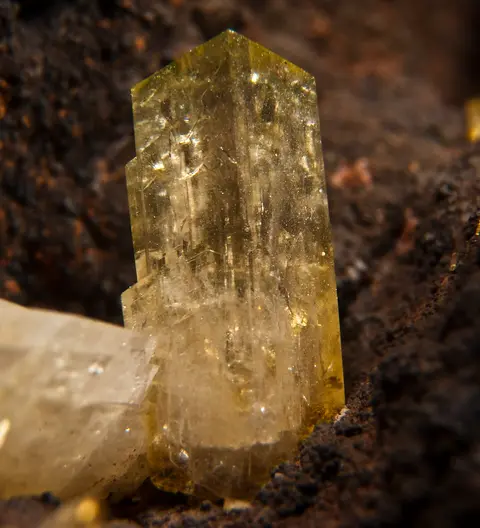
Adamite: Adamite Monocristal
Adamite Monocristal. Photo: Didier Descouens, CC BY-SA 4.0, via Wikimedia Commons.
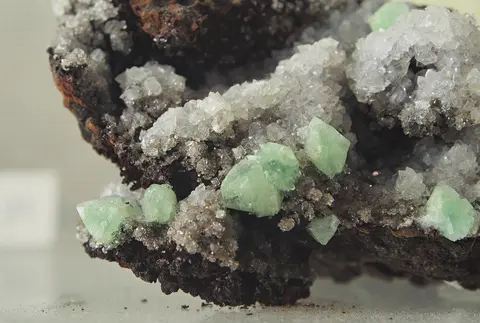
Adamite: Adamite and Calcite Specimen 16
Adamite and Calcite Specimen 16. Photo: Photo by and (c)2015 Derek Ramsey ( Ram-Man ), CC BY-SA 4.0, via Wikimedia Commons.
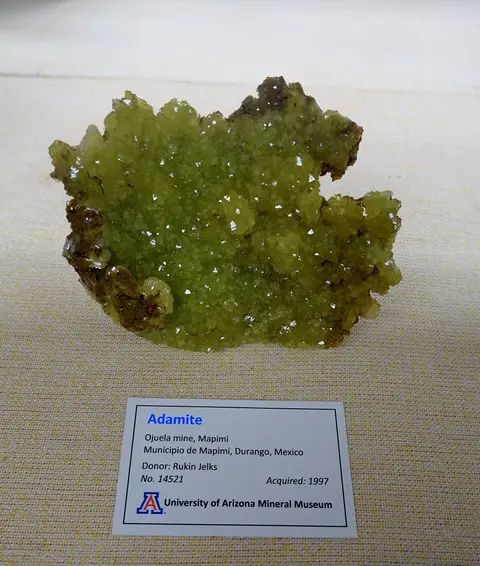
Adamite: Adamite, Ojuela mine, Mapimi, Municipio de Mapimi, Durango, Mexico - University of Arizona Mineral Museum - University of Arizona - Tucson, AZ - DSC08526
Adamite, Ojuela mine, Mapimi, Municipio de Mapimi, Durango, Mexico - University of Arizona Mineral Museum - University of Arizona - Tucson, AZ - DSC08526. Photo: Daderot, CC0, via Wikimedia Commons.
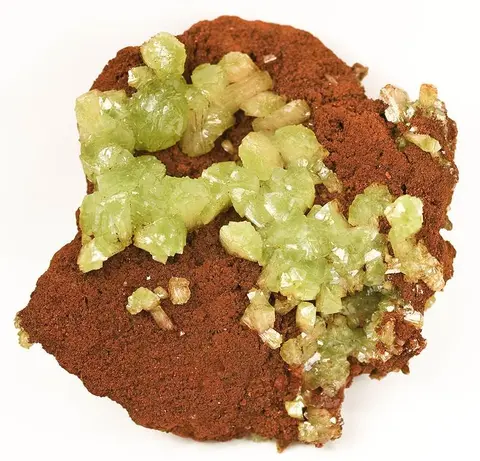
Adamite: Adamite-199996
Adamite-199996. Photo: Robert M. Lavinsky, CC BY-SA 3.0, via Wikimedia Commons.

What adamite is worth

Not enough data. We have not yet seen 5 or more current dealer listings for adamite in any one form, so we show no range rather than guess.

Show 3 of the listings behind these numbers
Sample dealer listings for Adamite
ListingSizeLocalityAskingSeen
Austinite with Adamite #AH58992
Dakota Matrix Minerals
6.5 cmGold Hill mine, Tooele Co., Utah, United States$30
Adamite #67686
Dakota Matrix Minerals
4 cmMina Ojuela, Mapimi, Durango, Mexico$35
2.65" Fluorescent, Gemmy Adamite Crystals on Matrix - Mexico
FossilEra
6.7 cmMexico$79

These are dealer asking prices: what shops list adamite for, not what it sells for and not an appraisal. Selling to a dealer usually brings well below retail, because the dealer has to resell it at a margin.

How to identify adamite

  • Bright yellow, lime-green or yellow-green crystals, sometimes colorless, pink to purple (cobalt) or green (copper)
  • Often grows as radiating fans, sprays and wedge-shaped crystals on rusty brown limonite matrix
  • Strong bright green fluorescence under longwave and shortwave UV in most specimens
  • Glassy luster on crystal faces
  • Soft enough to be scratched by a steel knife (hardness 3.5)
  • Feels heavier than quartz or calcite of the same size

Adamite varieties

Ojuela adamite

Adamite from the Ojuela mine at Mapimi, Durango, Mexico, the source of most adamite specimens on the market. The same mineral; Ojuela material is the classic look, with bright yellow to lime-green fans and sprays on rusty limonite, plus rarer purple cobaltoan and green copper-bearing pieces.

Where adamite comes from

Ojuela mine, Mapimi, Durango, Mexico
The best known source, producing bright yellow sprays on limonite and purple cobaltoan pieces.
Lavrion (Laurium), Attica, Greece
Old mine slags and workings with green copper-bearing and pink cobalt-bearing crystals.
Tsumeb, Namibia
Rare, large crystals from the famous mine, highly sought by advanced collectors.
Gold Hill, Tooele County, Utah, USA
Small crystals in cavities, a classic American locality.
Cap Garonne, Var, France
Micromount specimens of copper-bearing adamite.

Adamite lookalikes

Legrandite

Legrandite does not fluoresce, while most adamite glows bright green under UV.

  • Also a zinc arsenate from Ojuela
  • Legrandite forms longer, deeper yellow prisms
  • SG about 3.98 vs 4.3 to 4.5

Smithsonite

Smithsonite forms botryoidal crusts rather than wedge-shaped crystals or fans.

  • Smithsonite hardness 4 to 4.5
  • Smithsonite fizzes slowly in warm vinegar
  • Usually pearly crusts instead of glassy crystals

Olivenite

Olivenite is olive to dark green and does not fluoresce.

  • Copper arsenate, darker color
  • Fibrous or prismatic habit
  • Forms a series with copper-rich adamite

Hemimorphite

Hemimorphite is harder (4.5 to 5) and usually white or blue, rarely yellow-green.

  • Thin bladed fans of colorless crystals
  • Lower SG about 3.4
  • Usually weak or no green fluorescence

Also mistaken for adamite: mimetite.

Fake, dyed and treated adamite

  • Other yellow-green minerals labeled as adamite

    Occasional

    • No green glow under UV
    • Wrong habit for adamite (crusts, long needles)
  • Crystals glued onto matrix

    Occasional

    • Glue visible at the contact
    • Crystal does not sit naturally in the limonite
    • Glue may glow differently under UV

Is my adamite real? Tests you can do at home

  1. UV torch

    Shine a longwave (365 nm) UV torch on the specimen in a dark room.

    Real
    Most adamite glows bright green.
    Fake or lookalike
    Legrandite, olivenite and most lookalikes stay dark.
  2. Loupe on crystal habit

    Look at the crystals with a 10x loupe.

    Real
    Wedge-shaped crystals and radiating fans with glassy faces.
    Fake or lookalike
    Smithsonite shows botryoidal crusts, hemimorphite thin flat blades.
  3. Weight in hand

    Compare with a quartz or calcite piece of similar size.

    Real
    Noticeably heavier (SG 4.3 to 4.5).
    Fake or lookalike
    Quartz, calcite and hemimorphite feel lighter.

A stone that passes these tests is consistent with natural adamite, not proven. For valuable pieces, a gem lab report settles treatment and origin.

Treatments

Repair and gluing (occasional)
Reattached crystals or sprays lower value compared with undamaged pieces. Loupe at contacts; UV can show glue differently from the mineral.

What moves the price of adamite

  1. Color. Saturated yellow, lime green and purple cobaltoan colors bring the most.
  2. Crystal size and form. Large, well-formed fans and sprays outrank tiny crystals.
  3. Fluorescence. Strong bright green glow adds collector appeal.
  4. Locality. Ojuela is the reference; Tsumeb and fine Lavrion pieces command premiums.
  5. Contrast with matrix. Bright crystals on dark limonite display best.
  6. Damage. Chipped or crushed sprays lose much of their value.

Care and safety

Contains arsenic. Wash your hands after handling, do not lick, grind or cut it, and keep it away from children.

Sources

Prices: 3 current listings from Dakota Matrix Minerals, FossilEra, seen 2026-11-20 to 2026-11-20. How we collect prices.