Dealer asking prices for dolomite, middle half of current listings, checked 2026-11-20. Bar shows the 25th to 75th percentile; the dark tick is the median.
These are dealer asking prices: what shops list dolomite for, not what it sells for and not an appraisal. Selling to a dealer usually brings well below retail, because the dealer has to resell it at a margin.
How to identify dolomite
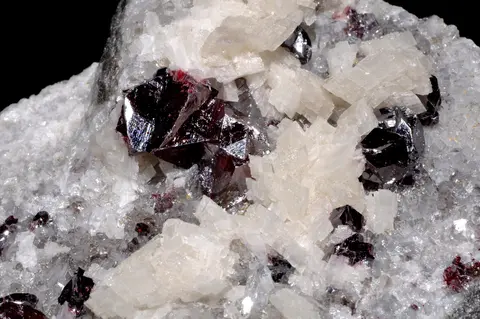
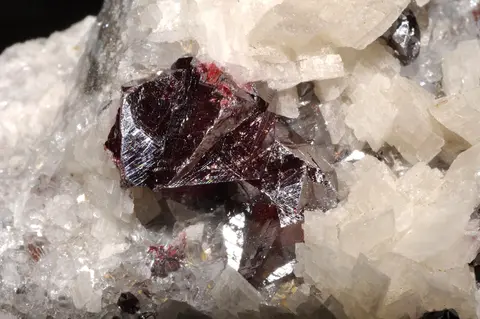
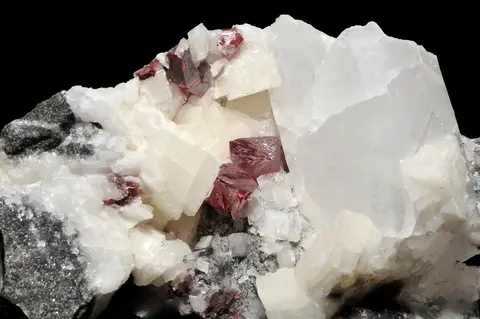
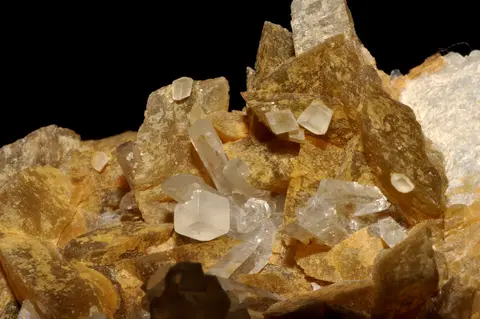
Dolomite is a calcium magnesium carbonate mineral, CaMg(CO3)2, and also the name of the rock (dolostone) made mostly of it. Crystals are typically curved, saddle-shaped rhombs in white, cream, pink or tan.
Curved, saddle-shaped rhombohedral crystals with a pearly to glassy luster are the signature habit.
Breaks into rhombs along three cleavages, like calcite.
Hardness 3.5 to 4: a steel knife scratches it, but a copper coin barely does, and it does not scratch glass.
Barely reacts to household vinegar or cold dilute acid as a solid piece; powdered dolomite reacts slowly.
White to cream, pink or tan; iron-bearing dolomite weathers brown.
As a rock (dolostone), it is fine to medium grained, often sugary, and frequently has small cavities.
Dolomite varieties
Kona dolomite
Kona dolomite is a Paleoproterozoic dolostone from the Kona Dolomite formation near Marquette, Michigan, cut and polished for its red, pink, white and gray bands and fossil stromatolites. It is a rock, not a crystal specimen: banded, fine-grained dolostone colored by iron and silica, valued as a lapidary material and for its ancient stromatolite structures.
Pink dolomite
Pink dolomite is dolomite colored pink by cobalt or manganese, with the most saturated pink crystals coming from cobalt deposits at Kolwezi, Democratic Republic of Congo. It shares the saddle-shaped crystals and properties of dolomite; only trace cobalt or manganese sets its color apart.
Where dolomite comes from
Eugui, Navarra, Spain
Classic transparent, colorless to cream rhombs on magnesite matrix.
Kolwezi, Katanga, Democratic Republic of Congo
Pink cobalt-bearing dolomite crystals.
Brumado, Bahia, Brazil
Dolomite crystals with magnesite from a large magnesite mine.
Tri-State district and Ohio, USA
Pink to white saddle-shaped crystals with galena, sphalerite and celestine in limestone and dolostone.
Dolomite Mountains, Italy
The mountain range named after the mineral, made of dolostone.
Marquette County, Michigan, USA
Source of Kona dolomite, a banded and stromatolitic lapidary rock.
Dyed white carbonate (dolomite or magnesite) sold as turquoise or other colored stones
Common
Color concentrated in cracks and pores
Acetone or nail polish remover on a cotton swab picks up color
Soft, scratched by a knife
Dolomite countertops sold as quartzite or 'soft quartzite'
Common
Does not scratch glass
A knife point scratches it
Lemon juice or vinegar left on a scrap etches it dull
Pink dolomite sold as rhodochrosite or pink calcite
Occasional
Curved saddle crystals
Lighter pink and less dense than rhodochrosite (SG 3.6)
Is my dolomite real? Tests you can do at home
Vinegar test
Put a few drops of household vinegar on a hidden spot of a solid piece, then on a little scraped powder, and watch with a loupe.
Real
Solid dolomite shows little or no fizz; the powder bubbles slowly.
Fake or lookalike
Calcite and limestone fizz visibly as solid pieces; quartz and quartzite do not react even as powder.
Can leave a small mark.
Glass scratch test
Try to scratch a piece of glass with a sharp edge of the specimen.
Real
Dolomite does not scratch glass.
Fake or lookalike
Quartz and quartzite scratch glass easily.
Knife scratch test
Draw a steel knife point across a hidden spot.
Real
The knife leaves a scratch with moderate pressure.
Fake or lookalike
Quartz is not scratched; calcite scratches a bit more easily.
Can leave a small mark.
Crystal shape check
Look for crystal faces with a loupe.
Real
Curved, saddle-shaped rhombs, often stacked.
Fake or lookalike
Calcite rhombs and scalenohedrons have flat faces.
A stone that passes these tests is consistent with natural dolomite, not proven. For valuable pieces, a gem lab report settles treatment and origin.
Treatments
Dyeing (occasional)
Turns white carbonate into turquoise, coral or other simulants; such pieces have little value. Acetone swab picks up color; dye pools in cracks.
Resin filling of slabs (common)
Fills pits and fissures in countertop slabs; standard in the stone trade. Glossy resin patches that react differently to scratches and heat.
What moves the price of dolomite
Crystal quality. Transparent, sharp, undamaged rhombs bring the most; massive dolomite is a bulk commodity.
Locality. Eugui (Spain) and Kolwezi pink cobaltoan dolomite are classic collector localities.
Color. Pink cobalt-bearing crystals are worth more than white.
Associations. Dolomite with galena, sphalerite, fluorite or magnesite is more appealing.
Size and damage. Larger clean crystals with intact edges are scarcer.
Questions collectors ask about dolomite
Dolomite vs calcite: how do you tell them apart?
Calcite fizzes in household vinegar or dilute acid as a solid piece, while dolomite reacts only weakly when powdered. Dolomite is also a little harder (3.5 to 4 against 3) and often forms curved saddle-shaped crystals.
Dolomite vs limestone: what is the difference?
Limestone is made mostly of calcite and fizzes readily in acid, while dolostone (dolomite rock) is made mostly of dolomite and reacts only when powdered. Dolostone usually forms when magnesium-rich water alters limestone.
Dolomite vs quartzite: how do you tell them apart?
Quartzite scratches glass and resists a knife, while dolomite does not scratch glass and is scratched by a knife. Dolomite also etches from acidic spills, which quartzite does not.
Dolomite vs marble: what is the difference?
Marble is metamorphosed carbonate rock; when it is made of calcite it fizzes in dilute acid, and when it is made of dolomite it is called dolomitic marble. Countertop 'dolomite' is generally a dolomitic marble, a little harder than calcite marble but still etchable.
Dolomite vs dolostone: what is the difference?
Dolomite is the mineral, CaMg(CO3)2. Dolostone is a sedimentary rock made mostly of that mineral, though many people use 'dolomite' for both.
Is dolomite expensive?
As a mineral it is common and usually inexpensive, but fine crystal specimens from classic localities such as Eugui or Kolwezi sell for considerably more. Crystal quality, color and locality drive value, as shown in the price table above.
Sources
Prices: 20 current listings from Dakota Matrix Minerals, FossilEra, iRocks (The Arkenstone), Kingsley North, seen 2026-11-20 to 2026-11-20. How we collect prices.