RockValues

Rhodochrosite value and identification

Dealers list rhodochrosite specimens at $19 to $425; tumbled stones run about $570 to $1,750 per pound.

Prices checked . Page updated .
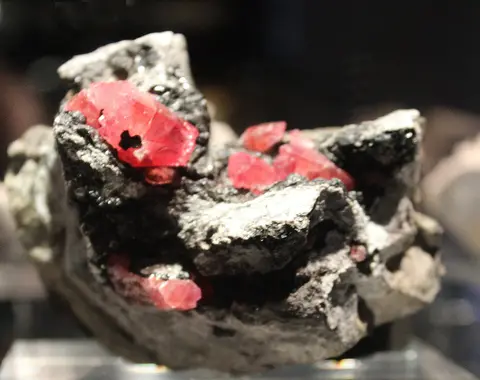
Rhodochrosite: Freiberg, Terra mineralia, rhodochrosite
Freiberg, Terra mineralia, rhodochrosite. Photo: Dguendel, CC BY 4.0, via Wikimedia Commons.
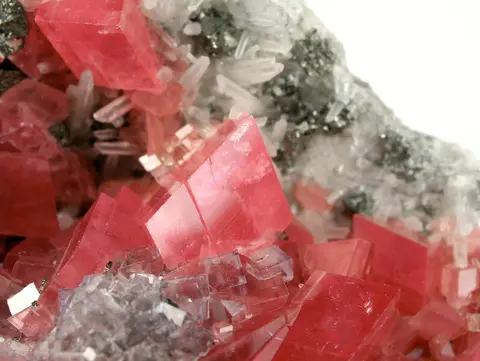
Rhodochrosite: Fluorite-Quartz-Rhodochrosite-ed10a
Fluorite-Quartz-Rhodochrosite-ed10a. Photo: Robert M. Lavinsky, CC BY-SA 3.0, via Wikimedia Commons.
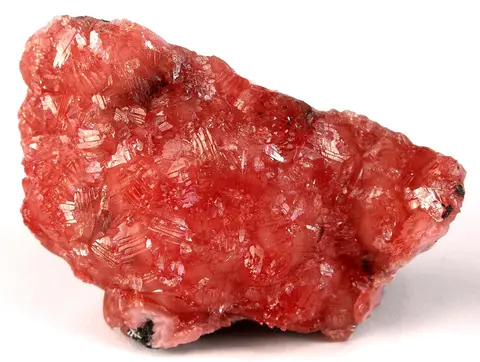
Rhodochrosite: Manganite-Rhodochrosite-tmu57a
Manganite-Rhodochrosite-tmu57a. Photo: Robert M. Lavinsky, CC BY-SA 3.0, via Wikimedia Commons.
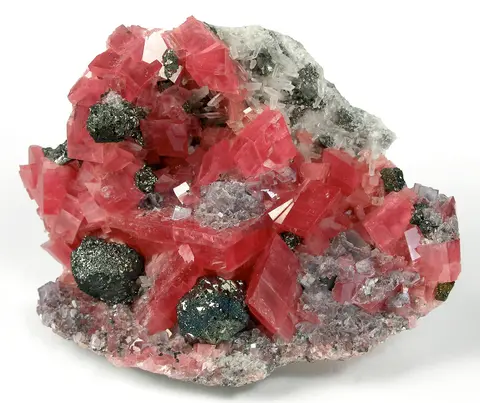
Rhodochrosite: Fluorite-Quartz-Rhodochrosite-ed10b
Fluorite-Quartz-Rhodochrosite-ed10b. Photo: Robert M. Lavinsky, CC BY-SA 3.0, via Wikimedia Commons.

What rhodochrosite is worth

Dealer asking prices for rhodochrosite, middle half of current listings, checked 2026-11-20. Bar shows the 25th to 75th percentile; the dark tick is the median.
Form and sizeTypical asking priceRange chartMedianListings
Specimens (per piece)$19 to $425$1176 from 2 dealers
Slabs and polished pieces (per piece)$85 to $295$2655 from 1 dealer
Tumbled stones (per pound)$572 to $1,769$1,0615 from 1 dealer
Cut stones (per carat)Not enough data (2 listings, need 5)
Show 12 of the listings behind these numbers

These are dealer asking prices: what shops list rhodochrosite for, not what it sells for and not an appraisal. Selling to a dealer usually brings well below retail, because the dealer has to resell it at a margin.

How to identify rhodochrosite

Rhodochrosite is manganese carbonate (MnCO3), a soft pink to red mineral of the calcite group. It occurs as banded stalactitic masses used for carvings and as transparent red rhombohedral crystals prized by collectors.

  • Rose pink to raspberry red color, often banded in light and dark pink layers in massive material
  • Soft: hardness 3.5 to 4, scratched by a steel knife
  • Perfect rhombohedral cleavage in three directions, like calcite
  • Vitreous to pearly luster
  • Heavy for a carbonate (SG about 3.5 to 3.7)
  • Crystals form rhombs or scalenohedra, often on quartz, pyrite or tetrahedrite in metal veins
  • Surfaces may darken to brown or black where manganese oxidizes

Rhodochrosite varieties

Sweet home rhodochrosite

Rhodochrosite from the Sweet Home mine near Alma, Colorado, known for transparent cherry red rhombohedral crystals with quartz, tetrahedrite and fluorite. Sweet Home crystals are transparent and deep red, the top end of collector rhodochrosite, unlike the opaque banded material common in the trade.

Rhodochrosite stalactite

Stalactitic rhodochrosite forms in cavities as dripstone, and cross sections show concentric pink and white rings. It is massive banded rhodochrosite valued for its pattern rather than for transparent crystals.

Argentine rhodochrosite

Argentine rhodochrosite is the banded stalactitic material from the Capillitas mine in Catamarca, used for carvings, slabs and cabochons. It is opaque to translucent banded material known as Inca rose, cut for pattern rather than collected as crystals.

N'chwaning rhodochrosite

Rhodochrosite from the N'Chwaning mines in South Africa's Kalahari manganese field, known for deep red transparent crystals. N'Chwaning crystals are among the darkest red and most transparent rhodochrosite, ranking with Sweet Home as collector benchmarks.

Where rhodochrosite comes from

Sweet Home mine, Alma, Colorado, USA
Source of the finest transparent cherry red rhombs, including the Alma King.
Capillitas, Catamarca, Argentina
Banded stalactitic rhodochrosite cut into slices showing concentric rings; Argentina's national stone.
N'Chwaning mines, Kalahari manganese field, South Africa
Deep red crystals, some among the best transparent rhodochrosite known.
Peru
Pink to red crystals from mines such as Uchucchacua and Pasto Bueno, often on quartz.
Wutong, Guangxi, China
Pink to red rhombs on quartz and other minerals.

Rhodochrosite lookalikes

Rhodonite

Rhodonite has black manganese oxide veins and is harder; it does not show rhodochrosite's banding.

  • Rhodonite hardness 5.5 to 6.5, not scratched easily by steel
  • Two cleavages near 90 degrees
  • SG 3.4 to 3.7

rhodonite vs rhodochrosite

Mangano calcite

Mangano calcite is pale pink and lighter; it glows bright pink under UV.

  • SG about 2.7
  • Hardness 3

Pink dolomite

Pink dolomite forms curved saddle-shaped crystals and is lighter.

  • SG about 2.85
  • Pearly curved faces

Rose quartz

Rose quartz is hard (7) and has no cleavage.

  • SG 2.65

Thulite

Thulite is mottled pink and white, harder and not banded.

  • Hardness 6 to 6.5

Also mistaken for rhodochrosite: pink calcite, cobalt calcite, tugtupite, erythrite, inesite.

Fake, dyed and treated rhodochrosite

  • Dyed calcite, marble or howlite

    Common

    • Color concentrated in cracks and grain boundaries
    • Acetone swab picks up pink
    • Lighter in hand
  • Reconstituted rhodochrosite (crushed material bonded with resin)

    Occasional

    • Angular fragments in a resin matrix under a loupe
    • Plastic-like warmth and low weight
  • Resin or plastic beads with painted bands

    Occasional

    • Very light
    • Uniform bands
    • Hot point softens resin

Is my rhodochrosite real? Tests you can do at home

  1. Steel scratch test

    Draw a steel knife or nail across a hidden spot.

    Real
    Steel scratches rhodochrosite fairly easily.
    Fake or lookalike
    Rhodonite, rose quartz and thulite resist steel.

    Can leave a small mark.

  2. Specific gravity by water displacement

    Weigh dry and suspended in water on a 0.01 g scale; divide dry weight by the loss.

    Real
    About 3.5 to 3.7.
    Fake or lookalike
    Calcite and marble about 2.7, howlite about 2.5, resin below 2.
  3. Acetone swab for dye

    Rub a cotton swab with nail polish remover (acetone) on a hidden area.

    Real
    Swab stays clean.
    Fake or lookalike
    Dyed stone may stain the swab pink.
  4. Loupe inspection of banding

    Examine banded material with a 10x loupe.

    Real
    Natural bands are wavy and concentric with fine crystal texture.
    Fake or lookalike
    Reconstituted stone shows angular chips in resin; dyed stone shows color pooled in cracks.

A stone that passes these tests is consistent with natural rhodochrosite, not proven. For valuable pieces, a gem lab report settles treatment and origin.

Treatments

Resin stabilizing (occasional)
Strengthens porous banded material for beads and cabochons; lowers value compared to natural. Plastic-like luster; lab testing for polymer.
Waxing (occasional)
Improves polish on banded material; small effect on value. Waxy feel; hot point beads wax (destructive).

What moves the price of rhodochrosite

  1. Form. Transparent red crystals rank far above banded massive material.
  2. Color. Deep cherry red ranks highest, then bright pink; brownish or pale tones lower value.
  3. Locality. Sweet Home and N'Chwaning crystals carry major premiums.
  4. Crystal size and sharpness. Large, sharp, lustrous rhombs with no damage.
  5. Matrix and associations. Contrasting matrix such as quartz, tetrahedrite or fluorite adds value.
  6. Banding pattern. For massive material, even concentric bands and strong pink.
  7. Treatment. Untreated pieces rank above stabilized or reconstituted.

Care and safety

Soft and cleaves easily; it scratches and chips in rings. Avoid acids, heat and ultrasonic cleaners.

Sources

Prices: 31 current listings from FossilEra, iRocks (The Arkenstone), Throwin Stones, seen 2026-11-20 to 2026-11-20. How we collect prices.