RockValues

Inesite value and identification

Inesite is a hydrated calcium manganese silicate, Ca2Mn7Si10O28(OH)2·5H2O, that forms pink to orange-red radiating sprays in manganese deposits. It is a collector mineral, best known from the Kalahari manganese field of South Africa.

Prices checked . Page updated .
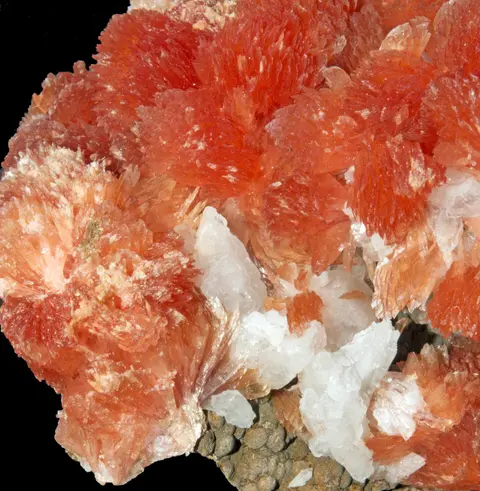
Inesite: Inesite-Calcite-Prehnite-114277
Inesite-Calcite-Prehnite-114277. Photo: Robert M. Lavinsky, CC BY-SA 3.0, via Wikimedia Commons.
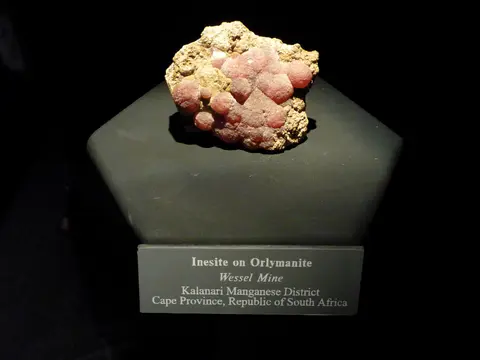
Inesite: Inesite on Orlymanite from Cape Province, Southafrica
Inesite on Orlymanite from Cape Province, Southafrica. Photo: Waifer X, CC BY 2.0, via Wikimedia Commons.
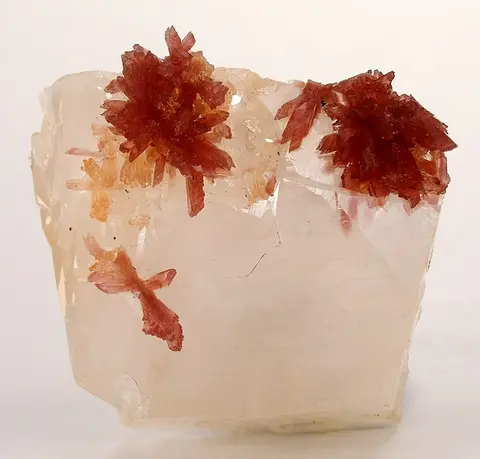
Inesite: Inesite, calcite 2
Inesite, calcite 2. Photo: Géry PARENT, CC BY-SA 4.0, via Wikimedia Commons.

What inesite is worth

Not enough data. We have not yet seen 5 or more current dealer listings for inesite in any one form, so we show no range rather than guess.

Show 5 of the listings behind these numbers
Sample dealer listings for Inesite
ListingSizeLocalityAskingSeen
1.9" Polished Pink Inesite Egg - South Africa
FossilEra
4.8 cmSouth Africa$25
2.15" Pink Inesite Crystals on Matrix - California
FossilEra
5.5 cmCalifornia$35
1.45" Pink Inesite Crystals on Matrix - California
FossilEra
3.7 cmCalifornia$35
1.85" Pink Inesite Crystals on Matrix - California
FossilEra
4.7 cmCalifornia$45
2.75" Fibrous, Rose-Red Inesite Crystal Aggregation - South Africa
FossilEra
7 cmSouth Africa$195

These are dealer asking prices: what shops list inesite for, not what it sells for and not an appraisal. Selling to a dealer usually brings well below retail, because the dealer has to resell it at a margin.

How to identify inesite

  • Pink, rose to orange-red color, often brighter orange-pink in South African material.
  • Radiating sprays, fans and balls of bladed or fibrous crystals; the name comes from Greek for flesh-colored fibers.
  • Vitreous to silky luster on crystal faces.
  • Hardness 5.5 to 6: resists a steel knife.
  • SG about 3.0.
  • Typically with manganese oxides, calcite, quartz or other manganese silicates.

Where inesite comes from

N'Chwaning and Wessels mines, Kalahari manganese field, South Africa
The finest and most colorful orange-pink sprays and balls on the market.
Hale Creek mine, Trinity County, California, USA
Pink radiating inesite from a manganese deposit, well known to American collectors.
Nanzenbach, Dillenburg, Hesse, Germany
Type locality of the species.

Inesite lookalikes

Rhodochrosite

Rhodochrosite forms rhombohedral crystals or banded masses, is softer, and a knife scratches it.

  • Rhodochrosite hardness 3.5 to 4
  • SG 3.7
  • Perfect rhombohedral cleavage

Rhodonite

Rhodonite is usually massive pink with black manganese veins, rarely in radiating sprays.

  • Rhodonite hardness 5.5 to 6.5
  • SG 3.4 to 3.7

Mangano calcite

Mangano calcite fizzes slightly in vinegar, is softer and fluoresces pink under short-wave UV.

  • Hardness 3
  • SG 2.7

Fake, dyed and treated inesite

  • Other pink manganese minerals labeled as inesite

    Occasional

    • Rhombohedral crystals point to rhodochrosite
    • Fizzing in vinegar points to calcite
    • A soft, knife-scratchable spray is not inesite
  • Re-attached sprays on matrix

    Occasional

    • Glue at the base of sprays
    • Spray orientation not matching growth surface

Is my inesite real? Tests you can do at home

  1. Knife scratch test

    Try a steel knife tip on a hidden part of a spray.

    Real
    Resists the knife.
    Fake or lookalike
    Rhodochrosite and mangano calcite scratch.

    Can leave a small mark.

  2. Vinegar test

    Put one drop of household vinegar on a hidden spot and watch with a loupe.

    Real
    No fizzing.
    Fake or lookalike
    Mangano calcite fizzes; rhodochrosite reacts only weakly.

    Can leave a small mark.

  3. Short-wave UV check

    If you have a short-wave UV lamp, shine it on the specimen in the dark, protecting your eyes and skin.

    Real
    Generally no strong glow.
    Fake or lookalike
    Mangano calcite glows pink to red.

A stone that passes these tests is consistent with natural inesite, not proven. For valuable pieces, a gem lab report settles treatment and origin.

What moves the price of inesite

  1. Color. Bright orange-pink to rose red sprays rank above pale or brownish material.
  2. Habit and sharpness. Full, undamaged radiating balls or fans with lustrous blades.
  3. Locality. Kalahari specimens set the standard; Hale Creek and type locality pieces appeal to locality collectors.
  4. Matrix and associations. Contrasting matrix or associated minerals.
  5. Damage. Crushed blades and broken sprays reduce value.

Sources

Prices: 5 current listings from FossilEra, seen 2026-11-20 to 2026-11-20. How we collect prices.