Tugtupite is a rare sodium beryllium aluminum silicate chloride, related in structure to sodalite, found as pink to crimson masses in alkaline igneous rocks. Nearly all gem and specimen material comes from the Ilimaussaq complex in southwest Greenland.
Prices checked . Page updated .
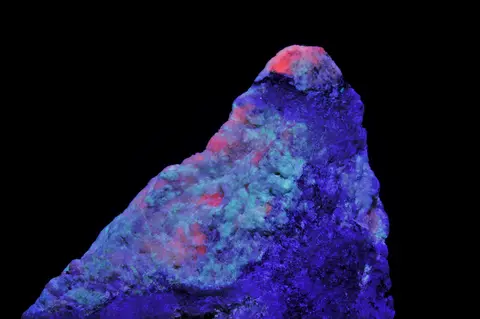
Tugtupite, UVL. Photo: Parent Géry, CC BY-SA 3.0, via Wikimedia Commons.
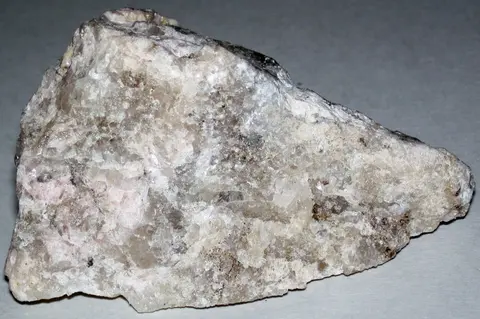
Tugtupite in alkaline syenite before UV exposure (Ilímaussaq Complex, Mesoproterozoic, 1.16 Ga; Taseq Slope, Greenland) 2. Photo: James St. John, CC BY 2.0, via Wikimedia Commons.
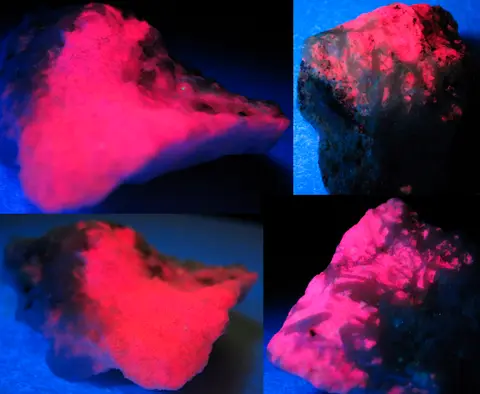
Tugtupite fluorescing (Ilímaussaq Complex, Mesoproterozoic, 1.16 Ga; Taseq Slope, Greenland). Photo: James St. John, CC BY 2.0, via Wikimedia Commons.
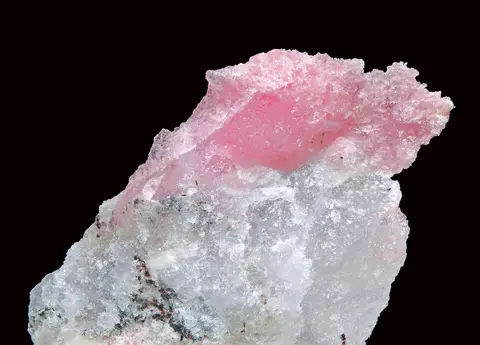
Tugtupite 1. Photo: Géry PARENT, CC BY-SA 3.0, via Wikimedia Commons.
What tugtupite is worth
Not enough data. We have not yet seen 5 or more current dealer listings for tugtupite in any one form, so we show no range rather than guess.
These are dealer asking prices: what shops list tugtupite for, not what it sells for and not an appraisal. Selling to a dealer usually brings well below retail, because the dealer has to resell it at a margin.
How to identify tugtupite
Pink, rose to deep crimson color, often mottled or veined through white feldspar, analcime or sodalite.
Fluoresces bright red to orange red under a UV torch, strongest under shortwave.
Tenebrescent: the pink deepens after exposure to sunlight or UV and pales again after days in the dark.
Translucent with a vitreous to greasy luster on polished surfaces.
Soft for a gem: hardness 4, so a steel knife scratches it.
Light in the hand (SG 2.36), similar to sodalite and lighter than quartz.
Where tugtupite comes from
Ilimaussaq complex, near Narsaq, southwest Greenland
Type locality (Tugtup agtakorfia and the Kvanefjeld and Taseq areas). The only source of gem and cabochon grade material, sold as rough, slabs and cabochons.
Mont Saint-Hilaire, Quebec, Canada
Tiny crystals of interest to micromount collectors, not cutting material.
Lovozero massif, Kola Peninsula, Russia
Minor occurrences in alkaline rocks, specimen interest only.
Thulite is a pink zoisite that does not deepen in color after sunlight and is heavier (SG about 3.1).
Thulite hardness 6 to 6.5
Fake, dyed and treated tugtupite
Other pink fluorescent rocks sold as tugtupite
Occasional
No color change after a few minutes under a UV torch or in sun
Fluorescence orange or absent instead of red
No Greenland provenance from the seller
Dyed pale rock or quartzite sold as red tugtupite
Rare
Color concentrated in cracks
Acetone swab picks up color
No red fluorescence
Is my tugtupite real? Tests you can do at home
UV torch fluorescence
In a dark room shine a shortwave UV lamp, or a 365 nm longwave torch, on the stone.
Real
Bright red to orange red glow, strongest under shortwave.
Fake or lookalike
Orange, yellow or no glow.
Tenebrescence check
Keep the piece in a drawer for a few days, note the color, then expose it to UV or direct sun for several minutes.
Real
Pink to red deepens noticeably, then slowly fades again in the dark.
Fake or lookalike
Color stays the same.
Steel scratch on a hidden spot
Press a steel knife point lightly on an unpolished back edge.
Real
Steel scratches it (hardness 4).
Fake or lookalike
Quartzite or dyed chalcedony resists steel.
Can leave a small mark.
Specific gravity by water displacement
Weigh the piece dry on a kitchen scale, then weigh the water it displaces in a cup and divide.
Real
About 2.36, close to sodalite.
Fake or lookalike
Rhodochrosite or rhodonite read about 3.5 or more.
A stone that passes these tests is consistent with natural tugtupite, not proven. For valuable pieces, a gem lab report settles treatment and origin.
Treatments
None routine (rare)
Tugtupite is sold untreated; the color shift comes from light exposure, not treatment. Not usually a concern.
What moves the price of tugtupite
Color. Deep, even crimson outranks pale or blotchy pink.
Tenebrescent response. Pieces that deepen strongly in sunlight are preferred.
Translucency. Glowing translucent material is scarce; most is opaque and mixed with white minerals.
Proportion of tugtupite. Slabs and cabochons with mostly red tugtupite rank above those dominated by white matrix.
Provenance. Documented Greenland material is expected; supply is limited.
Size and cut. Larger clean cabochons and rare faceted stones are scarce.
Care and safety
Hardness 4 means it scratches easily; keep it away from harder stones and avoid ring use. Store away from bright light if you want to keep the paler resting color, or display in light for deeper color.