RockValues

Magnetite value and identification

Magnetite is an iron oxide (Fe3O4) and the most strongly magnetic natural mineral. It is a major iron ore and forms black, metallic octahedral crystals, grains and massive ore.

Prices checked . Page updated .

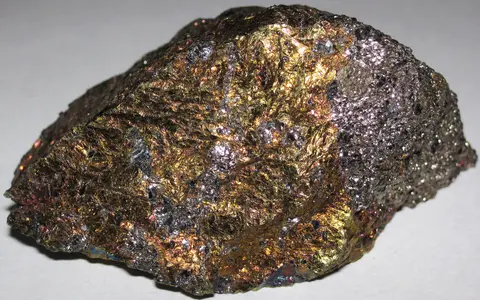
Magnetite: Chalcopyrite-pyrrhotite-magnetite (Paleoproterozoic, 1.85 Ga; Creighton Mine, Sudbury Impact Structure, Ontario, Canada) 2
Chalcopyrite-pyrrhotite-magnetite (Paleoproterozoic, 1.85 Ga; Creighton Mine, Sudbury Impact Structure, Ontario, Canada) 2. Photo: James St. John, CC BY 2.0, via Wikimedia Commons.
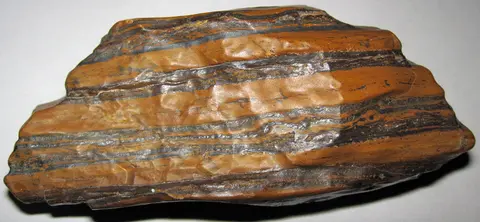
Magnetite: BIF ventifact (limonite-magnetite banded iron formation, Archean; Ferris Dune Field, Windy Gap, Wyoming, USA) 2 (25475973503)
BIF ventifact (limonite-magnetite banded iron formation, Archean; Ferris Dune Field, Windy Gap, Wyoming, USA) 2 (25475973503). Photo: James St. John, CC BY 2.0, via Wikimedia Commons.
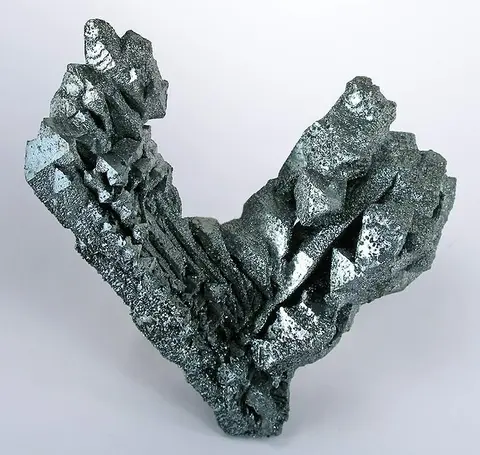
Magnetite: Hematite-Magnetite-160165
Hematite-Magnetite-160165. Photo: Robert M. Lavinsky, CC BY-SA 3.0, via Wikimedia Commons.
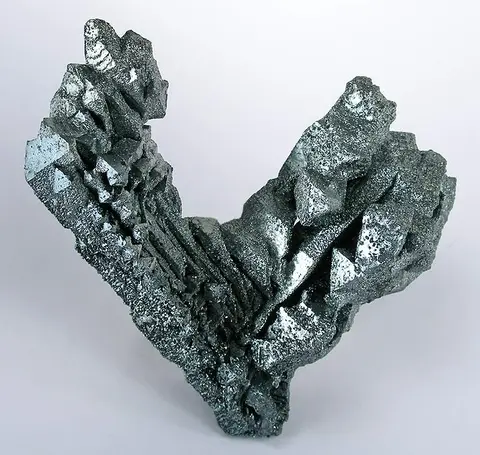
Magnetite: Hematite-Magnetite-t08-25ba
Hematite-Magnetite-t08-25ba. Photo: Robert M. Lavinsky, CC BY-SA 3.0, via Wikimedia Commons.

What magnetite is worth

Not enough data. We have not yet seen 5 or more current dealer listings for magnetite in any one form, so we show no range rather than guess.

Show 6 of the listings behind these numbers

These are dealer asking prices: what shops list magnetite for, not what it sells for and not an appraisal. Selling to a dealer usually brings well below retail, because the dealer has to resell it at a margin.

How to identify magnetite

  • Strongly attracted to a magnet, even small grains
  • Black streak on unglazed porcelain
  • Black to dark gray color with a metallic to dull luster
  • Heavy in the hand (SG about 5.2)
  • Crystals are commonly octahedrons (two pyramids base to base) or rhombic dodecahedrons
  • No cleavage, but may break along flat parting planes

Magnetite varieties

Where magnetite comes from

Kiruna, Sweden
One of the world's largest magnetite iron ore deposits.
Zillertal, Tyrol, Austria
Classic sharp octahedra in green chlorite schist, a collector favorite.
Cerro Huanaquino, Potosi, Bolivia
Large, lustrous octahedral crystals that dominate the specimen market.
Magnet Cove, Arkansas, USA
Known for magnetite and natural lodestone.
Beach and river sands worldwide
Black sand concentrates in gold pans are largely magnetite.

Magnetite lookalikes

Hematite

Hematite gives a red-brown streak and is not attracted to a magnet (or only weakly).

  • Hematite SG 5.0 to 5.3, similar weight
  • Hematite crystals are tabular or bladed, not octahedral

hematite vs magnetite

Iron meteorite

A ground corner of an iron meteorite shows bright silvery nickel-iron metal; magnetite stays black.

  • Iron meteorites SG 7.5 to 8, much heavier
  • Meteorites often show thumbprint-like regmaglypts and fusion crust
  • Magnetite streak is black; metal leaves no streak

Magnesite

Magnesite is white to gray and not magnetic; the two are confused only by name.

  • Magnesite is magnesium carbonate
  • SG about 3.0

magnesite vs magnetite

Obsidian

Obsidian is glass: it is light (SG about 2.4), non-magnetic and breaks with sharp, shiny conchoidal fractures.

  • Obsidian streak is white
  • Thin edges are translucent

magnetite black vs obsidian black

Chromite and ilmenite

Both are only weakly magnetic; chromite has a brown streak.

  • Chromite SG 4.5 to 4.8
  • Ilmenite SG 4.7

Also mistaken for magnetite: meteorite, chondrite, lodestone, cassiterite, uraninite, tantalite, psilomelane.

Fake, dyed and treated magnetite

  • "Magnetic hematite" or hematine beads sold as magnetite

    Very common

    • Perfectly uniform, mirror-polished beads
    • Strong enough to cling to each other in a strand, beyond normal magnetite
    • Man-made ferrite ceramic; chips show gray granular interior
    • Often labeled hematite or magnetite interchangeably
  • Magnetized magnetite sold as natural lodestone

    Occasional

    • Not detectable at home; both attract iron
    • Natural lodestone usually holds weaker, uneven poles
  • Painted or oiled rough to darken and add shine

    Rare

    • Color rubs off with acetone
    • Streak still shows the true mineral

Is my magnetite real? Tests you can do at home

  1. Magnet

    Hang a small magnet on a string and bring the stone near it, or touch a fridge magnet to the stone.

    Real
    Strong, obvious pull.
    Fake or lookalike
    Hematite and obsidian show no pull; chromite and ilmenite only weak pull.
  2. Streak plate

    Rub a corner on the back of an unglazed ceramic tile.

    Real
    Black streak.
    Fake or lookalike
    Hematite red-brown; chromite brown.

    Can leave a small mark.

  3. Specific gravity with a kitchen scale

    Weigh dry, then suspended in water; divide dry weight by the loss in water.

    Real
    About 5.2.
    Fake or lookalike
    Iron meteorites 7.5 to 8; obsidian about 2.4.
  4. Scratch test against glass

    Drag a sharp edge across a glass tile.

    Real
    Usually scratches glass or is close to it (5.5 to 6.5).
    Fake or lookalike
    Softer metallic minerals such as galena do not.

    Can leave a small mark.

A stone that passes these tests is consistent with natural magnetite, not proven. For valuable pieces, a gem lab report settles treatment and origin.

Treatments

Artificial magnetizing (occasional)
Turns ordinary magnetite into a lodestone-like piece; reduces value as a natural lodestone. Not detectable at home; provenance matters.

What moves the price of magnetite

  1. Crystal form. Sharp, lustrous octahedra and dodecahedra are worth far more than massive ore.
  2. Size. Large single crystals with clean faces are scarce.
  3. Matrix. Crystals on contrasting matrix such as green chlorite schist from Zillertal are prized.
  4. Locality. Classic localities draw collector interest.
  5. Natural magnetism. Natural lodestones that pick up iron sell as a separate category.
  6. Damage. Chipped edges and rust stains lower value.

Sources

Prices: 6 current listings from FossilEra, seen 2026-11-20 to 2026-11-20. How we collect prices.