What obsidian is worth
By variety
Show 12 of the listings behind these numbers
These are dealer asking prices: what shops list obsidian for, not what it sells for and not an appraisal. Selling to a dealer usually brings well below retail, because the dealer has to resell it at a margin.
How to identify obsidian
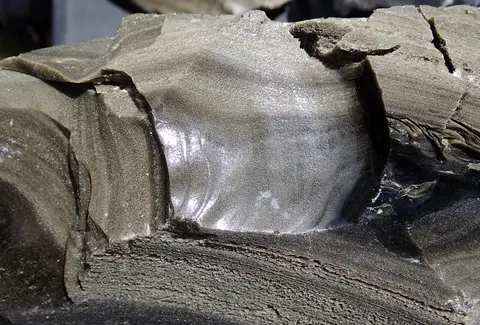
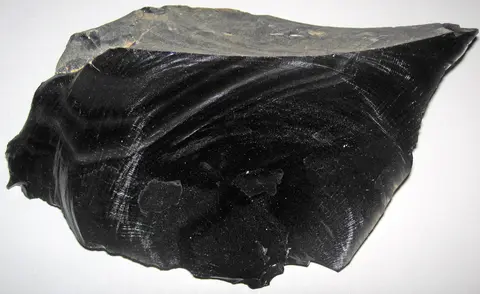
Obsidian is natural volcanic glass, formed when silica-rich lava (usually rhyolitic, around 70 to 75 percent silica) cools too fast for crystals to grow. It is a rock, not a mineral, and its black color comes from tiny crystallites and magnetite dust suspended in the glass.
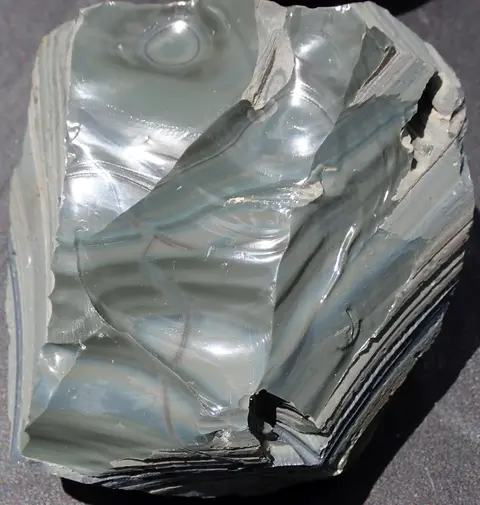
- Glassy luster on fresh surfaces and a smooth, shell-shaped (conchoidal) fracture with very sharp edges.
- Thin edges held to a strong light are translucent smoky gray, brown or greenish gray, not a clear bright color.
- Weathered surfaces are often frosted, pitted or rind-covered, while broken faces are mirror-bright.
- No crystal faces, no cleavage and no grain; it breaks the same way in every direction.
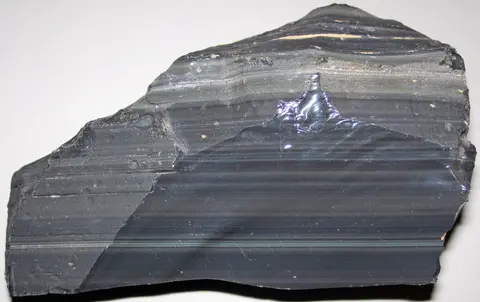
- Flow banding, gray or brown streaks, white snowflake spherulites or a sheen under a light are common internal features.
- Hardness about 5 to 5.5: a steel knife scratches it with effort and it does not scratch quartz.
- Feels light for its size compared with metallic or iron-rich black stones (specific gravity about 2.35 to 2.6).
Obsidian varieties
Velvet obsidian
A trade name for Mexican obsidian with a soft, multicolored sheen that gives a velvety look under direct light. Velvet obsidian is a sheen obsidian, closely related to rainbow and gold sheen types; the name describes the soft look of the sheen rather than a separate material.
Midnight lace obsidian
A trade name for black obsidian with fine gray, lace-like flow banding that shows best on polished surfaces. The lace pattern is flow banding preserved in the glass; it has no sheen or spherulites, only contrasting layers.
Glass buttes obsidian
Obsidian from Glass Buttes, Lake County, Oregon, one of the most varied obsidian deposits in North America. A locality name rather than a type: Glass Buttes produces black, mahogany, gold and silver sheen, rainbow, midnight lace and the rare fire obsidian.
Oregon obsidian
A general name for obsidian collected in Oregon, mainly from Glass Buttes and other volcanic fields in the central and eastern part of the state. A regional label rather than a type; Oregon obsidian covers many varieties, including fire obsidian, which is found nowhere else in quantity.
Where obsidian comes from
- Glass Buttes, Lake County, Oregon, USA
- One of the most varied deposits: black, mahogany, gold and silver sheen, rainbow, midnight lace and the rare fire obsidian. Much of it is on public land open to hobby collecting.
- Davis Creek, Modoc County, California, USA
- Known for rainbow and sheen obsidian and for collecting areas in the Modoc National Forest.
- Jalisco, Mexico
- Main source of the rainbow, gold sheen and velvet obsidian sold cut and tumbled in shops worldwide.
- Millard County, Utah, USA
- Classic source of snowflake obsidian with white cristobalite spherulites.
- Superior, Pinal County, Arizona, USA
- Type area for Apache tears, small rounded obsidian nodules weathering out of gray perlite.
- Armenia
- Large obsidian fields that supply black and banded material to the carving and bead trade.
- Lipari, Italy
- Historic source traded across the Mediterranean in prehistory; of interest for archaeology more than specimens.
Obsidian lookalikes
Slag glass
Slag often has round gas bubbles, swirls of unnatural color (blue, green, purple) and metallic or rusty specks.
- Industrial byproduct from smelting or glassmaking
- Specific gravity varies and is often higher than obsidian
- Colors far brighter and more saturated than natural obsidian
- Found near old furnaces, rail lines and dumps rather than volcanic areas
Tourmaline forms striated prism crystals and scratches glass easily; obsidian has no crystal shape.
- Hardness 7 to 7.5 versus obsidian 5 to 5.5
- Specific gravity about 3.1 to 3.2, noticeably heavier
- Triangular cross section with lengthwise grooves
- Fully opaque even on thin edges
black tourmaline vs obsidian
Onyx has a waxy polish and stays opaque on thin edges; obsidian edges glow smoky gray when backlit.
- Hardness about 7, scratches glass
- Most black onyx on the market is dyed chalcedony
- Fracture is less glassy and more waxy
- Specific gravity about 2.6
onyx vs obsidian
Hematite leaves a red-brown streak and is very heavy; obsidian streak is white.
- Specific gravity about 5.3, roughly twice obsidian
- Metallic luster rather than glassy
- Hardness 5.5 to 6.5
hematite vs obsidian
Chert is dull to waxy and fully opaque, not glassy.
- Hardness about 7
- Microcrystalline quartz, not glass
- Breaks conchoidally like obsidian but with a duller surface
chert vs obsidian
Basalt
Basalt is grainy, dull and often has visible crystals or vesicles; it never shows the glassy fracture of obsidian.
- Specific gravity about 2.9 to 3.0
- Dark gray to black, dull luster
- Fine-grained crystalline rock, not glass
Tektites have sculpted, etched surfaces and moldavite is green; obsidian from volcanoes is mostly black and has no such sculpting.
- Tektites form from meteorite impacts, not volcanoes
- Moldavite specific gravity about 2.3 to 2.4
- Green obsidian is almost never natural
Also mistaken for obsidian: chalcedony, rhyolite, magnetite, tektite.
Fake, dyed and treated obsidian
Colored glass sold as green, blue, red or purple obsidian
Very common
- Bright transparent colors such as emerald green, cobalt blue or amber that natural obsidian does not show
- Perfectly clean interior or round bubbles
- Uniform color with no flow banding or crystallites
- Often sold under trade names like Andara crystal or simply as green obsidian
Slag glass sold as rainbow or black obsidian
Common
- Swirled bright colors and iridescence on the surface rather than inside
- Round gas bubbles and rusty metallic inclusions
- Often in chunks with a frothy or ropy side
Black onyx or black glass beads labeled obsidian
Occasional
- Onyx beads are fully opaque and scratch glass
- Glass beads are often perfectly uniform with mold seams
- Real obsidian beads show smoky translucency at drill holes
Is my obsidian real? Tests you can do at home
-
Thin edge backlight
Shine a bright flashlight through the thinnest edge of the piece.
- Real
- Natural obsidian glows smoky gray, brown or olive at the edge, often with faint banding or specks.
- Fake or lookalike
- Man-made glass shows a clear, saturated color (green, blue, red); onyx and tourmaline stay completely dark.
-
Loupe inspection
Look inside the stone and along the surface with a 10x loupe.
- Real
- Stretched or elongated bubbles, tiny dark crystallites, flow lines or spherulites.
- Fake or lookalike
- Perfectly round bubbles, swirls of unnatural color or no features at all point to man-made glass.
-
Scratch against glass
Try to scratch a piece of window or bottle glass with a sharp edge of the stone, then wipe the mark.
- Real
- Obsidian is about the same hardness as glass and leaves at most a faint scratch.
- Fake or lookalike
- Tourmaline, onyx and chert (hardness 7) cut glass easily; this test does not separate obsidian from other glass.
Can leave a small mark.
-
Streak plate
Rub an unpolished corner on the back of a white ceramic tile.
- Real
- White or no visible streak.
- Fake or lookalike
- Hematite leaves red-brown, magnetite leaves black.
Can leave a small mark.
-
Specific gravity with a kitchen scale
Weigh the stone dry, then weigh it hanging by a thread in a cup of water on the scale; divide the dry weight by the weight of water displaced.
- Real
- About 2.35 to 2.6.
- Fake or lookalike
- Black tourmaline about 3.1, hematite about 5, slag glass often above 2.7.
A stone that passes these tests is consistent with natural obsidian, not proven. For valuable pieces, a gem lab report settles treatment and origin.
Treatments
- Coating (rare)
- Some tumbled pieces are given a metallic vapor coating to add rainbow color; coated pieces are novelty items and should be sold as coated. Color sits only on the surface and wears off at edges; natural sheen is inside the stone and shifts as you turn it under a single light.
What moves the price of obsidian
- Variety and optical effect. Fire obsidian and strong rainbow material sit far above plain black, with gold sheen, silver sheen and snowflake in between.
- Strength of the sheen. Bright, even rainbow or sheen bands across a whole face matter more than size.
- Size and form. Large clean rough, spheres and carvings move value; tumbled pieces and Apache tears are inexpensive staples.
- Cutting and polish. Rainbow and fire obsidian must be cut parallel to the layers to show color, so skilled cutting adds value.
- Locality. Documented Glass Buttes fire obsidian or named Oregon and California material carries a collector premium.
- Damage. Obsidian chips easily; edge chips on polished pieces reduce value.
Care and safety
Obsidian chips and fractures more easily than quartz. Store pieces apart, and avoid hard knocks and sudden temperature changes. Broken edges are razor sharp.
Questions collectors ask about obsidian
- How is obsidian rock formed?
- Silica-rich lava erupts and cools so quickly that atoms cannot arrange into crystals, leaving a solid glass. It usually forms at the edges of rhyolite lava flows and domes.
- What is obsidian used for?
- Prehistoric people made arrowheads, blades and mirrors from it because it breaks to a razor edge. Today it is used for jewelry, carvings, spheres and some specialty surgical blades.
- Is obsidian worth money?
- Common black obsidian is abundant and inexpensive, while fire obsidian, strong rainbow obsidian and fine large carvings are worth considerably more. Variety, sheen strength, size and cutting quality drive value; see the price table above.
- What is the rarest color of obsidian?
- Fire obsidian from Glass Buttes, Oregon, with thin-film rainbow colors, is among the rarest. Bright transparent green, blue or purple pieces sold as obsidian are almost always man-made glass.
- How to tell if green obsidian is real or fake?
- Natural obsidian is not bright transparent green; thin edges are smoky gray-green at most. Clear emerald green, bottle green or teal pieces with round bubbles are glass.
Sources
Prices: 49 current listings from FossilEra, Kingsley North, The Gem Shop, seen 2026-11-20 to 2026-11-20. How we collect prices.