Dealers list rhyolite slabs and polished pieces 20 to 40 cm (8 to 16 in) at $110 to $200.
Prices checked . Page updated .
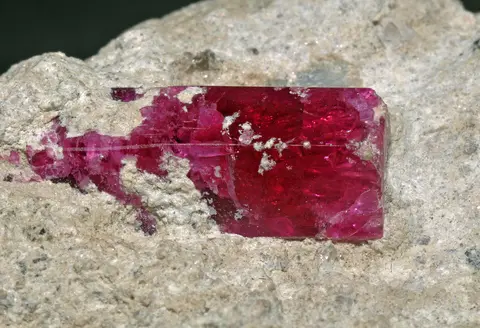
Béryl rouge sur gangue de rhyolite (Wah-Wah Mountains Utah - USA) 1. Photo: Parent Géry, CC BY-SA 3.0, via Wikimedia Commons.
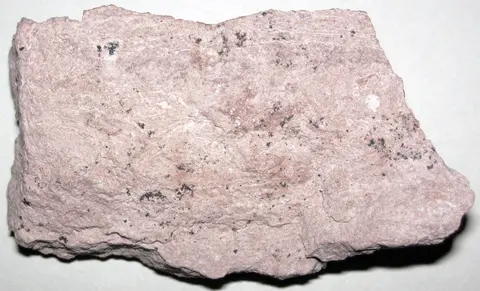
Garnet Hill Rhyolite (Late Eocene, 36-37 Ma; Garnet Hill, White Pine County, Nevada, USA). Photo: James St. John, CC BY 2.0, via Wikimedia Commons.
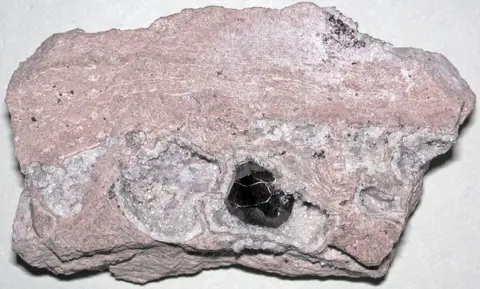
Garnet in rhyolite (Garnet Hill Rhyolite, Late Eocene, 36-37 Ma; Garnet Hill, White Pine County, Nevada, USA). Photo: James St. John, CC BY 2.0, via Wikimedia Commons.
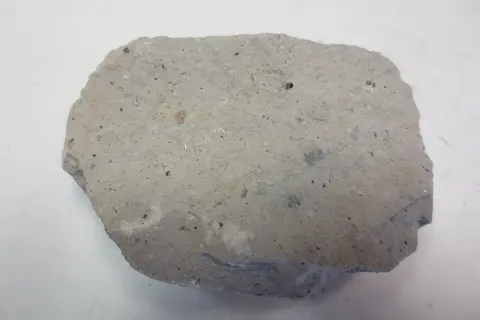
Rhyolite Colorado. Photo: Amcyrus2012, CC BY-SA 4.0, via Wikimedia Commons.
What rhyolite is worth
Dealer asking prices for rhyolite, middle half of current listings, checked 2026-11-20. Bar shows the 25th to 75th percentile; the dark tick is the median.
These are dealer asking prices: what shops list rhyolite for, not what it sells for and not an appraisal. Selling to a dealer usually brings well below retail, because the dealer has to resell it at a margin.
How to identify rhyolite
Rhyolite is a silica-rich volcanic rock with the same chemistry as granite, cooled quickly at the surface so its grains are too small to see. It is mostly quartz, potassium feldspar and plagioclase, often with flow banding, spherulites or scattered larger crystals.
Fine-grained to glassy groundmass in light colors: pink, tan, cream, light gray, lavender, reddish or pale green.
Often porphyritic: small glassy quartz or blocky feldspar crystals scattered in the fine groundmass.
Flow banding, thin wavy layers that formed as the thick lava moved, is common.
Round spherulites or orbs from a few millimeters to several centimeters, sometimes with hollow centers (lithophysae).
Hardness about 6 to 6.5: it usually scratches glass weakly, especially where quartz grains are present.
Light to medium weight (density about 2.4 to 2.6), lighter than basalt.
Breaks with a rough, slightly gritty surface rather than the smooth, waxy break of jasper or chert.
Rhyolite varieties
Rainforest rhyolite
Rainforest rhyolite is green to yellow-green rhyolite from Queensland, Australia, with brown and red spherulites and orbs, sold widely as rainforest jasper. It is ordinary rhyolite in composition but with distinctive green coloring and orbicular spherulites that make it a lapidary stone.
Birdseye rhyolite
Birdseye rhyolite is a trade name for rhyolite with small round spots, usually darker red, brown or white spherulites, scattered through a lighter groundmass. It is standard rhyolite whose spotted, eye-like spherulites give it a lapidary use; the name describes the pattern, not a different rock.
Where rhyolite comes from
Yellowstone and the Snake River Plain, USA
Huge rhyolite flows and welded tuffs; textbook exposures of the rock type.
Oregon, USA
Rhyolite flows and tuffs produce thunder eggs and many picture and orbicular rocks sold as jasper.
Queensland, Australia
Mount Hay and nearby areas supply green and orbicular rhyolite sold as rainforest jasper, plus thunder eggs.
Mexico
Source of many orbicular and spotted rhyolites marketed under jasper trade names.
Taupo Volcanic Zone, New Zealand
Active rhyolitic volcanic center with young flows and pumice.