What moldavite is worth
Show 12 of the listings behind these numbers
These are dealer asking prices: what shops list moldavite for, not what it sells for and not an appraisal. Selling to a dealer usually brings well below retail, because the dealer has to resell it at a margin.
How to identify moldavite
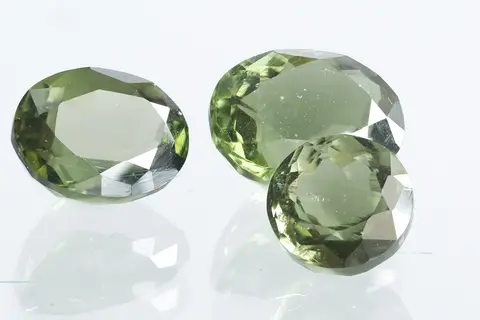
Moldavite is a translucent green tektite from southern Bohemia and Moravia in the Czech Republic, formed by the Ries impact in southern Germany about 15 million years ago.
Moldavite is the only tektite that is green and transparent in normal light; most other tektites look black. See tektite value for the species as a whole.
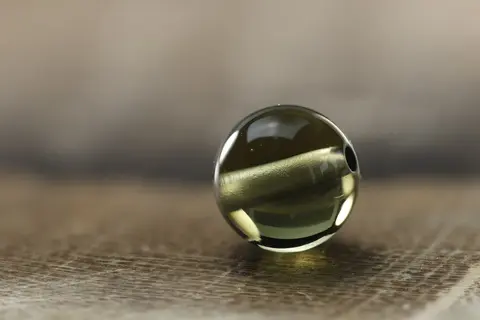
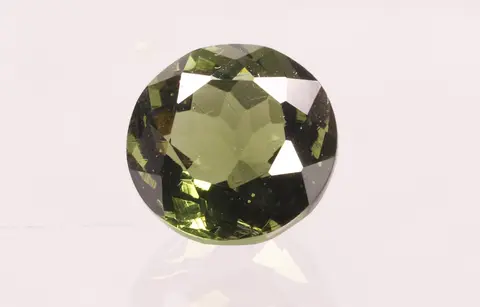
- Bottle green to olive or brownish green, transparent to translucent
- Deeply etched, sculpted, often fernlike or spiky surface on natural pieces
- Elongated or swirled bubbles and wormlike lechatelierite inclusions under a loupe
- Flow lines visible when backlit
- SG about 2.32 to 2.38
Where moldavite comes from
- Southern Bohemia, Czech Republic
- Most moldavite, from sand and gravel pits around Ceske Budejovice, including Chlum and Besednice (known for spiky 'hedgehog' pieces).
- Moravia, Czech Republic
- Browner, often larger moldavite from the Trebic area.
- Lusatia, Germany, and Horn, Austria
- Minor finds.
Moldavite lookalikes
Also mistaken for moldavite: obsidian.
Fake, dyed and treated moldavite
Manufactured green glass
Very common
- Very even saturated emerald green
- Round bubbles but no lechatelierite
- Shapes repeat across a dealer's stock
- Uniform acid-frosted surface or obvious mold marks
- SG often above 2.45
Faceted green glass sold as cut moldavite
Common
- No swirl lines
- Perfectly clean
Is my moldavite real? Tests you can do at home
-
Loupe and backlight
Look through the stone against a flashlight at 10x.
- Real
- Swirl lines, elongated bubbles and threadlike lechatelierite.
- Fake or lookalike
- Clean glass or only round bubbles.
-
Specific gravity
Weigh dry and suspended in water on a gram scale, then divide.
- Real
- 2.32 to 2.38.
- Fake or lookalike
- Many glasses read 2.45 to 2.6.
-
Color under daylight
Compare against a white card in daylight.
- Real
- Soft forest or olive green, often uneven.
- Fake or lookalike
- Bright, even emerald or lime green.
A stone that passes these tests is consistent with natural moldavite, not proven. For valuable pieces, a gem lab report settles treatment and origin.
Treatments
- Faceting or polishing (occasional)
- Cut moldavite is legitimate; raw pieces with natural sculpture usually command more per gram. Visible.
- Acid etching or reshaping (occasional)
- Artificial enhancement of surface lowers value once spotted. Uniform frosting and sharp, regular grooves.
What moves the price of moldavite
- Surface sculpting. Deep natural 'hedgehog' sculpting is the most sought.
- Locality. Besednice and Chlum pieces carry a premium.
- Weight. Larger pieces are increasingly scarce.
- Color and clarity. Bright, clear green beats dark or brownish.
- Seller and documentation. Fakes are everywhere; reputable sourcing adds value.
Questions collectors ask about moldavite
- What is moldavite?
- Moldavite is a green natural glass from the Czech Republic, formed about 15 million years ago when an asteroid impact in southern Germany melted and threw out surface rock. It is a tektite, not a crystal.
- How to tell if moldavite is real or fake?
- Look through it with a loupe against a light: real moldavite shows swirls, elongated bubbles and threadlike lechatelierite, and has an SG of about 2.32 to 2.38. Fakes are usually too evenly green, have only round bubbles and come in repeated shapes.
- Is moldavite illegal?
- No. Moldavite is legal to own, buy and sell. Digging it on private or protected land in the Czech Republic without permission is illegal, as with any mineral collecting.
- How much is 1 gram of moldavite worth?
- Per-gram value depends on surface sculpting, locality, size and clarity, with raw sculpted pieces above plain fragments. See the price table above for current observed figures.
Sources
Prices: 183 current listings from Dave's Rock Shop, FossilEra, Throwin Stones, seen 2026-11-20 to 2026-11-20. How we collect prices.