RockValues

Meteorite value and identification

Dealers list meteorite whole stones at $5.50 to $22 per gram.

Prices checked . Page updated .
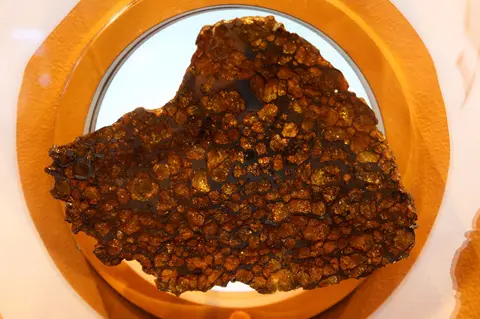
Meteorite: Meteorite with crystals - panoramio
Meteorite with crystals - panoramio. Photo: Jiaqian AirplaneFan, CC BY 3.0, via Wikimedia Commons.
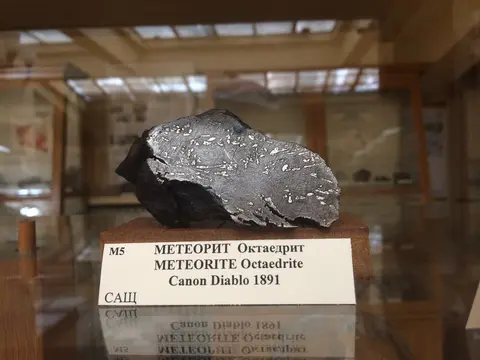
Meteorite: A FRAGMENT OF CANYON DIABLO METEORITE AT THE MUSEUM OF MINERALOGY, SOFIA UNIVERSITY 'ST. KLIMENT OHRIDSKI'
A FRAGMENT OF CANYON DIABLO METEORITE AT THE MUSEUM OF MINERALOGY, SOFIA UNIVERSITY 'ST. KLIMENT OHRIDSKI'. Photo: Motekov, CC0, via Wikimedia Commons.
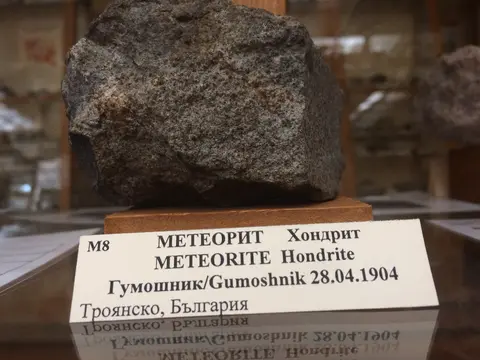
Meteorite: METEORITE GUMOSHNIK-BULGARIA 28-04-1904 MUSEUM OF MINERALOGY AT SOFIA UNIVERSITY
METEORITE GUMOSHNIK-BULGARIA 28-04-1904 MUSEUM OF MINERALOGY AT SOFIA UNIVERSITY. Photo: Motekov, CC0, via Wikimedia Commons.
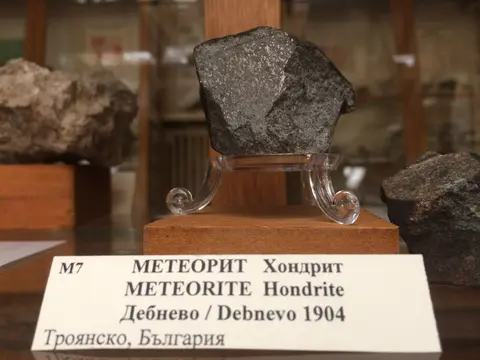
Meteorite: METEORITE HONDRITE - DEBNEVO 1904 AT MUSEUM OF MINERALOGY, SOFIA UNIVERSITY 'ST. KLIMENT OHRIDSKI'
METEORITE HONDRITE - DEBNEVO 1904 AT MUSEUM OF MINERALOGY, SOFIA UNIVERSITY 'ST. KLIMENT OHRIDSKI'. Photo: Motekov, CC BY 4.0, via Wikimedia Commons.

What meteorite is worth

Dealer asking prices for meteorite, middle half of current listings, checked 2026-11-20. Bar shows the 25th to 75th percentile; the dark tick is the median.
Form and sizeTypical asking priceRange chartMedianListings
Whole stones (per gram)$5.49 to $22$11718 from 5 dealers
Slabs and polished pieces (per piece)$195 to $695$34973 from 3 dealers
5 to 10 cm (2 to 4 in)$217 to $695$29539 from 3 dealers
under 5 cm (2 in)$177 to $320$19515 from 1 dealer
10 to 20 cm (4 to 8 in)$432 to $1,150$62512 from 2 dealers
Cabochons (per carat)Not enough data (0 listings, need 5)

By variety

Median dealer asking price by variety (individual).
VarietyMedianListings
Nwa meteorite$16 per gram357
Chondrite$12 per gram71
Sikhote-alin$2.39 per gram37
Pallasite$10 per gram19
Campo Del Cielo$1.94 per gram14
Martian meteorite$303 per gram8
Gibeon meteorite$5.69 per gram8
Mundrabilla$3.71 per gram8
Iron meteorite$2.01 per gram6
Carbonaceous chondriteNot enough data6
Canyon diablo$2.15 per gram5
Lunar meteoriteNot enough data3
BrenhamNot enough data1
NantanNot enough data1
ImilacNot enough data1

By origin

  • Morocco: $3 to $21, median $20 (91 listings)
  • Russia: $2.29 to $7.13, median $4.29 (51 listings)
  • Libya: $3.64 to $11, median $4.10 (30 listings)
  • United States: $4.20 to $20, median $7.22 (27 listings)
  • Nigeria: $7.13 to $11, median $10 (27 listings)
  • Egypt: $1.13 to $2.28, median $1.16 (23 listings)
Show 12 of the listings behind these numbers
Sample dealer listings for Meteorite
ListingSizeLocalityAskingSeen
Chondrite Meteorite Sections (1-2 Grams) - NWA 869
FossilEra
2 g$4
Chondrite Meteorite Sections (2-3 Grams) - NWA 869
FossilEra
3 g$5
Sikhote-Alin Iron Meteorite Individuals meteorite #SASM, 9.8 gm
The Meteorite Market
10 gSikhote-Alin Mountains, Maritime Province, Russia. (46° 9' 36"N, 134° 39' 12"E)$5
Gebel Kamil Iron Meteorite with Case - Egypt
FossilEra
Egypt$10
Al Haggounia EL3 meteorite #ALH4-22, 4.22 gm
The Meteorite Market
4 gAl Haggounia, Morocco (27° 30'N, 12° 30'W)$11
Agoudal Iron Meteorites (2-4 grams) - Morocco
FossilEra
4 gMorocco$12
Sericho Pallasite Meteorite Metal Skeletons - Kenya
FossilEra
Kenya$12
.57" Sericho Pallasite Meteorite (3.01 g) Metal Skeleton
FossilEra
3 g$12
Al Haggounia EL3 meteorite #ALH5-6, 5.6 gm
The Meteorite Market
6 gAl Haggounia, Morocco (27° 30'N, 12° 30'W)$13
Al Haggounia EL3 meteorite #ALH5-7, 5.7 gm
The Meteorite Market
6 gAl Haggounia, Morocco (27° 30'N, 12° 30'W)$14
Nantan Meteorite in Magnifying Box
Dave's Rock Shop
Yoachi area of Lihu, Nantan County, Guangxi Zhuang, China$15
.71" Sericho Pallasite Meteorite (3.56 g) Metal Skeleton
FossilEra
4 g$15

These are dealer asking prices: what shops list meteorite for, not what it sells for and not an appraisal. Selling to a dealer usually brings well below retail, because the dealer has to resell it at a margin.

How to identify meteorite

A meteorite is a piece of an asteroid, the Moon or Mars that survived the fall through Earth's atmosphere. The three main groups are stony meteorites (mostly silicate minerals), iron meteorites (iron-nickel metal) and stony-iron meteorites (a mix of both).

  • Thin black or dark brown fusion crust, often under 1 mm thick, on unbroken surfaces of fresh meteorites
  • Shallow thumbprint-like dents (regmaglypts) on the outside, especially on irons
  • Heavy for its size: irons are much heavier than ordinary rocks, and most stones are still heavier than typical Earth rocks
  • Attracts a magnet in most cases because of iron-nickel metal
  • A small ground window shows bright metal flecks in stony types or solid silvery metal in irons
  • Many stony meteorites show small round grains (chondrules) on a cut or broken face
  • Almost never full of gas bubbles; a bubbly, glassy rock is usually slag or lava
  • Older finds weather to rusty brown, and the crust can be partly gone

Meteorite varieties

Stony meteorite

Stony meteorites are made mainly of silicate minerals such as olivine and pyroxene, with or without iron-nickel metal. They include chondrites and achondrites. The most common kind of meteorite to fall, but harder to recognize than irons because they look more like Earth rocks and weather quickly.

Muonionalusta

Muonionalusta is a fine octahedrite iron meteorite (group IVA) found in glacial deposits in northern Sweden near the Finnish border, first reported in 1906. A named iron with a fine, sharp Widmanstatten pattern, popular for slices, spheres and jewelry. It has a very old terrestrial age and can rust if not stabilized.

Campo Del Cielo

Campo del Cielo is a coarse octahedrite iron meteorite (group IAB) that fell several thousand years ago in the Gran Chaco region of Argentina, forming a field of small craters. The most common and affordable iron meteorite on the market, sold as wire-brushed individuals and etched slices; it tends to rust.

Sikhote-alin

Sikhote-Alin is an iron meteorite that fell on 12 February 1947 in the Sikhote-Alin Mountains of the Russian Far East, one of the largest witnessed iron falls. A witnessed fall of very coarse octahedrite iron (group IIAB), sold as jagged shrapnel and as individuals with sharp regmaglypts.

Esquel

Esquel is a pallasite found in 1951 in Chubut Province, Argentina, known for large, clear, gem-quality olivine crystals. A named pallasite with some of the most transparent olivine of any pallasite and relatively good stability, making it a top choice for display slices.

Aletai

Aletai is an anomalous IIIE iron meteorite from the Altay region of Xinjiang, China, including the large Armanty mass. A named iron with large masses scattered over a long strewn field; slices show a medium etch pattern.

Nwa meteorite

NWA stands for Northwest Africa, the official name prefix given to meteorites found in the Sahara whose exact find site is unknown, usually sold through Morocco. Not a type of meteorite but a naming system: each classified NWA meteorite gets a number from the Meteoritical Society. Stones sold as NWA without a number are unclassified and may not be meteorites.

Nantan

Nantan is a coarse octahedrite iron meteorite (group IAB) from Guangxi, China; Chinese records describe a fall in the area in 1516. A named iron known for heavy rust and splitting caused by chloride minerals, so pieces need careful stabilization.

Mundrabilla

Mundrabilla is an ungrouped iron meteorite (related to group IAB) from the Nullarbor Plain in Western Australia, with masses of many tonnes. A named iron with large troilite inclusions that break up the etch pattern on slices.

Seymchan

Seymchan is a meteorite found in 1967 in the Magadan region of Russia. It was first classed as an iron and later reclassified as a pallasite after olivine-bearing parts were found. A popular pallasite sold both as all-metal slices with a clear Widmanstatten pattern and as slices with olivine pockets.

Imilac

Imilac is a pallasite from the Atacama Desert in Chile, known since the early nineteenth century. A named pallasite usually sold as small skeletal metal pieces whose olivine has weathered out, and as slices with darker olivine.

Where meteorite comes from

Northwest Africa (Sahara)
Most meteorites on the market are desert finds sold through Morocco under NWA numbers.
Oman and the Arabian Peninsula
Desert finds including lunar and Martian meteorites.
Antarctica
The richest source scientifically; finds belong to research programs and are not sold.
Gran Chaco, Argentina
Campo del Cielo iron crater field, the most common iron on the market.
Meteor Crater, Arizona, USA
Source of Canyon Diablo iron.
Gibeon area, Namibia
Fine octahedrite iron used for jewelry and watch dials.
Kansas and Nebraska, USA
Many finds in farm fields, including the Brenham pallasite.

Meteorite lookalikes

Slag

Slag is full of gas bubbles and often glassy or swirled; meteorites are almost never bubbly.

  • Slag can be magnetic and heavy
  • Cut slag shows bubbles and glass, not chondrules or nickel metal
  • Often found near old smelters, railroads and farms

Magnetite

Magnetite gives a black streak on a streak plate; meteorites usually give none or a faint gray one.

  • SG about 5.2
  • Strongly magnetic
  • No fusion crust or metal flecks

magnetite vs meteorite

Hematite

Hematite leaves a red-brown streak and is at most weakly magnetic.

  • SG about 5.3
  • No metal flecks inside
  • Often banded or botryoidal

hematite vs meteorite

Basalt and lava rock

Lava rocks usually have gas holes and lighter weight; a ground face shows no metal.

  • SG about 2.8 to 3
  • Weakly magnetic at most
  • No fusion crust or chondrules

Man-made iron and steel

Cast iron and steel lack the nickel and Widmanstatten pattern of iron meteorites.

  • Nickel test kit stays negative on most steel
  • Machined surfaces, casting seams or rust scale

Also mistaken for meteorite: tektite, concretions, moqui marbles.

Fake, dyed and treated meteorite

  • Earth rocks sold as meteorites (meteorwrongs)

    Very common

    • No fusion crust
    • No metal on a ground face
    • Gas bubbles
    • Streak red-brown or black
    • No official classification name
  • Slag and industrial iron sold as meteorites

    Very common

    • Vesicles and glass
    • No nickel
    • Casting marks
  • Etched steel with an imitation Widmanstatten pattern

    Occasional

    • Pattern too regular or printed-looking
    • Negative nickel test
    • Sold cheaply as jewelry with no named meteorite
  • Common meteorites sold as rare named ones

    Common

    • Seller cannot show classification or provenance
    • Looks like common Campo del Cielo or NWA chondrite
    • Lunar or Martian claims without a Meteoritical Bulletin name

Is my meteorite real? Tests you can do at home

  1. Magnet test

    Hang a small strong magnet on a string and hold it near the rock.

    Real
    Irons pull strongly; most stony meteorites pull noticeably.
    Fake or lookalike
    Many Earth rocks do not react, but magnetite and slag also pull, so a pull alone proves nothing.
  2. Streak plate

    Rub a corner on the unglazed back of a ceramic tile.

    Real
    Little or no streak, or faint gray.
    Fake or lookalike
    Hematite gives red-brown, magnetite black.

    Can leave a small mark.

  3. Small ground window

    Grind a fingernail-sized spot on an edge with a file or coarse sandpaper and look with a loupe.

    Real
    Bright, silvery metal flecks in stony meteorites or solid metal in irons; often chondrules.
    Fake or lookalike
    Earth rocks show no metal flecks; slag shows bubbles and glass.

    Can leave a small mark.

  4. Specific gravity with a kitchen scale

    Weigh the rock dry, then suspended in water; divide dry weight by the loss in weight.

    Real
    Irons about 7.5 to 8; ordinary chondrites about 3.3 to 3.7.
    Fake or lookalike
    Basalt about 2.8 to 3; most sandstones and limestones about 2.3 to 2.7.
  5. Nickel test kit

    On a ground metal spot, use a dimethylglyoxime nickel test kit sold for jewelry allergy testing.

    Real
    Turns pink, showing nickel.
    Fake or lookalike
    Most slag and steel stay negative.

    Can leave a small mark.

  6. Loupe on the outside

    Examine the surface with a 10x loupe.

    Real
    Thin fusion crust, sometimes with flow lines, and regmaglypts.
    Fake or lookalike
    Thick weathering rinds, bubbles, glassy swirls or mineral banding.

A stone that passes these tests is consistent with natural meteorite, not proven. For valuable pieces, a gem lab report settles treatment and origin.

Treatments

Cutting, polishing and etching (almost always)
Iron and stony-iron slices are etched to show the Widmanstatten pattern; well-etched slices sell better. Obvious; check the pattern looks natural.
Rust stabilization (common)
Heating, drying, oiling or coating to slow rusting; good stabilization protects value. Oily or lacquered surface.
Wire brushing and cleaning (common)
Removes rust from irons such as Campo del Cielo and Sikhote-Alin; heavy brushing can remove crust and lower value. Uniform metallic sheen and brush marks.

What moves the price of meteorite

  1. Type and rarity. Lunar, Martian and rare achondrites bring far more than common chondrites and irons.
  2. Official classification. A Meteoritical Bulletin name and classification are essential for value.
  3. Witnessed fall vs find. Pieces from observed falls, such as Allende or Sikhote-Alin individuals, carry a premium.
  4. Freshness. Fresh black fusion crust and unweathered interiors outrank rusty finds.
  5. Form. Complete individuals with regmaglypts or oriented shapes beat fragments; well-etched slices sell well.
  6. Size. Value scales with mass, with premiums for display-size complete pieces.
  7. Stability. Pieces that do not rust or crumble are worth more.
  8. Provenance. Pieces from famous collections or with clear paperwork are preferred.

Care and safety

Iron and stony-iron meteorites rust, sometimes badly, because of chlorine in the metal. Keep them dry with silica gel, avoid handling with bare hands, and never wash them in water.

Questions collectors ask about meteorite

How to tell if a meteorite is real?
Look for a thin fusion crust, thumbprint dents, high weight, attraction to a magnet and bright metal flecks on a small ground spot. Confirmation needs a meteorite lab or university specialist, which ends in an official classification.
Will a magnet stick to a meteorite rock?
On most, yes, because they contain iron-nickel metal; irons pull strongly and ordinary chondrites noticeably. Some rare types such as many lunar and Martian meteorites barely react, and magnetic Earth rocks such as magnetite and slag also attract a magnet.
What is the difference between slag and meteorite?
Slag is man-made smelting waste that is usually full of gas bubbles and glassy or swirled. Meteorites almost never have bubbles, have a thin fusion crust and show metal flecks or solid nickel-iron when ground.
Can meteorites have gold in them?
Only in trace amounts far too small to see, along with traces of platinum-group metals. A rock with visible gold is an Earth ore, not a meteorite.
Why shouldn't I touch a meteorite with my bare hands?
Skin oils and salt speed rusting of the iron-nickel metal, and handling contaminates fresh falls that scientists may want to study. Use gloves or a clean cloth; touching is not dangerous to you.
Can I sell a meteorite I found?
Often yes, but ownership depends on where it was found: the landowner usually has rights, and some governments restrict collection or export. Getting it classified and named through the Meteoritical Society makes a sale far easier.

Sources

Prices: 836 current listings from Dave's Rock Shop, FossilEra, Fossil Realm, iRocks (The Arkenstone), The Meteorite Market, seen 2026-11-20 to 2026-11-20. How we collect prices.