What concretions is worth
Not enough data. We have not yet seen 5 or more current dealer listings for concretions in any one form, so we show no range rather than guess.
Show 1 of the listings behind these numbers
These are dealer asking prices: what shops list concretions for, not what it sells for and not an appraisal. Selling to a dealer usually brings well below retail, because the dealer has to resell it at a margin.
How to identify concretions
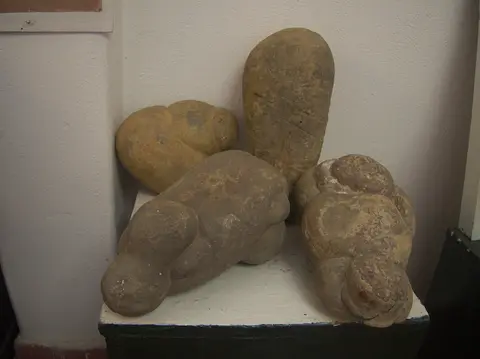
- Rounded, spherical, disc-shaped, dumbbell or knobby forms, often found weathering out of sandstone, shale or clay.
- Solid inside when broken, with the same grains as the surrounding rock, sometimes in concentric layers.
- Often harder and darker than the host rock because of extra cement.
- May have a fossil, shell or plant fragment at the center.
- Iron oxide types are brown to black on the outside and much heavier than plain sandstone.
- Fused pairs and clusters (doubles, triples) are common.
Where concretions comes from
- Navajo Sandstone, southern Utah and northern Arizona, USA
- Iron oxide 'Moqui marbles' weather out by the thousand; collecting is banned in national parks and monuments.
- Rock City, Ottawa County, Kansas, USA
- Giant calcite-cemented sandstone concretions up to several meters across.
- Moeraki, Otago, New Zealand
- Large spherical septarian boulders on the beach.
- Mazon Creek, Illinois, USA
- Ironstone concretions that split to reveal Pennsylvanian plant and animal fossils.
- Ohio and Kentucky shales, USA
- Large concretions in the Devonian Ohio Shale, some containing fish fossils.
- Morocco and Madagascar
- Commercial sources of polished concretions and septarian nodules.
Concretions lookalikes
Geodes are hollow and lined with crystals; concretions are solid.
- Geodes feel light for their size
- Geodes often have a cauliflower-textured shell
concretion vs geode
Septarians are concretions with cracks filled by yellow calcite; plain concretions lack the crack network.
- Same origin, extra mineral-filled fractures
Concretions show sand grains on a broken or ground face; meteorites show metal flecks and are attracted to a magnet.
- Iron oxide concretions are not strongly magnetic
- Meteorites have fusion crust
Thunder eggs come from volcanic rock and show an agate-filled star-shaped core when cut.
- Rhyolite shell
- Center is chalcedony or agate
Fossil eggs
Real dinosaur eggshell shows a thin shell layer with pore structure; concretions are uniform sediment throughout.
- Most 'dinosaur eggs' found by hobbyists are concretions
Also mistaken for concretions: dinosaur bone, fulgurite.
Fake, dyed and treated concretions
Concretions sold as dinosaur eggs or fossils
Common
- No eggshell layer on a cut face
- Grains of sand or mud right through the center
Concretions sold as meteorites
Common
- Sandy interior
- No metal flakes
- No magnet attraction
Moqui marbles with doubtful origin or collected from protected land
Occasional
- No collection information
- Claims of national park origin
Is my concretions real? Tests you can do at home
-
Look at a broken or ground face
Examine a broken edge or a small polished window with a 10x loupe.
- Real
- Sand or mud grains cemented together, sometimes in rings.
- Fake or lookalike
- Meteorites show metal; geodes are hollow; eggs show a shell layer.
-
Vinegar drop
Put a drop of household white vinegar on a hidden spot and watch closely with a loupe.
- Real
- Calcite-cemented concretions fizz slowly.
- Fake or lookalike
- Silica and iron oxide types and meteorites do not fizz.
Can leave a small mark.
-
Magnet test
Hang the piece on a thread and bring a strong magnet close.
- Real
- Usually no pull or a very weak one.
- Fake or lookalike
- Iron meteorites pull strongly.
A stone that passes these tests is consistent with natural concretions, not proven. For valuable pieces, a gem lab report settles treatment and origin.
Treatments
- Polishing and cutting (common)
- Cut and polished concretions show internal rings or fossils and sell above rough ones. Visible.
What moves the price of concretions
- Fossil content. A well-preserved fossil inside, such as Mazon Creek fauna, adds the most value.
- Shape and symmetry. Perfect spheres and unusual forms are preferred.
- Size. Large intact concretions are heavier to move and scarcer in good shape.
- Locality and legality. Documented, legally collected material from known sites sells best.
- Finish. Cut and polished pieces showing structure sell above rough ones.