


Thunder egg
A thunder egg is usually solid with a star shaped agate center, from rhyolite; a geode is hollow or crystal lined.
- Thunder eggs are heavy for their size
- Rough rhyolite shell
Dealers list geodes geodes at $150 to $365.
Prices checked . Page updated .
| Form and size | Typical asking price | Range chart | Median | Listings |
|---|---|---|---|---|
| Geodes and nodules (per piece) | $151 to $367 | $265 | 7 from 1 dealer |
| Listing | Size | Locality | Asking | Seen |
|---|---|---|---|---|
| 4.6" Septarian "Dragon Egg" Geode - Sparkly Black Crystals FossilEra | 11.7 cm | $47 | ||
| Whole Unopened Las Choyas Geode - 3.5 to 3.75" FossilEra | 9.5 cm | $55 | ||
| 10.8" Free-Standing Polished Septarian Geode - Black Crystals FossilEra | 27.4 cm | $247 | ||
| 8.2" Septarian "Dragon Egg" Geode - Sparkly Black Crystals FossilEra | 20.8 cm | $265 | ||
| 8.2" Septarian "Dragon Egg" Geode - Sparkly Black Crystals FossilEra | 20.8 cm | $285 | ||
| 5.35" Beautiful Septarian Geode Geode - Utah FossilEra | 13.6 cm | Utah | $449 | |
| 7.7" Golden Crystal Filled Septarian Geode "Egg" - Utah FossilEra | 19.6 cm | Utah | $995 |
These are dealer asking prices: what shops list geodes for, not what it sells for and not an appraisal. Selling to a dealer usually brings well below retail, because the dealer has to resell it at a margin.
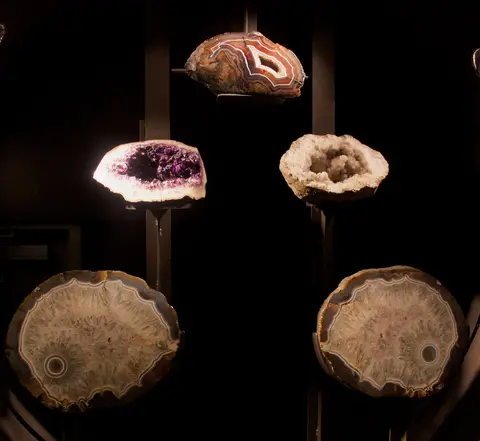
A geode is a roughly round rock with a hollow interior lined with crystals or banded chalcedony, formed when mineral-rich water deposits layers inside a cavity. Most form in gas pockets in volcanic rock or in dissolved nodules in limestone and shale; the linings are usually quartz, amethyst, calcite or chalcedony.
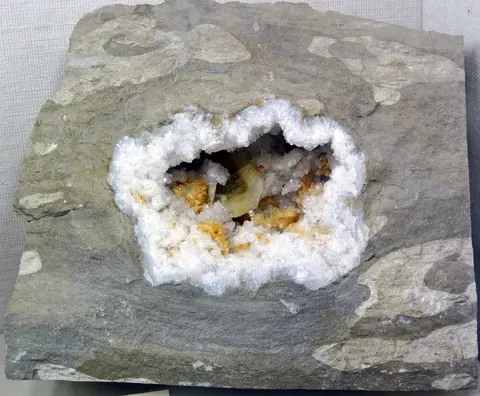
Indiana geodes are sedimentary geodes weathering out of Mississippian rocks in southern Indiana, typically with white quartz, chalcedony and calcite linings. Sedimentary, like Keokuk geodes, with a lumpy exterior and mostly quartz interiors.
Kentucky geodes are sedimentary quartz and chalcedony geodes from Mississippian rocks of central Kentucky, collected from creeks and road cuts. Same type as Indiana and Keokuk geodes, often with white quartz and banded chalcedony interiors.
Moroccan geodes are small, usually round quartz geodes sold whole for cracking or cut in halves, often with clear or white quartz linings. The main source of inexpensive 'crack your own' geodes; many Moroccan geodes on the market are dyed in bright colors.
Trancas geodes are a Mexican trade name for volcanic geodes sold as cut halves with chalcedony rims and quartz crystal interiors. Volcanic geodes like Las Choyas, typically harder and with more chalcedony than Midwest sedimentary geodes.
Las Choyas geodes, also called coconut geodes, come from volcanic tuff at Las Choyas in Chihuahua, Mexico. They are small, round and usually lined with quartz crystals and chalcedony. Volcanic and very round, sold in quantity as whole 'coconut' geodes; interiors are mostly clear to white quartz, sometimes with amethyst tints.
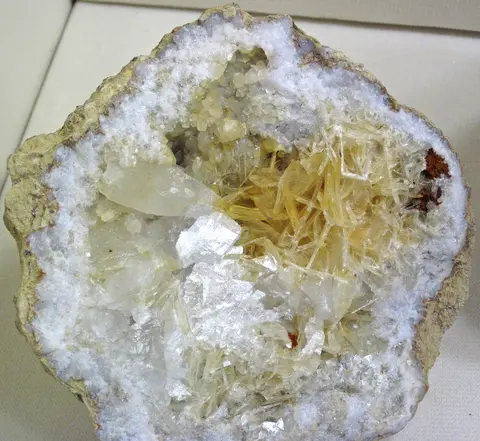
Keokuk geodes are sedimentary geodes from the Warsaw Formation around Keokuk, Iowa, and nearby Illinois and Missouri, lined with quartz, chalcedony and calcite and sometimes containing rarer minerals. The classic American geode; known for varied inclusions such as pyrite, sphalerite, kaolinite, dolomite, millerite and occasionally trapped water or oil.
Brazilian geodes are mostly amethyst and agate geodes from basalt lava flows in Rio Grande do Sul, including tall amethyst 'cathedrals'. Volcanic, often large, with deep purple amethyst; also the main source of dyed agate geodes and of heated 'citrine' geodes.
Chihuahua geodes are volcanic geodes from the state of Chihuahua, Mexico, including the Las Choyas coconut geodes. Hard, round volcanic geodes with chalcedony rims and quartz interiors, sold in large quantities.
A thunder egg is usually solid with a star shaped agate center, from rhyolite; a geode is hollow or crystal lined.
A concretion is solid all the way through, often layered or with a fossil at the center.
Septarians show a network of calcite filled cracks on the outside or when cut.
Agate nodules are filled solid with banded chalcedony; a geode has a hollow center.
Chert nodules are solid, waxy and fracture with sharp conchoidal edges.
Also mistaken for geodes: kentucky agate, brazilian agate, enhydro agate, agatized coral, moqui marbles.
Very common
Very common
Common
Common
Common
Lift the candidate next to a solid rock of the same size.
Shake near your ear, then tap lightly with another rock.
Drag the shell across a glass bottle.
Can leave a small mark.
Rub a hidden crystal area with a nail polish remover swab.
Use a soil pipe cutter or a rock saw, with eye protection. A hammer and chisel works but often shatters it.
Damages the stone: test only an inconspicuous spot or a piece you do not mind marking.
A stone that passes these tests is consistent with natural geodes, not proven. For valuable pieces, a gem lab report settles treatment and origin.
Prices: 7 current listings from FossilEra, seen 2026-11-20 to 2026-11-20. How we collect prices.