RockValues

Moqui marbles value and identification

Small, round iron oxide concretions, mostly sandstone with a hard rind of hematite and goethite, that weather out of the Jurassic Navajo Sandstone in Utah and Arizona.

A variety of concretions. Prices checked .
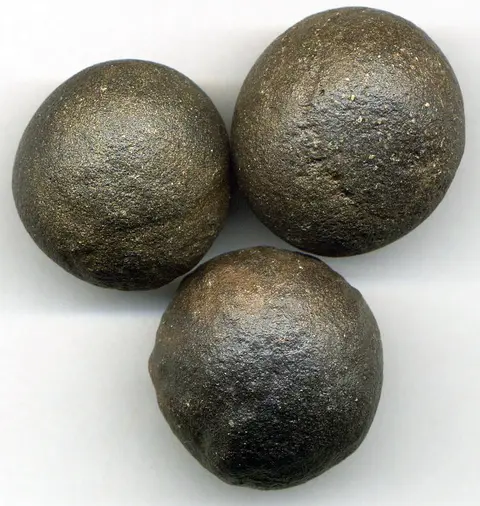
Moqui marbles: Moqui Marbles (ironstone concretions, Late Oligocene, about 25 Ma; southern Utah, USA
Moqui Marbles (ironstone concretions, Late Oligocene, about 25 Ma; southern Utah, USA. Photo: James St. John, CC BY 2.0, via Wikimedia Commons.

What moqui marbles is worth

Not enough data. We have not yet seen 5 or more current dealer listings for moqui marbles in any one form, so we show no range rather than guess.

These are dealer asking prices: what shops list moqui marbles for, not what it sells for and not an appraisal. Selling to a dealer usually brings well below retail, because the dealer has to resell it at a margin.

How to identify moqui marbles

Moqui marbles are a specific concretion type: marble to golf ball sized spheres with an iron oxide shell and sandy core, far heavier than plain sandstone. See concretions value for the species as a whole.

  • Dark brown to black spheres, usually 1 to 5 cm, often with a slightly knobby or ridged surface.
  • Some are fused doubles or have a flat 'UFO' shape.
  • Heavy for their size compared with sandstone.
  • Broken pieces show a dark iron oxide rind around a tan sandy core, or iron oxide throughout.
  • Streak from the rind is yellow-brown to red-brown.

Where moqui marbles comes from

Grand Staircase-Escalante area, Utah, USA
Classic area; collecting is prohibited in national parks and the national monument.
Northern Arizona, USA
Navajo Sandstone exposures, many on tribal land where collecting needs permission.

Moqui marbles lookalikes

Meteorite

Moqui marbles are not strongly magnetic and show sand inside; meteorites have metal and fusion crust.

  • Meteorites SG 3.5 to 8

Solid hematite nodules

Solid hematite is much heavier throughout and streaks clearly red.

  • Hematite SG about 5.3

Small geodes

Geodes are hollow with crystals; Moqui marbles are solid or sandy inside.

Fake, dyed and treated moqui marbles

  • Other iron concretions sold as Moqui marbles or 'shaman stones'

    Common

    • No Navajo Sandstone origin
    • Different internal structure
  • Moqui marbles sold as meteorites

    Common

    • Sandy core
    • No metal
    • No strong magnet pull

Is my moqui marbles real? Tests you can do at home

  1. Streak plate

    Rub the rind on unglazed porcelain.

    Real
    Yellow-brown to reddish brown streak.
    Fake or lookalike
    Meteorites often leave a gray metallic smear; magnetite gives black.

    Can leave a small mark.

  2. Magnet test

    Hang on a thread near a strong magnet.

    Real
    Little or no pull.
    Fake or lookalike
    Meteorites pull strongly.
  3. Weight comparison

    Compare with a sandstone pebble of the same size.

    Real
    Noticeably heavier.
    Fake or lookalike
    Plain sandstone pebbles are lighter.

A stone that passes these tests is consistent with natural moqui marbles, not proven. For valuable pieces, a gem lab report settles treatment and origin.

What moves the price of moqui marbles

  1. Shape. Perfect spheres and unusual fused forms are preferred.
  2. Size. Larger, intact spheres are scarcer.
  3. Legal origin. Documented collection from private or permitted land matters to serious buyers.
  4. Surface. Intact, unchipped rinds sell above broken ones.

Care and safety

Collecting Moqui marbles is illegal in national parks and national monuments, and needs permission on tribal and private land.

Store dry; the iron oxide rind can flake if kept damp for long periods.

Sources

Prices: no current dealer listings yet. How we collect prices.